Pound Sterling gains after BoE cuts interest rates to 4.25%, guides gradual easing
- The Pound Sterling rebounds strongly against its peers as two BoE officials voted for leaving interest rates steady.
- The BoE lowered interest rates by 25 bps to 4.25%, as expected, and reiterated its gradual policy-easing approach.
- US President Trump is set to announce his first bilateral trade deal, reportedly with the UK, since returning to the White House.

The Pound Sterling (GBP) attracts bids against its peers in Thursday’s European session after the Bank of England’s (BoE) hawkish interest rate cut decision. The BoE has cut borrowing rates by 25 basis points (bps) to 4.25%, as expected, making it the fourth interest rate trim in the current monetary expansion cycle, which it started in August last year.
Seven out of nine Monetary Policy Committee (MPC) members voted for an interest rate reduction, out of which two policymakers, Swati Dhingra and Alan Taylor, endorsed a larger-than-usual rate cut of 50 bps. Meanwhile, MPC member Catherine Mann and Chief Economist Huw Pill voted for leaving interest rates at 4.5%. Economists expected that only Swati Dhingra would support a bigger rate cut, and the rest would vote for a 25-bps interest rate reduction.
The BoE has retained its "gradual and careful" stance to the monetary expansion path and raised its Gross Domestic Product (GDP) forecast for the current year. The BoE has revised its GDP growth rate for the year to 1%, up from 0.75% projected in February. However, market experts anticipated that the BoE could roll back its gradual policy easing reference due to potential economic risks in the face of tariffs announced by United States (US) President Donald Trump.
"We anticipate the BoE will downgrade its Gross Domestic Product (GDP) forecasts due to the trade war, and there is a risk the BoE may remove the reference to a ’gradual’ cutting cycle," analysts at Commonwealth Bank of Australia said earlier this week.
Meanwhile, BoE Governor Andrew Bailey has expressed confidence that the disinflation trend is intact and the central bank has forecasted the headline Consumer Price Index (CPI) in the one-year timeframe at 2.4%, down from the forecast of 3% made in February.
Daily digest market movers: Pound Sterling outperforms US Dollar
- The Pound Sterling rebounds strongly to near 1.3350 against the US Dollar (USD) during North American trading hours after recovering initial losses. The GBP/USD pair bounces back as the US Dollar gives back a majority of its initial gains. The US Dollar Index (DXY), which tracks the Greenback’s value against six major currencies, wobbles around 100. The USD Index showed strength earlier in the day as the Federal Reserve (Fed) signaled that there is “no rush for interest rate cuts” amid a “great deal of uncertainty about tariffs” after leaving interest rates steady in the current range of 4.25%-4.50 on Wednesday.
- The Fed kept borrowing rates steady for the third meeting in a row as risks to inflation have skewed to the upside. “Risks of higher unemployment and higher inflation have risen,” Fed Chair Jerome Powell said in the press conference. “We aim to anchor inflation expectations,” he added.
- Comments from Powell also signaled stagflation risks. Powell said that tariffs so far are “significantly bigger than expected” and that “higher inflation, and lower employment” is possible if large increases in tariffs as announced are “sustained”.
- Meanwhile, US President Trump has criticized Powell again for not reducing interest rates. "Too late" Jerome Powell is a fool, who doesn’t have clue, Trump said in a post on Truth.Social during European trading hours.
- Going forward, the major trigger for the Greenback will be progress in bilateral trade deals between the US and its trading partners. On Wednesday, US President Trump said that he will unveil a bilateral deal closed with a trading ally on Thursday.
- A report from The New York Times (NYT) has shown that the nation with which the White House will announce its first trade deal will be the United Kingdom (UK). The impact of the US-UK trade deal is expected to be positive for the US Dollar, whose safe-haven status has been somewhat dented amid uncertainty over the global economic outlook in the face of Trump’s new economic policies. However, the impact of any deal is expected to be limited as Britain already holds a trade deficit with the US.
- During European trading hours, the Sky News reported that the UK and the US have reached a "heads of terms" agreement and a "substantive" step towards a full trade deal.
- Another major trigger for Forex markets will be trade discussions between the US and China, which have been confirmed for Saturday in Switzerland. Financial market participants expect the meeting to be more about de-escalating the trade war than negotiating deals. “My sense is that this will be about de-escalation, not about the big trade deal,” US Treasury Secretary Scott Bessent said on Tuesday.
Technical Analysis: Pound Sterling returns above 1.3300
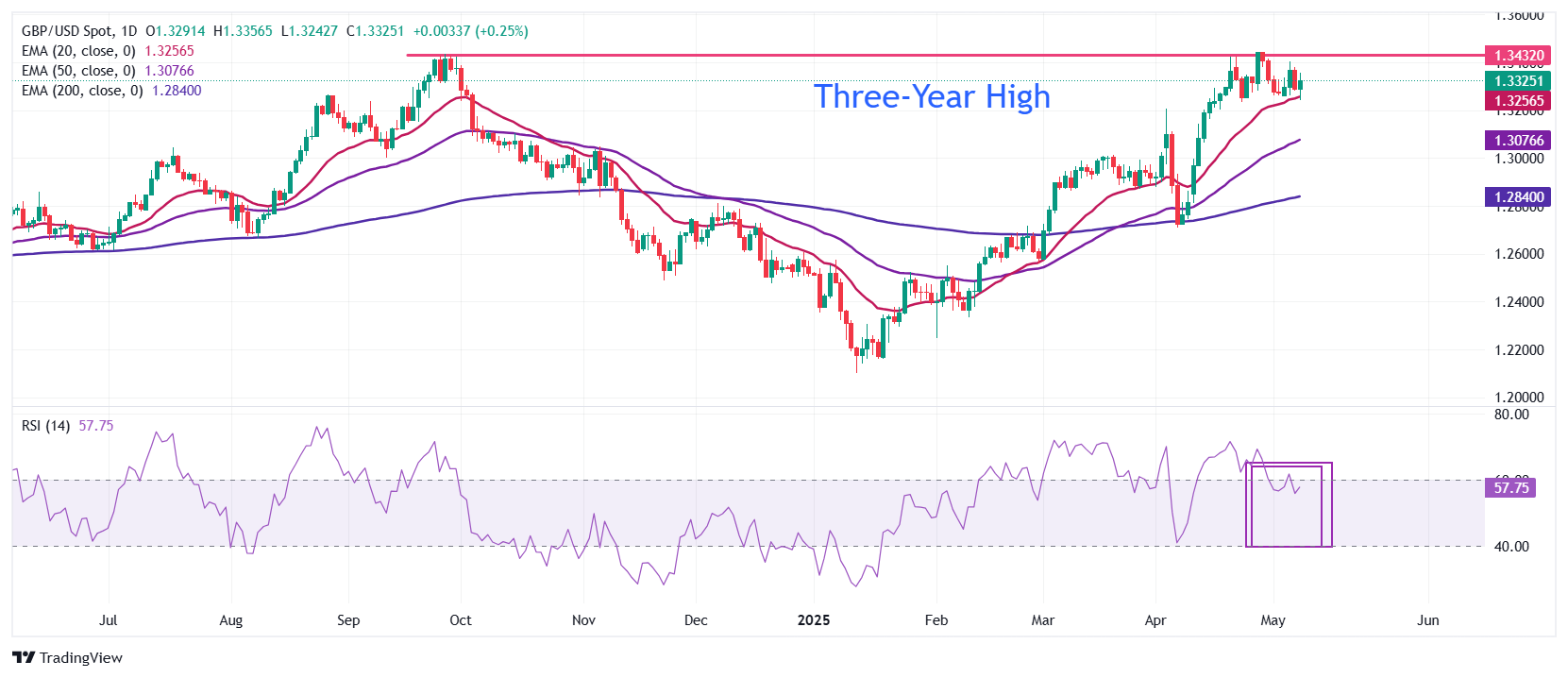
The Pound Sterling snaps its initial sell-off and rebounds above 1.3300 against the US Dollar on Thursday. The overall outlook of the pair remains bullish as all short-to-long Exponential Moving Averages (EMAs) are sloping higher.
The 14-day Relative Strength Index (RSI) slides into the 40.00-60.00 range, indicating that bullish momentum has concluded. However, the bullish bias remains intact.
On the upside, the three-year high of 1.3445 will be a key hurdle for the pair. Looking down, the April 3 high around 1.3200 will act as a major support area.
BoE FAQs
The Bank of England (BoE) decides monetary policy for the United Kingdom. Its primary goal is to achieve ‘price stability’, or a steady inflation rate of 2%. Its tool for achieving this is via the adjustment of base lending rates. The BoE sets the rate at which it lends to commercial banks and banks lend to each other, determining the level of interest rates in the economy overall. This also impacts the value of the Pound Sterling (GBP).
When inflation is above the Bank of England’s target it responds by raising interest rates, making it more expensive for people and businesses to access credit. This is positive for the Pound Sterling because higher interest rates make the UK a more attractive place for global investors to park their money. When inflation falls below target, it is a sign economic growth is slowing, and the BoE will consider lowering interest rates to cheapen credit in the hope businesses will borrow to invest in growth-generating projects – a negative for the Pound Sterling.
In extreme situations, the Bank of England can enact a policy called Quantitative Easing (QE). QE is the process by which the BoE substantially increases the flow of credit in a stuck financial system. QE is a last resort policy when lowering interest rates will not achieve the necessary result. The process of QE involves the BoE printing money to buy assets – usually government or AAA-rated corporate bonds – from banks and other financial institutions. QE usually results in a weaker Pound Sterling.
Quantitative tightening (QT) is the reverse of QE, enacted when the economy is strengthening and inflation starts rising. Whilst in QE the Bank of England (BoE) purchases government and corporate bonds from financial institutions to encourage them to lend; in QT, the BoE stops buying more bonds, and stops reinvesting the principal maturing on the bonds it already holds. It is usually positive for the Pound Sterling.
Author

Sagar Dua
FXStreet
Sagar Dua is associated with the financial markets from his college days. Along with pursuing post-graduation in Commerce in 2014, he started his markets training with chart analysis.