Pound Sterling trades firmly ahead of US PCE Inflation data
- The Pound Sterling clings to gains near 1.3750 against a weakened US Dollar amid Trump-Powell policy tensions.
- Investors fear that Fed Powell’s replacement for not supporting interest rate cuts will dampen the central bank’s credibility.
- BoE’s Bailey warns of labor market risks due to an increase in employers’ contributions to National Insurance.

The Pound Sterling (GBP) holds onto gains near a fresh three-year high around 1.3770 against the US Dollar (USD) during European trading hours on Friday. The GBP/USD pair clings to gains as the US Dollar struggles to gain ground due to a sharp deterioration in its safe-haven demand, following tensions between United States (US) President Donald Trump and Federal Reserve (Fed) Chair Jerome Powell over the monetary policy status.
At the time of writing, the US Dollar Index (DXY), which tracks the Greenback’s value against six major currencies, struggles to hold the fresh three-and-a-half-year low around 97.00 posted on Thursday.
US President Trump has called Fed’s Chair Powell “terrible” for not lowering interest rates, and senior officials have confirmed that the President will find his successor as early as this summer, Wall Street Journal (WSJ) reported on early Thursday. The replacement of Fed’s Powell, who prioritized fundamental risks over Trump’s economic agenda, has forced traders to reassess the US Dollar’s exceptionalism.
Analysts at Principal Asset Management said, "Trump-Powell conflict brings up the whole concern about the credibility and reliability of US institutions again, which is typically something that people don’t like."
Meanwhile, traders have also raised Fed dovish bets, assuming that decisions made by Trump’s contender will be biased towards the President economic policies.
According to the CME FedWatch tool, the probability of the Fed cutting interest rates in July has increased to 20.7% from 12.5% a week ago.
Daily digest market movers: Pound Sterling trades broadly stable despite UK labor market risks
- The Pound Sterling trades calmly against its major peers on Friday. The British currency has remained firm this week despite growing concerns over the labor market strength and increasing upside inflation risks.
- On Thursday, Bank of England (BoE) Governor Andrew Bailey , in a keynote speech at the British Chambers of Commerce’s (BCC) Global Annual Conference, cited concerns over uncertainty surrounding the inflation outlook and the labor market, Reuters reported. “In recent months, the evidence that slack is opening up has strengthened, especially in the labour market,” Bailey said.
- Earlier this week, Andrew Bailey also warned of increasing employment risks in his testimony before the Lords Economic Affairs Committee. Bailey stated that the increase in employers’ contribution to social security schemes seems to be “affecting labour market”.
- Meanwhile, a recent survey from the BCC also showed that almost one-third of small and medium-sized enterprises have or are planning to reduce their labor force as they struggle to bear the burden of an increase in employers’ contributions to National Insurance (NI).
- On the monetary policy outlook, Governor Bailey reiterated a gradual downward interest rate path. Meanwhile, traders have priced in two interest rate cuts of 25 basis points (bps) in the remainder of the year that will push borrowing rates lower to 3.75%.
- Going forward, investors will focus on revised estimates for the United Kingdom (UK) Q1 Gross Domestic Product (GDP) data, which will be released on Monday. According to the preliminary estimate, the UK economy expanded by 0.7% in the first quarter.
- On the global front, China also also agreed to expedite supply of rare earths to Washington, following the confirmation from US Commerce Secretary Howard Lutnick on Thursday that the deal with Beijing was "signed and sealed two days ago". This scenario indicates further improvement in trade relations between the US and China.
- In the US, investors await the US Personal Consumption Expenditures (PCE) Price Index data for May, which will be published at 12:30 GMT. Investors should brace for more criticism from Donald Trump towards Jerome Powell for supporting a “wait and see” approach on interest rates if the data shows signs of price pressures cooling down further. On the contrary, signs of price pressures accelerating would encourage market experts to argue against Donald Trump’s support for interest rate cuts.
British Pound PRICE This week
The table below shows the percentage change of British Pound (GBP) against listed major currencies this week. British Pound was the strongest against the US Dollar.
| USD | EUR | GBP | JPY | CAD | AUD | NZD | CHF | |
|---|---|---|---|---|---|---|---|---|
| USD | -2.17% | -2.42% | -1.60% | -0.82% | -1.87% | -2.04% | -2.29% | |
| EUR | 2.17% | -0.28% | 0.59% | 1.38% | 0.27% | 0.13% | -0.16% | |
| GBP | 2.42% | 0.28% | 0.95% | 1.66% | 0.55% | 0.42% | 0.13% | |
| JPY | 1.60% | -0.59% | -0.95% | 0.77% | -0.30% | -0.39% | -0.78% | |
| CAD | 0.82% | -1.38% | -1.66% | -0.77% | -1.01% | -1.23% | -1.51% | |
| AUD | 1.87% | -0.27% | -0.55% | 0.30% | 1.01% | -0.16% | -0.41% | |
| NZD | 2.04% | -0.13% | -0.42% | 0.39% | 1.23% | 0.16% | -0.29% | |
| CHF | 2.29% | 0.16% | -0.13% | 0.78% | 1.51% | 0.41% | 0.29% |
The heat map shows percentage changes of major currencies against each other. The base currency is picked from the left column, while the quote currency is picked from the top row. For example, if you pick the British Pound from the left column and move along the horizontal line to the US Dollar, the percentage change displayed in the box will represent GBP (base)/USD (quote).
Technical Analysis: Pound sterling clings to gains around 1.3770
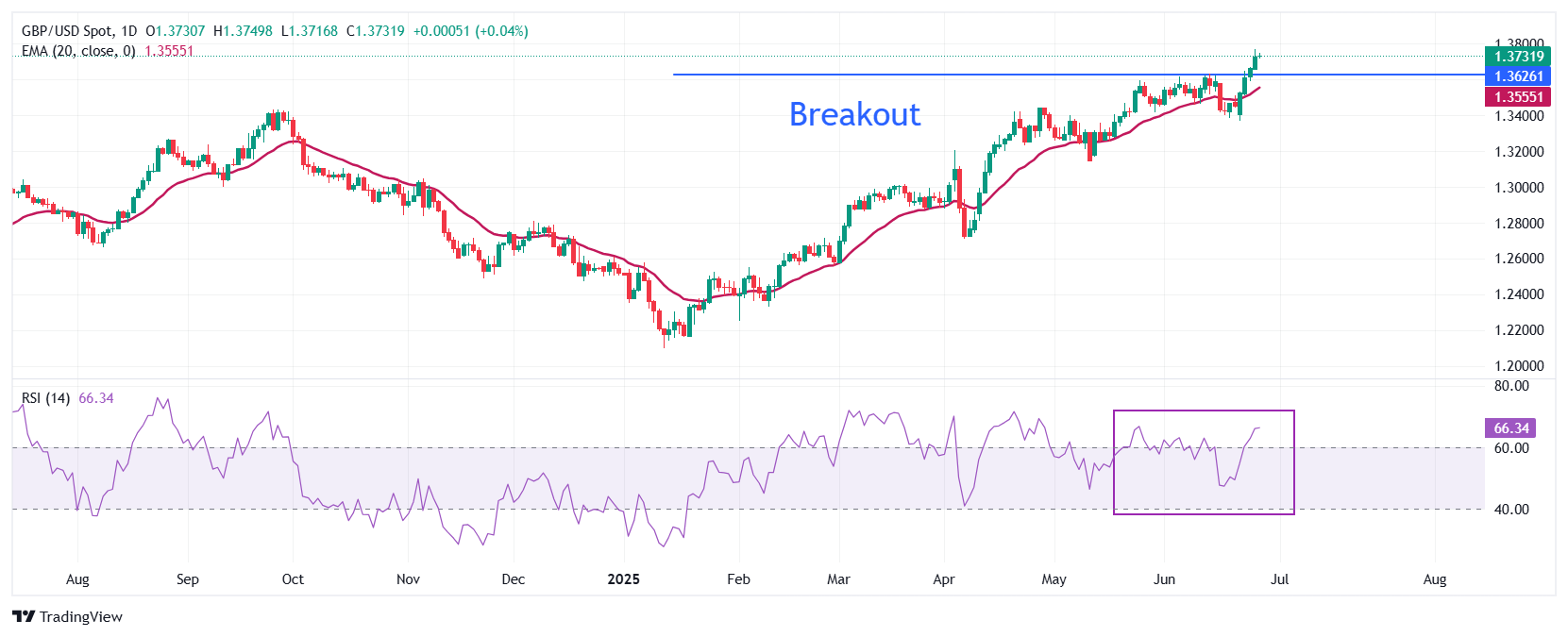
The Pound Sterling clings to gains near a fresh three-year high around 1.3770 against the US Dollar during the European trading session on Friday. The GBP/USD pair strengthened after breaking above the horizontal resistance near the June 13 high around 1.3630 on Wednesday. The upward-sloping 20-day Exponential Moving Average (EMA) around 1.3555 suggests that the near-term trend is bullish.
The 14-day Relative Strength Index (RSI) jumps to near 65.00, suggesting that the momentum is on the upside.
Looking down, Monday’s low around 1.3370 will act as a key support zone. On the upside, the psychological level of 1.4000 will act as the key barrier.
Economic Indicator
Core Personal Consumption Expenditures - Price Index (YoY)
The Core Personal Consumption Expenditures (PCE), released by the US Bureau of Economic Analysis on a monthly basis, measures the changes in the prices of goods and services purchased by consumers in the United States (US). The PCE Price Index is also the Federal Reserve’s (Fed) preferred gauge of inflation. The YoY reading compares the prices of goods in the reference month to the same month a year earlier. The core reading excludes the so-called more volatile food and energy components to give a more accurate measurement of price pressures." Generally, a high reading is bullish for the US Dollar (USD), while a low reading is bearish.
Read more.Next release: Fri Jun 27, 2025 12:30
Frequency: Monthly
Consensus: 2.6%
Previous: 2.5%
Source: US Bureau of Economic Analysis
After publishing the GDP report, the US Bureau of Economic Analysis releases the Personal Consumption Expenditures (PCE) Price Index data alongside the monthly changes in Personal Spending and Personal Income. FOMC policymakers use the annual Core PCE Price Index, which excludes volatile food and energy prices, as their primary gauge of inflation. A stronger-than-expected reading could help the USD outperform its rivals as it would hint at a possible hawkish shift in the Fed’s forward guidance and vice versa.
Author

Sagar Dua
FXStreet
Sagar Dua is associated with the financial markets from his college days. Along with pursuing post-graduation in Commerce in 2014, he started his markets training with chart analysis.

















