Pound Sterling rises against US Dollar ahead of Trump-Harris battle, BoE-Fed policy
- The Pound Sterling jumps against the US Dollar as the latter declines ahead of the US presidential election.
- Kamala Harris appears to be giving a tough competition to Donald Trump, according to the latest polls.
- Investors expect the Fed and the BoE to cut interest rates by 25 bps on Thursday.

The Pound Sterling (GBP) gains sharply against the US Dollar (USD) in North American trading hours on Monday but continues to struggle near the psychological resistance of 1.3000. The GBP/USD pair aims for a firm footing above the key support of 1.2900 as the US Dollar plunges ahead of the United States (US) presidential election on Tuesday.
The US Dollar Index (DXY), which tracks the Greenback’s value against six major currencies, tumbles to near 103.60, the lowest level in almost two weeks. The Greenback was knocked out after the Des Moines Register/Mediacom Iowa Poll showed that Democratic candidate Kamala Harris is up three points over former US President Donal Trump in a state where Trump won clearly in 2016 and 2020. Meanwhile, the majority of national polls show a knife-edge race between both candidates.
Trump’s victory is expected to weigh on risk-perceived currencies as he will likely favor protectionist policies to boost domestic business activity. Trump vowed to levy a 10% universal tariff on all economies, except for China, which is expected to face even higher duties.
Apart from the US election, investors will also focus on the Federal Reserve’s (Fed) policy decision, which will be announced on Thursday. The Fed is expected to cut interest rates again, but at a slower pace of 25 basis points (bps). In September, the Fed started the policy-easing cycle with a larger-than-usual 50 bps cut. Investors will pay close attention to the Fed’s guidance for the December policy meeting.
Daily digest market movers: Pound Sterling underperforms its major peers
- The Pound Sterling weakens against its major peers, except the US Dollar, at the start of the week, with investors also focusing on the Bank of England’s (BoE) monetary policy decision, which will be announced on Thursday.
- The BoE is expected to cut interest rates by 25 basis points (bps) to 4.75%. Out of the nine-member led Monetary Policy Committee (MPC), seven members are expected to vote in favor of a rate reduction, while two are expected to support leaving interest rates unchanged at 5%. BoE external MPC member Catherine Mann is likely to be one of those who would support keeping rates stable.
- Investors will pay close attention to BoE Governor Andrew Bailey’s press conference after the policy decision to get fresh guidance for the policy action in December. Market participants will also seek clues about how the BoE assessesAnnual Forecast Statement presented by the Labour government, particularly of how it could influence the interest rate path for the next year and the inflation outlook.
- UK Chancellor of the Exchequer announced 40 billion pounds worth of taxes, the highest since 1993, and a slew of investment projects to revive public spending. Reeves also announced that the Office for Business Responsibility (OBR) raised current-year inflation targets to 2.5% from the 2.2% projected in March.
Technical Analysis: Pound Sterling stays above 200-day EMA
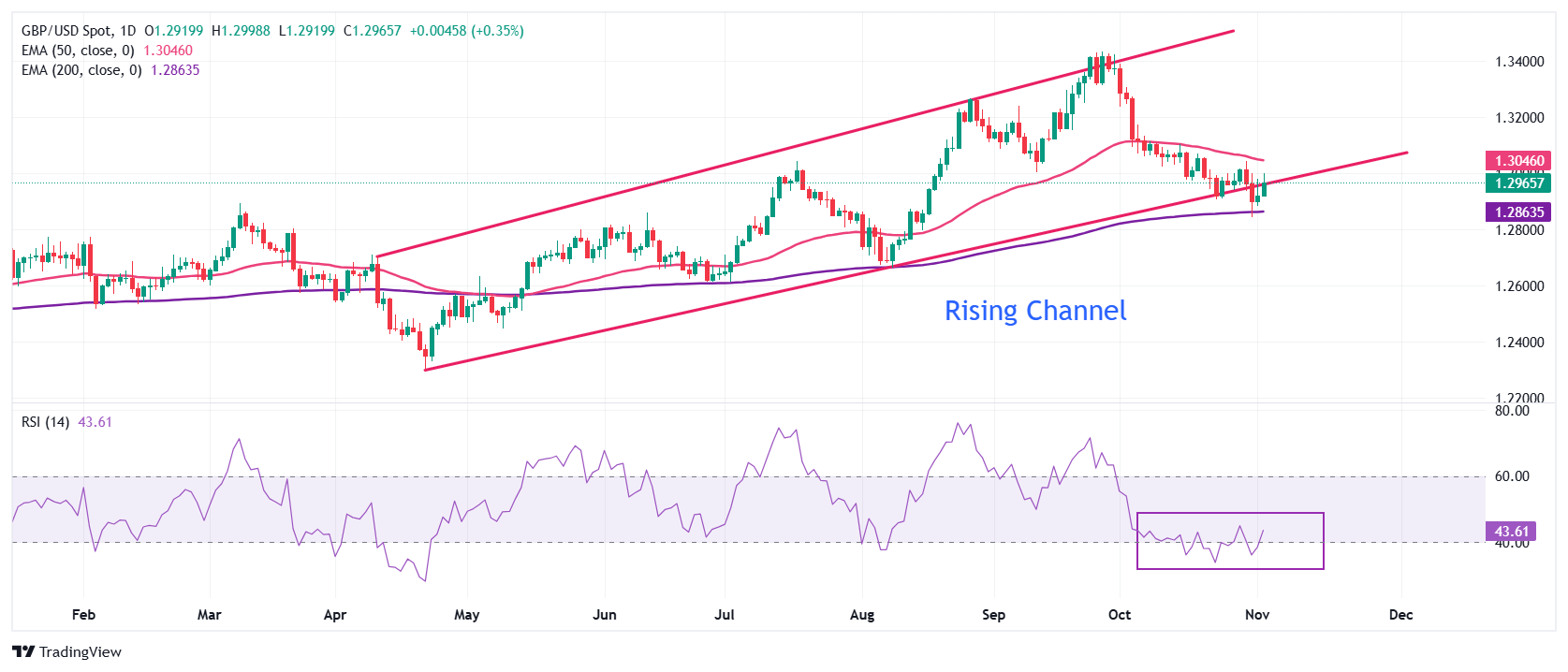
The Pound Sterling holds right above a fresh 11-week low of 1.2850 against the US Dollar, which also aligns with the 200-day Exponential Moving Average (EMA). While the pair seems to have found a cushion near the 200-day EMA around 1.2850, the near-term trend remains uncertain as it stays below the 50-day EMA around 1.3060.
The pair remains at make or a break near the lower boundary of the Rising Channel chart formation on the daily time frame.
The 14-day Relative Strength Index (RSI) rebounds above 40.00, signaling a buying interest at lower levels.
Looking down, the round-level support of 1.2800 will be a major cushion for Pound Sterling bulls. On the upside, the Cable will face resistance near the 50-day EMA around 1.3060.
BoE FAQs
The Bank of England (BoE) decides monetary policy for the United Kingdom. Its primary goal is to achieve ‘price stability’, or a steady inflation rate of 2%. Its tool for achieving this is via the adjustment of base lending rates. The BoE sets the rate at which it lends to commercial banks and banks lend to each other, determining the level of interest rates in the economy overall. This also impacts the value of the Pound Sterling (GBP).
When inflation is above the Bank of England’s target it responds by raising interest rates, making it more expensive for people and businesses to access credit. This is positive for the Pound Sterling because higher interest rates make the UK a more attractive place for global investors to park their money. When inflation falls below target, it is a sign economic growth is slowing, and the BoE will consider lowering interest rates to cheapen credit in the hope businesses will borrow to invest in growth-generating projects – a negative for the Pound Sterling.
In extreme situations, the Bank of England can enact a policy called Quantitative Easing (QE). QE is the process by which the BoE substantially increases the flow of credit in a stuck financial system. QE is a last resort policy when lowering interest rates will not achieve the necessary result. The process of QE involves the BoE printing money to buy assets – usually government or AAA-rated corporate bonds – from banks and other financial institutions. QE usually results in a weaker Pound Sterling.
Quantitative tightening (QT) is the reverse of QE, enacted when the economy is strengthening and inflation starts rising. Whilst in QE the Bank of England (BoE) purchases government and corporate bonds from financial institutions to encourage them to lend; in QT, the BoE stops buying more bonds, and stops reinvesting the principal maturing on the bonds it already holds. It is usually positive for the Pound Sterling.
Author

Sagar Dua
FXStreet
Sagar Dua is associated with the financial markets from his college days. Along with pursuing post-graduation in Commerce in 2014, he started his markets training with chart analysis.















