Pound Sterling struggles against USD as traders pare back Fed dovish bets
- The Pound Sterling rebounds slightly after weak UK GDP-driven-selling on Friday.
- The next big move for the British currency will likely occur on Wednesday when UK inflation data for October will be released.
- Fed officials refrain from projecting the consequences of Trump’s policies on interest rates.

The Pound Sterling (GBP) remains under pressure near 1.2600 against the US Dollar (USD) in Monday’s North American session. The GBP/USD pair struggles to gain ground as the US Dollar clings to gains near a more-than-a-year high, with the US Dollar Index (DXY) wobbling around 107.00.
The Greenback trades firmly as investors expect the Federal Reserve (Fed) to follow a more gradual rate-cut approach given the recent slight rebound in inflation and the growth outlook on strong expectations that President-elected Donald Trump will be able to implement his economic agenda smoothly.
In the December meeting, there is a 62% chance that the Fed will cut interest rates by 25 basis points (bps) to 4.25%-4.50%, according to the CME FedWatch tool. This is significantly down from the almost 77% seen a month ago.
Trump’s victory is also making analysts reassess the Fed’s interest-rate outlook for next year. “The Fed’s Monetary Policy Committee (MPC) will be acutely aware that Donald Trump’s policies could be significantly inflationary, primarily due to the impact of tariffs being passed on to consumers while lower taxes heat up the economy,” analysts at Quilter Investors said. “Investors will no doubt be combing through their comments carefully for any perceived guidance on how that might impact the path of interest rates going forward,” they added.
Meanwhile, Fed officials have refused to comment on the likely impact of Trump’s policies on the monetary policy action and the economic outlook. On Thursday, Fed Chair Jerome Powell said that “it is too early to reach judgments on the effect of Trump policies.”
On the economic data front, investors await the preliminary S&P Global Purchasing Managers’ Index (PMI) data for November, which will be published on Friday.
Daily digest market movers: Pound Sterling remains on backfoot against US Dollar
- The Pound Sterling edges higher against its major peers on Monday, striving to gain ground after Friday’s sell-off. The British currency fell sharply after the United Kingdom (UK) Office for National Statistics (ONS) showed that the economy surprisingly contracted by 0.1% in September. The data also showed that the economy barely grew in the third quarter.
- The unexpected fall in UK GDP could prompt expectations for more interest rate cuts by the Bank of England (BoE). "We believe that if UK economic data continues to disappoint, the BoE may become more focused on reviving growth," according to analysts at BBVA.
- The uncertainty over the UK economic outlook is expected to deepen further as the government is caught between choosing the European Union (EU) and the US for strengthening its trade relations. The comments from Stephen Moore, a senior economist advisor to Donald Trump, in an interview with BBC indicated that the US will be less interested in working with the UK if it puts the EU ahead of it.
- “The UK is kind of caught in the middle of these two forms of economic model and I believe that Britain would be better off moving towards more of the American model of economic freedom. And if that were the case, I think it would spur the Trump administration’s willingness to do the free trade agreement with the UK," Moore said. His comments came after BoE Governor Andrew Bailey urged the administration to rebuild ties with the European Union.
- This week, investors will pay close attention to the UK Consumer Price Index (CPI) data for October, which will be published on Wednesday. The inflation data is likely to influence BoE rate cut expectations for the December meeting.
Technical Analysis: Pound Sterling wobbles near 1.2600
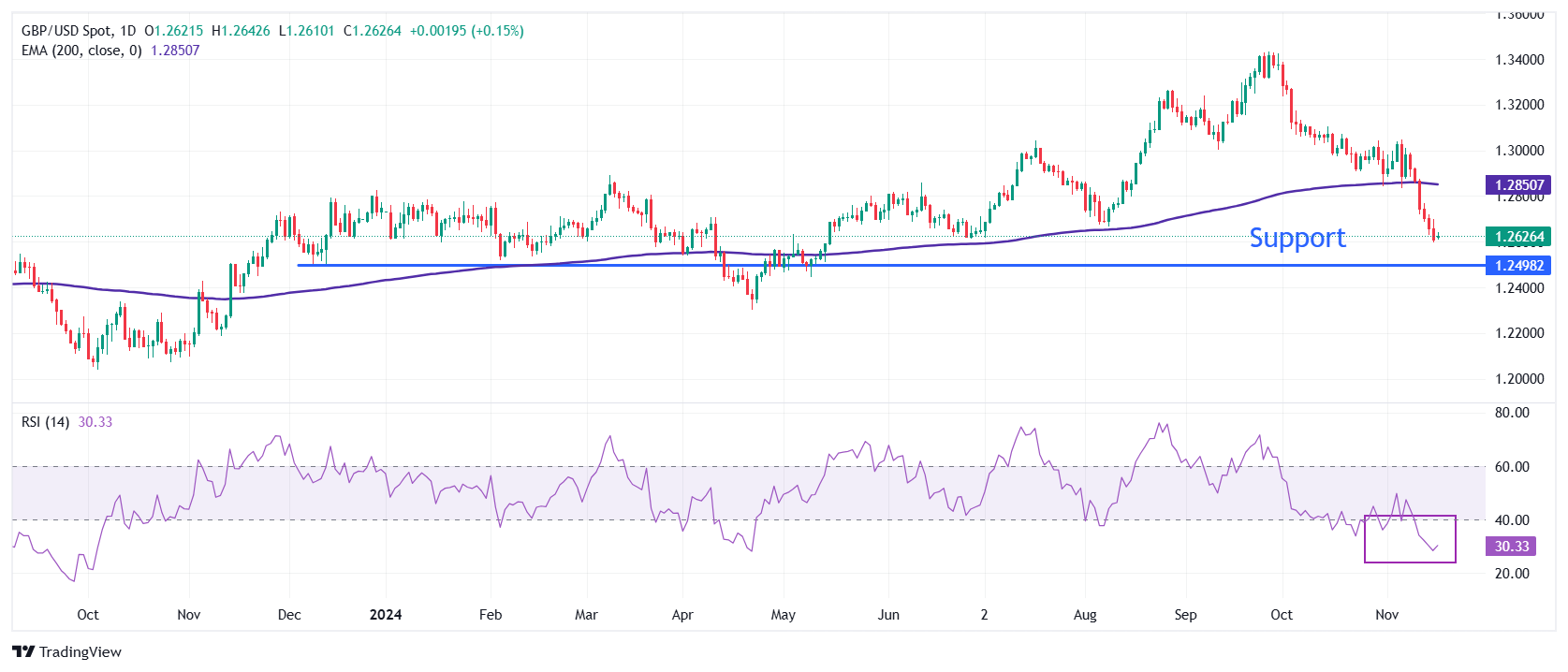
The Pound Sterling aims for a firm footing near 1.2600 against the US Dollar in European trading hours on Monday. The GBP/USD pair remains broadly under pressure as it remains well below the 200-day Exponential Moving Average (EMA) at 1.2850.
The 14-day Relative Strength Index (RSI) slides sharply to 30.00, suggesting a strong bearish momentum.
Looking down, the psychological support of 1.2500 will be a major cushion for Pound Sterling bulls. On the upside, the Cable will face resistance near the 200-day EMA.
BoE FAQs
The Bank of England (BoE) decides monetary policy for the United Kingdom. Its primary goal is to achieve ‘price stability’, or a steady inflation rate of 2%. Its tool for achieving this is via the adjustment of base lending rates. The BoE sets the rate at which it lends to commercial banks and banks lend to each other, determining the level of interest rates in the economy overall. This also impacts the value of the Pound Sterling (GBP).
When inflation is above the Bank of England’s target it responds by raising interest rates, making it more expensive for people and businesses to access credit. This is positive for the Pound Sterling because higher interest rates make the UK a more attractive place for global investors to park their money. When inflation falls below target, it is a sign economic growth is slowing, and the BoE will consider lowering interest rates to cheapen credit in the hope businesses will borrow to invest in growth-generating projects – a negative for the Pound Sterling.
In extreme situations, the Bank of England can enact a policy called Quantitative Easing (QE). QE is the process by which the BoE substantially increases the flow of credit in a stuck financial system. QE is a last resort policy when lowering interest rates will not achieve the necessary result. The process of QE involves the BoE printing money to buy assets – usually government or AAA-rated corporate bonds – from banks and other financial institutions. QE usually results in a weaker Pound Sterling.
Quantitative tightening (QT) is the reverse of QE, enacted when the economy is strengthening and inflation starts rising. Whilst in QE the Bank of England (BoE) purchases government and corporate bonds from financial institutions to encourage them to lend; in QT, the BoE stops buying more bonds, and stops reinvesting the principal maturing on the bonds it already holds. It is usually positive for the Pound Sterling.
Author

Sagar Dua
FXStreet
Sagar Dua is associated with the financial markets from his college days. Along with pursuing post-graduation in Commerce in 2014, he started his markets training with chart analysis.