GBP/USD slips as firm US jobless claims offset BoE cut bets
- GBP/USD edges lower after jobless claims beat forecasts, signaling US labor resilience.
- Dovish remarks from Stephen Miran contrast with Federal Reserve's steady-rate expectations.
- Political pressure on Keir Starmer and rising Bank of England easing bets cap Sterling upside.

The Pound Sterling (GBP) retreats over 0.11% on Thursday as the Greenback remains steady following a report that the number of Americans applying for unemployment benefits was below estimates last week, an indication of the resilience of the labor market. At the time of writing, GBP/USD trades at 1.3544 after reaching a daily high of 1.3575.
Sterling eases as resilient US labor data steadies the Dollar while UK political risks linger
Financial market sentiment worsened after Nvidia Corp reported earnings and a solid outlook. Nevertheless, the AI rally seems overextended, and market participants are seeking reassurance about the AI outlook. So far, Wall Street has registered losses between 0.28% and 2%.
Initial Jobless Claims in the US for the week ending February 21 rose from 208K to 212K, beneath forecasts of 215K. This and previously released jobs market data during the month revealed some stabilization in the labor market, highlighted by some Federal Reserve (Fed) officials.
Fed Governor Stephen Miran reaffirmed his dovish stance as he is looking for 1% rate cuts this year. He added that “prices right now seem stable,” and he does not think the US has an inflation problem.
Across the pond, in the UK, Prime Minister Keir Starmer is under pressure due to the nomination of Peter Mandelson as ambassador to the US, who has ties to Jeffrey Epstein.
Local elections in Gorton and Danton, located in Greater Manchester, are set to take place. Should Starmer's Labour Party fail to secure victory, there may be mounting calls for his removal as leader, a headwind for the British Pound.
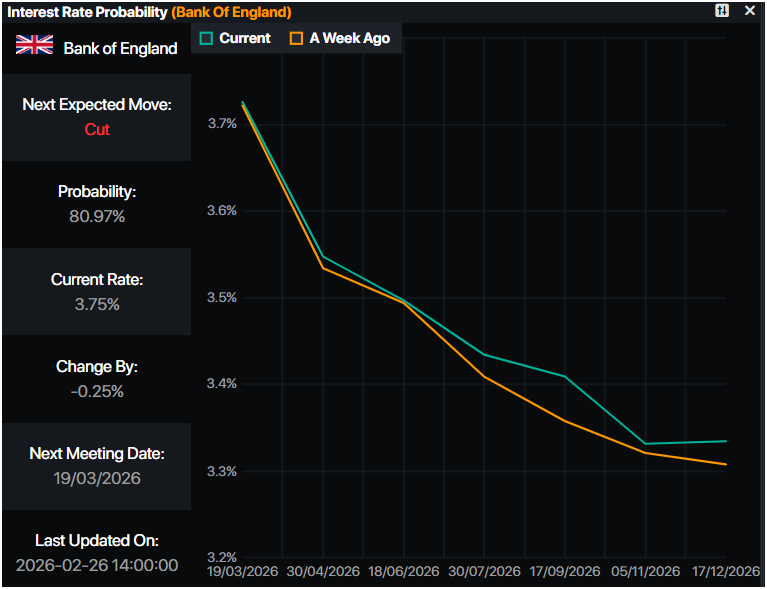
Aside from this, there is growing speculation that the Bank of England (BoE) will reduce rates in the March meeting, after Governor Andrew Bailey commented that a cut in that date is a “genuinely open question.”
Despite this, Bailey added that services inflation remains high, but on the other hand, the GDP growth was mediocre, and a jump in unemployment in Q4 2025 prompted investors to price in further easing by the UK central bank.
Money markets had priced in a 81% chance for a BoE rate cut in the March 19 meeting, according to Prime Market Terminal.
GBP/USD traders' focus shifts to Friday’s US Producer Price Index (PPI) data, along with speeches by Federal Reserve officials. In the UK, the calendar is absent except for a speech by BoE Chief Economist Huw Pill.
GBP/USD Price Forecast: Technical outlook
In the daily chart, GBP/USD trades at 1.3517. The pair sits just below the clustered simple moving averages around 1.3540–1.3535, but price is also capped by a descending resistance trend line from 1.3869, leaving the near-term bias neutral with a slight downside tilt. The long-running ascending support line from 1.3035 still underpins the broader uptrend, yet repeated failures along the falling resistance line and the softening Fed Sentiment Index highlight waning bullish momentum and the risk of a deeper pullback if spot slips decisively below the nearby averages.
Initial support emerges around 1.3500, in line with recent lows and just beneath the ascending trend-line zone, with a break exposing the next downside area near 1.3460 and then 1.3400. On the topside, the descending trend line now acts as immediate resistance around 1.3550, followed by last week’s highs near 1.3635 and the 1.3800 region, where prior peaks converge and a sustained break would be needed to revive a clear bullish continuation.
(The technical analysis of this story was written with the help of an AI tool.)
(This story was corrected on February 26 at 16:14 to say in the technical analysis section that the pair sits below the clustered simple moving averages around 1.3540–1.3535, not above.)
Author

Christian Borjon Valencia
FXStreet
Markets analyst, news editor, and trading instructor with over 14 years of experience across FX, commodities, US equity indices, and global macro markets.