Pound Sterling exhibits strength against US Dollar ahead of Fed Powell’s testimony
- Pound Sterling stretches its upside as markets expect the BoE to hold interest rates higher for longer than the Fed.
- UK inflation remains sticky, particularly in the services sector, due to solid wage growth.
- Investors await Fed Powell’s testimony for fresh cues on interest rate outlook.


The Pound Sterling (GBP) clings to gains, trading around 1.2670 on Monday’s early American session as investors price in that the Bank of England (BoE) won’t lower interest rates anytime soon. The United Kingdom’s (UK) inflation rate remains the highest in the Group of Seven economies (G-7), forcing BoE policymakers to hold interest rates in the restrictive territory for a longer period.
Solid wage growth, which quickly feeds into inflation in the services sector, has kept the outlook of the UK’s core Consumer Price Index (CPI) sticky. BoE policymakers believe that the pace at which labor costs and service inflation are growing still doubles the pace required for inflation to sustainably return to the 2% target.
Prospects of higher interest rates benefit the Pound Sterling as this tends to attract higher foreign inflows.
This week, a light UK economic calendar could allow the market sentiment to guide the GBP/USD pair majorly. In the United States, Federal Reserve (Fed) Chair Jerome Powell’s testimony before Congress and the Nonfarm Payrolls (NFP) data will impact the market sentiment as they could provide fresh insights about when the Fed could start reducing interest rates.
Daily digest market movers: Pound Sterling extends upside while US Dollar remains on backfoot
- Pound Sterling holds onto gains against the US Dollar on Monday’s European session, extending the V-shape recovery from 1.2600 on Friday.
- The US Dollar faces a sell-off as the United States Institute of Supply Management (ISM) reported a weak set of Manufacturing PMI figures for February. The ISM reported a poor New Orders Index and signaled increased layoffs in the manufacturing sector, which indicates a weak economic outlook.
- This week, the US Dollar will be guided by the testimony of Fed Chair Jerome Powell before Congress and the labor market data for February. Powell may provide fresh guidance on the interest rate outlook.
- Meanwhile, the outlook of the United Kingdom economy improves as the S&P Global/CIPS reported an upbeat Manufacturing PMI for February. The Manufacturing PMI came in at 47.5, the highest since April 2023, beating expectations and the prior reading of 47.1. However, the index has remained below the 50.0 threshold in each of the past 19 months, which signals a contraction.
- In the Manufacturing PMI report, S&P Global reported that the New orders intake from the domestic and overseas economies has been hit hard due to client destocking, subdued market confidence, and financial pressures. The report also warned that factory owners faced challenging circumstances in February due to supply chain disruptions amid the Red Sea crisis. The supply issues have delayed raw material deliveries, eventually resulting in inflated input prices.
- Going forward, the Pound Sterling will be majorly guided by market expectations regarding the timing of rate cuts by the Bank of England. Investors see the BoE lowering its key interest rate from August. However, BoE policymakers may continue to lean towards maintaining interest rates at 5.25% until they get confident that inflation will return to the desired rate of 2%.
- Apart from that, UK Finance Minister will present Spring budget, which will draw attention of investors. The Spring budget is expected to offer limited fiscal scope to tax cuts.
Technical Analysis: Pound Sterling aims to recapture 1.2700
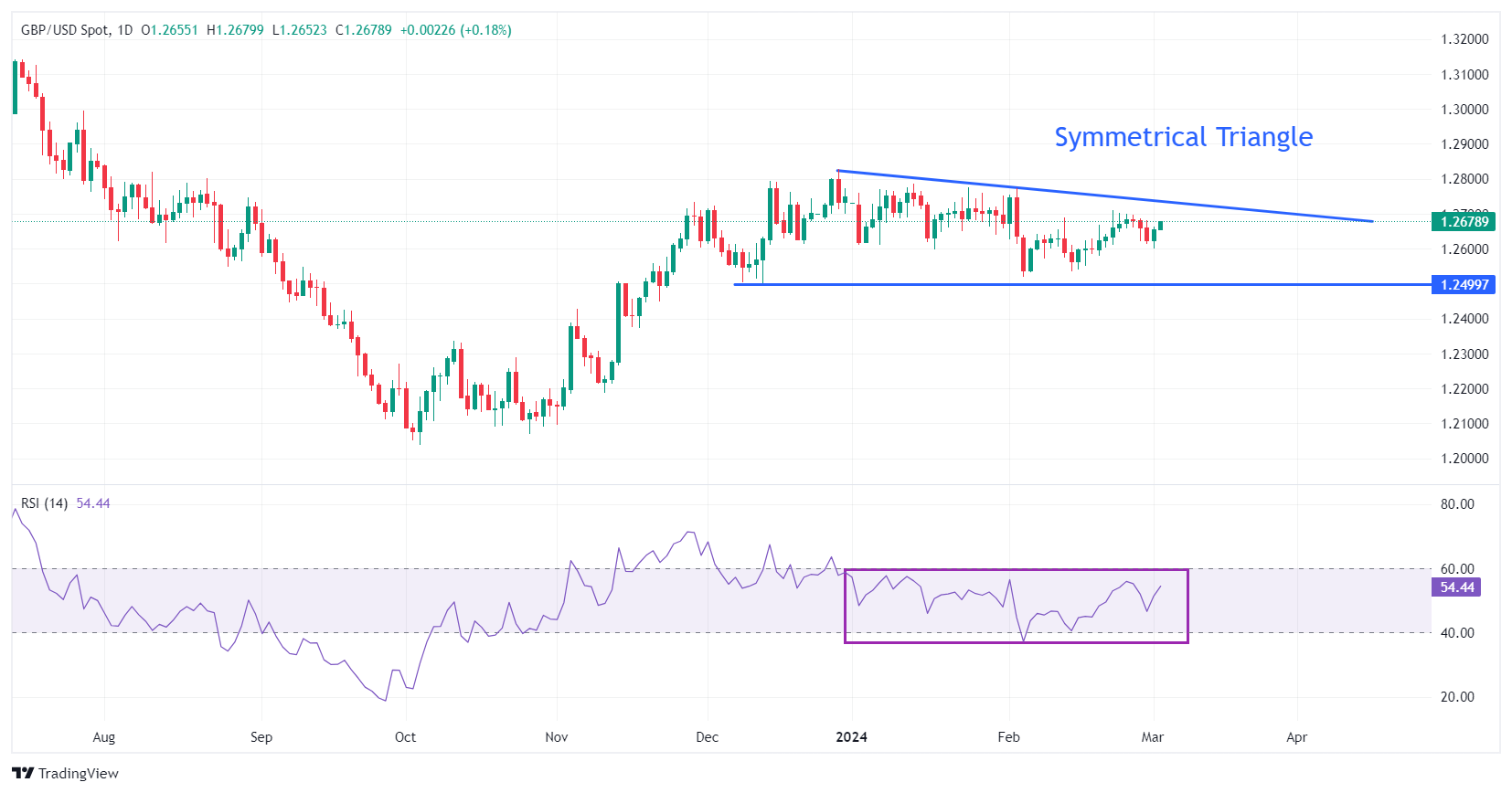
The Pound Sterling extends its upside to 1.2670 after a strong recovery from the round-level support of 1.2600. The major approaches the downward-sloping border of the Descending Triangle pattern formed on a daily time frame, placed from December 28 high at 1.2827. The horizontal support of the aforementioned chart pattern is plotted from December 13 low near 1.2500.
A Descending Triangle pattern exhibits indecisiveness among market participants but with a slight downside bias due to lower highs and flat lows.
The 14-period Relative Strength Index (RSI) remains inside the 40.00-60.00 region, indicating a sharp