Pound Sterling corrects further against US Dollar ahead of US core PCE inflation
- The Pound Sterling edges down after facing selling pressure near 1.2800 due to multiple tailwinds.
- A soft UK inflation outlook could prompt the BoE to start unwinding higher interest rates.
- The US Dollar recovers amid uncertainty ahead of the US core PCE price index.

The Pound Sterling (GBP) corrects to 1.2740 against the US Dollar (USD) in Wednesday’s American session after posting a fresh 10-week high at 1.2800 on Tuesday. The rally in the GBP/USD pair stalls as the United Kingdom (UK) inflation outlook softens and the US Dollar (USD) comes out of the woods.
UK shop price inflation data from the British Retail Consortium (BRC) indicated that prices of food and non-food items eased significantly in May. Annual shop price changes in the popular retail outlets in the UK grew by 0.6%, the slowest pace since November 2021, from the prior reading of 0.8%. Food price inflation dropped for the 13th straight month, declining to 3.2% from 3.4% in April. The agency noted that retailers are passing the benefit of lower prices to consumers.
A softer UK inflation outlook would boost expectations of rate cuts by the Bank of England (BoE), which has been maintaining a restrictive interest rate stance since December 2021. Currently, investors expect that the BoE could use the August meeting as the earliest point to begin the policy-normalization process.
Daily digest market movers: Pound Sterling drops sharply as US Dollar rebounds
- The Pound Sterling falls to 1.2740 against the US Dollar as the market sentiment turns cautious. The appeal for risk-perceived assets has become uncertain as investors expect that the Federal Reserve (Fed) will not start reducing interest rates before the fourth quarter of the year. S&P 500 futures have posted significant losses in the Asian session, reflecting a risk-off market mood. The US Dollar Index (DXY), which tracks the Greenback’s value against six major currencies, recovers to 104.70
- Traders redeemed their bets that the Fed to begin lowering borrowing costs from their current levels in the September meeting. The reason traders unwind their bets is that Fed policymakers want to see price pressures decline for months before considering interest rate cuts.
- The CME FedWatch tool shows that the probability of interest rates coming down from their current levels in September has declined to 44% from 58% recorded a week ago. On Tuesday, Minneapolis Fed Bank President Neel Kashkari said that the possibility of more rate hikes is quite low but has not been taken off the table. Kashkari emphasized that the Fed should wait for significant progress in disinflation before moving to rate cuts.
- This week, investors will focus on the core Personal Consumption Expenditure Price Index (PCE) data for April, which will be published on Friday, to get fresh cues about the Federal Reserve interest rate outlook. The Fed’s preferred inflation measure is estimated to have grown steadily on a monthly and annual basis at 0.3% and 2.8%, respectively. Steady inflation growth would prompt the likelihood of interest rates remaining at higher levels.
Technical Analysis: Pound Sterling corrects from 1.2800
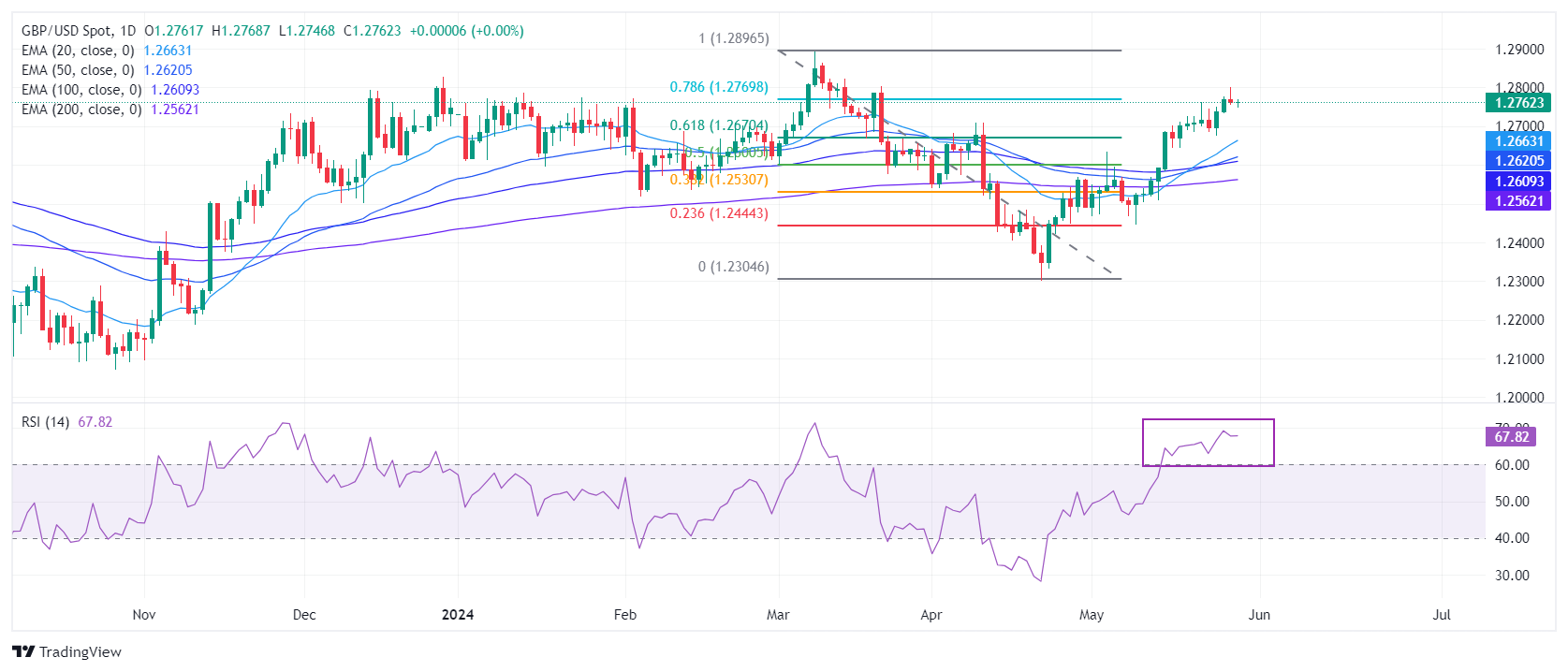
The Pound Sterling faces selling pressure near the round-level resistance of 1.2800. The GBP/USD pair is expected to remain volatile ahead of the release of the Fed’s preferred inflation gauge on Friday. However, the near-term outlook of the Cable remains firm as it holds the 61.8% Fibonacci retracement (plotted from the March 8 high of 1.2900 to the April 22 low at 1.2300) at 1.2670.
The Cable is expected to continue in the bullish trajectory as all short-to-long-term Exponential Moving Averages (EMAs) are sloping higher, suggesting a strong uptrend.
The 14-period Relative Strength Index (RSI) has shifted into the bullish range of 60.00-80.00, suggesting that the momentum has leaned toward the upside.
Fed FAQs
Monetary policy in the US is shaped by the Federal Reserve (Fed). The Fed has two mandates: to achieve price stability and foster full employment. Its primary tool to achieve these goals is by adjusting interest rates. When prices are rising too quickly and inflation is above the Fed’s 2% target, it raises interest rates, increasing borrowing costs throughout the economy. This results in a stronger US Dollar (USD) as it makes the US a more attractive place for international investors to park their money. When inflation falls below 2% or the Unemployment Rate is too high, the Fed may lower interest rates to encourage borrowing, which weighs on the Greenback.
The Federal Reserve (Fed) holds eight policy meetings a year, where the Federal Open Market Committee (FOMC) assesses economic conditions and makes monetary policy decisions. The FOMC is attended by twelve Fed officials – the seven members of the Board of Governors, the president of the Federal Reserve Bank of New York, and four of the remaining eleven regional Reserve Bank presidents, who serve one-year terms on a rotating basis.
In extreme situations, the Federal Reserve may resort to a policy named Quantitative Easing (QE). QE is the process by which the Fed substantially increases the flow of credit in a stuck financial system. It is a non-standard policy measure used during crises or when inflation is extremely low. It was the Fed’s weapon of choice during the Great Financial Crisis in 2008. It involves the Fed printing more Dollars and using them to buy high grade bonds from financial institutions. QE usually weakens the US Dollar.
Quantitative tightening (QT) is the reverse process of QE, whereby the Federal Reserve stops buying bonds from financial institutions and does not reinvest the principal from the bonds it holds maturing, to purchase new bonds. It is usually positive for the value of the US Dollar.
Author

Sagar Dua
FXStreet
Sagar Dua is associated with the financial markets from his college days. Along with pursuing post-graduation in Commerce in 2014, he started his markets training with chart analysis.


![How Wall Street rigs the game [Video]](https://editorial.fxsstatic.com/images/i/market-chaos-01.jpg)