|

Pound Sterling Price News and Forecast: GBP/USD could extend slide if 1.3100 support fails

GBP/USD Forecast: Pound Sterling could extend slide if 1.3100 support fails

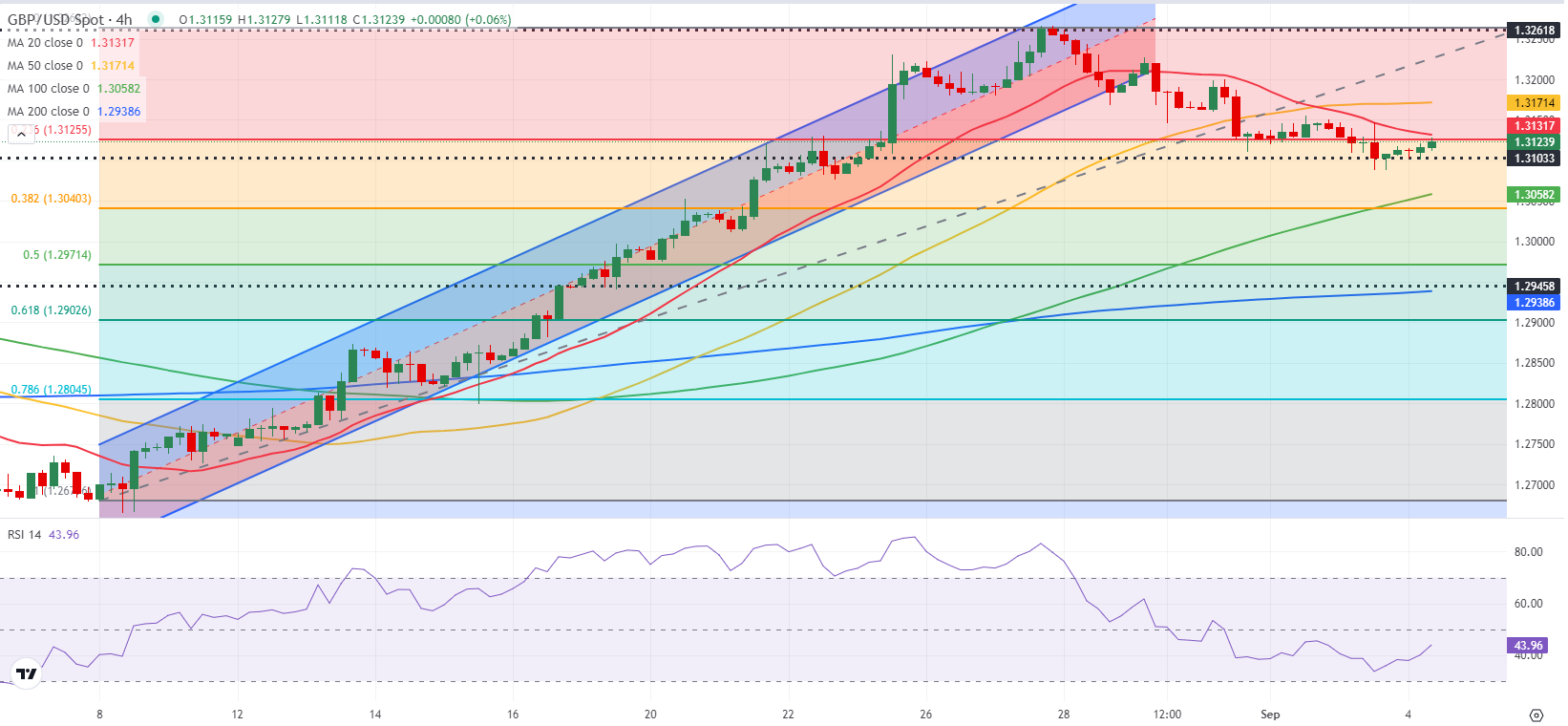
GBP/USD dropped to its lowest level in over a week below 1.3100 on Tuesday but managed to close the day above this level. The pair trades marginally higher in the European session on Wednesday as investors await the next catalyst.

The US Dollar (USD) showed no immediate reaction to the ISM Manufacturing PMI data on Tuesday, which edged higher to 47.2 in August from 46.8 in July. The risk-averse market atmosphere, as reflected by the sharp decline seen in Wall Street's main indexes, allowed the USD to hold its ground and forced GBP/USD to stretch lower. Read more...
GBPUSD

GBP/USD holds steady above 1.3100 ahead of Fed Beige Book

The GBP/USD pair flat lines near 1.3110 during the early European session on Wednesday. However, the risk-off sentiment ahead of the key US events could provide some support to the US Dollar (USD) and drag the major pair lower. The US JOLTS Job Openings and Fed Beige Book are due later on Wednesday.

Data released by the Institute for Supply Management (ISM) on Tuesday revealed that the Manufacturing PMI rose slightly to 47.2 in August from 46.8 in July. This figure came in below the market consensus of 47.5. Read more...

Author

FXStreet Team

Composed of a group of economic journalists and FX experts, the FXStreet content team produces and oversees all content published on FXStreet. It provides a purely journalistic approach to the Forex market.


More from FXStreet Team
Share:

Editor's Picks

AUD/USD sits at two-month lows near 0.6950 after Australian CPI data

AUD/USD is sitting at two-month lows near 0.6950 in the Asian session on Wednesday, as below-expectations August Australian underlying CPI data pours cold water on expectations for further RBA interest rate hikes. Chinese PMI data also fail to inspire the Australian Dollar, despite a pause in the US Dollar advance.

USD/JPY stays weak below 157.00 amid Japanese intervention risks

USD/JPY keeps losses below 157.00 in the Asian session on Wednesday, as hawkish BoJ expectations, along with intervention risks, underpin the Japanese Yen, countering dismal domestic factory output and retail sales data. Meanwhile, a broad US Dollar retreat also collaborates to the pair's downside.

Gold flat lines below $4,200 as traders await US PCE data for Fed rate cues

Gold extends its consolidative price move heading into the European session, trading below the $4,200 mark amid mixed fundamental cues. Falling US bond yields drag the US Dollar away from the two-month high, touched on Tuesday, and act as a tailwind for the commodity. However, hawkish US Federal Reserve expectations cap the upside as traders await important US macro data before placing fresh directional bets on the non-yielding bullion.

Aave Price consolidates below $161 as profit-taking emerges after 10% surge

Aave slips below $161 on Wednesday after surging more than 10% the previous day, with on-chain data suggesting increased profit-taking. Meanwhile, Aave founder Stani Kulechov is considering an AAVE token-burn mechanism under Aavenomics 3.0, adding a potential catalyst for AAVE.

Warning: The RBI's October rate hike may be too late as oil risks mount
The Indian Rupee (INR) is one of the worst-performing Asian currencies in 2026, down about 6.5% year-to-date against the US Dollar (USD) and trading near historic lows ahead of the October 5–7 Reserve Bank of India (RBI) meeting. Economists expect the RBI to raise its repo rate by 25 basis points (bps) next month and follow up with another increase in December to counter rising retail inflation.
Silver is more volatile than Gold ahead of PCE and NFP. This chart shows the positioning gap
The market’s attention is focused on American data this week, but there’s something only those with a trained eye may be looking at: Gold and Silver positioning gap. Financial markets are moving on fears, mostly related to persistently high energy prices driven by the Middle East war. Sure, the US Dollar (USD) is strong, but at what cost?