Pound Sterling edges higher against US Dollar after hot US core PCE Inflation data
- The Pound Sterling rises after surprisingly upbeat UK Retail Sales data for February.
- The UK economy expanded at a robust pace of 1.5% in the last quarter of 2024.
- Investors brace for impending tariffs from US President Trump.

The Pound Sterling (GBP) recovers nominal intraday losses and turns positive around 1.2960 against the US Dollar (USD) in Friday’s North American session. The GBP/USD pair ticks higher after the release of the United States (US) Personal Consumption Expenditure Price Index (PCE) data for February.
The US core PCE inflation -which excludes volatile food and energy prices - grew at a faster pace of 2.8% year-over-year, matching the Federal Reserve's (Fed) forecast provided in the December meeting. Economists expected the underlying inflation data to have accelerated by 2.7% against the 2.6% increase seen in January. Month-on-month core PCE inflation rose by 0.4%, faster than expectations and the former release of 0.3%.
Higher-than-expected growth in the US core PCE inflation data is expected to boost market expectations that the Fed will keep interest rates at their current levels for a longer period. According to the CME FedWatch tool, the central bank is almost certain to keep interest rates steady in the current range of 4.25%-4.50% in the May policy meeting, but there is an 8% chance that it can cut them in June.
Daily digest market movers: Pound Sterling flattens against US Dollar ahead of US PCE Inflation
- The Pound Sterling outperforms against its peers, except the US Dollar and the Japanese Yen (JPY), on Friday after the release of the United Kingdom (UK) Retail Sales data for February and revised Q4 Gross Domestic Product (GDP) figures. The Office for National Statistics (ONS) reported that Retail Sales, a key measure of consumer spending, surprisingly rose by 1% month-on-month. Economists expected the data to have declined by 0.3%. In January, retail sales grew at a robust pace of 1.4%, revised lower from 1.7%.
- In the 12 months to February, the consumer spending measure grew strongly by 2.2% compared to estimates of 0.5% and the former release of 0.6%, revised lower from 1%. Upbeat Retail Sales data is expected to support Bank of England (BoE) officials, who guided a "gradual and cautious" monetary easing outlook in last week's policy meeting after leaving interest rates unchanged at 4.5%.
- Meanwhile, revised GDP figures show that the economy expanded at a faster pace of 1.5% against the preliminary estimate of 1.4%.
- This week, UK Chancellor of the Exchequer Rachel Reeves delivered a budget update in which she announced a significant cut in welfare benefits and halved its GDP forecasts for the current year to 1%. Reeves added that amendments in welfare spending would save £4.8 billion, and she would rebuild a nearly £10 billion fiscal buffer.
- On the geopolitical front, investors brace for impending reciprocal tariffs by US President Donald Trump, which are expected to force market experts to revise their consumer inflation expectations. However, Fed officials and financial market participants had already anticipated that tariffs would be inflationary for the US and the global economy, respectively, in the near term. Still, they need clarity on tariff rates to know the degree of acceleration in price pressures.
- US President Trump is set to announce reciprocal tariffs on April 2, the same day his recently announced 25% levy on autos will be implemented. Meanwhile, UK Prime Minister Keir Starmer seeks to secure a deal with the US before Trump unveils reciprocal tariffs. “Trade wars are no good for anyone," Chancellor Rachel Reeves said in an interview with Bloomberg Television on Thursday and added that they are working intensely these next few days to try and secure “a good deal for Britain”.
- Market participants also expect that the impact of Trump’s tariffs will be very limited on the UK. In late February, Trump commented that he is not sure about imposing tariffs on the UK and sounded confident that a deal could be made as Keir Starmer was "very nice".
Technical Analysis: Pound Sterling holds key 20-day EMA
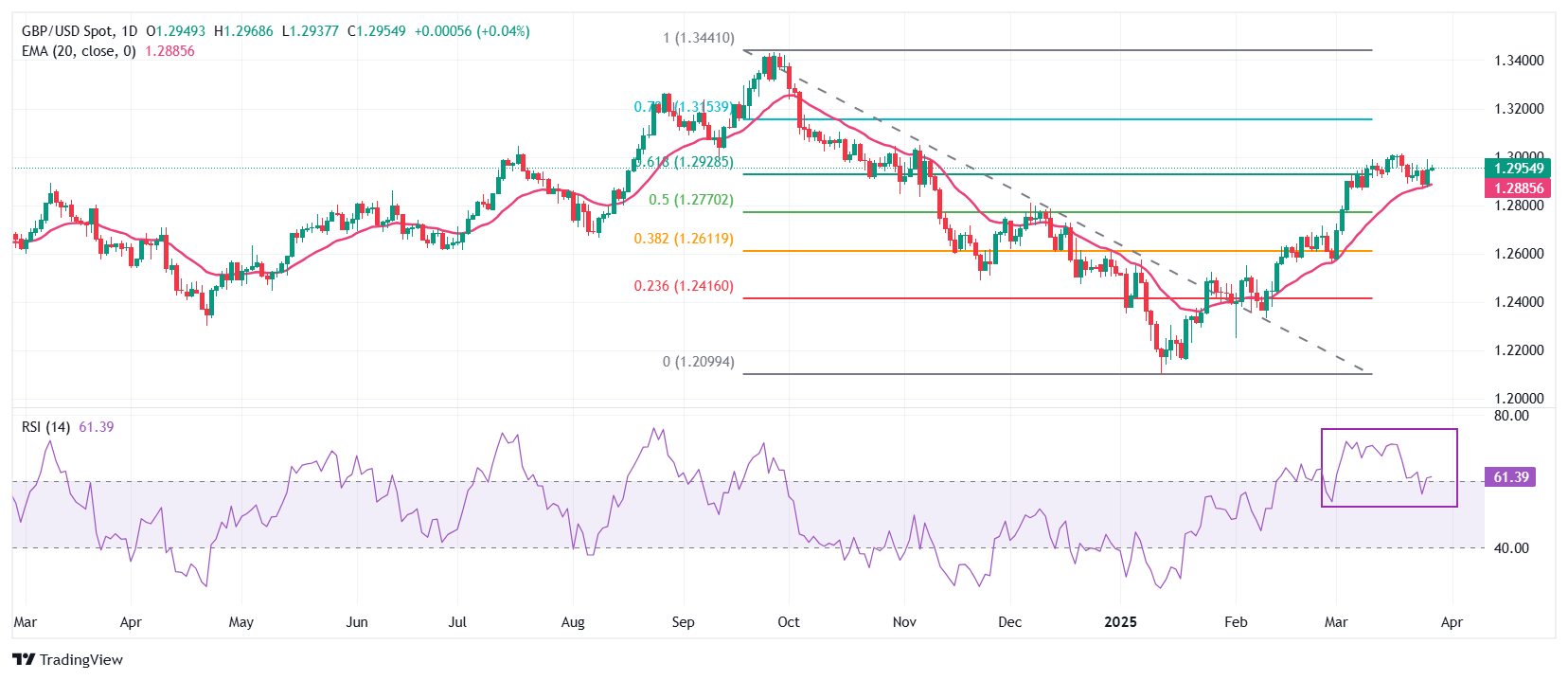
On Friday, the Pound Sterling strives to hold the 61.8% Fibonacci retracement, plotted from late-September high to mid-January low, near 1.2930 against the US Dollar. The 20-day Exponential Moving Average (EMA) continues to provide support to the pair around 1.2885.
The 14-day Relative Strength Index (RSI) cools down to near 60.00 after turning overbought above 70.00. Should a fresh bullish momentum come into action if the RSI resumes the upside journey after holding above the 60.00 level
Looking down, the 50% Fibonacci retracement at 1.2770 and the 38.2% Fibonacci retracement at 1.2615 will act as key support zones for the pair. On the upside, the October 15 high of 1.3100 will act as a key resistance zone.
Inflation FAQs
Inflation measures the rise in the price of a representative basket of goods and services. Headline inflation is usually expressed as a percentage change on a month-on-month (MoM) and year-on-year (YoY) basis. Core inflation excludes more volatile elements such as food and fuel which can fluctuate because of geopolitical and seasonal factors. Core inflation is the figure economists focus on and is the level targeted by central banks, which are mandated to keep inflation at a manageable level, usually around 2%.
The Consumer Price Index (CPI) measures the change in prices of a basket of goods and services over a period of time. It is usually expressed as a percentage change on a month-on-month (MoM) and year-on-year (YoY) basis. Core CPI is the figure targeted by central banks as it excludes volatile food and fuel inputs. When Core CPI rises above 2% it usually results in higher interest rates and vice versa when it falls below 2%. Since higher interest rates are positive for a currency, higher inflation usually results in a stronger currency. The opposite is true when inflation falls.
Although it may seem counter-intuitive, high inflation in a country pushes up the value of its currency and vice versa for lower inflation. This is because the central bank will normally raise interest rates to combat the higher inflation, which attract more global capital inflows from investors looking for a lucrative place to park their money.
Formerly, Gold was the asset investors turned to in times of high inflation because it preserved its value, and whilst investors will often still buy Gold for its safe-haven properties in times of extreme market turmoil, this is not the case most of the time. This is because when inflation is high, central banks will put up interest rates to combat it. Higher interest rates are negative for Gold because they increase the opportunity-cost of holding Gold vis-a-vis an interest-bearing asset or placing the money in a cash deposit account. On the flipside, lower inflation tends to be positive for Gold as it brings interest rates down, making the bright metal a more viable investment alternative.
BRANDED CONTENT
Finding the right broker for your trading strategy is essential, especially when specific features make all the difference. Explore our selection of top brokers, each offering unique advantages to match your needs.
Author

Sagar Dua
FXStreet
Sagar Dua is associated with the financial markets from his college days. Along with pursuing post-graduation in Commerce in 2014, he started his markets training with chart analysis.