Pound Sterling starts the week on a strong note
- The Pound Sterling rises to near 1.3390 against the US Dollar as the latter trades with caution due to uncertainty over the status of US-China trade talks.
- Beijing keeps denying Trump’s claim of having trade discussions with China’s Xi.
- The BoE is almost certain to cut interest rates next week.

The Pound Sterling (GBP) outperforms its peers at the start of the week despite firm expectations that the Bank of England (BoE) will cut interest rates by 25 basis points (bps) to 4.25% in the policy meeting on May 8. BoE dovish bets have escalated amid fears that the new tariff policy by the US will weaken economic growth in the United Kingdom (UK), and as inflation pressures seem to be subsiding.
Last week, BoE Governor Andrew Bailey stressed the need to consider the trade war risk by the central bank. "We do have to take very seriously the risk to growth,” Bailey said on the sidelines of the International Monetary Fund’s (IMF) Spring Meetings in Washington. However, he ruled out the possibility of an economic recession.
Additionally, BoE policymaker Megan Greene has also expressed concerns over “weak productivity” and “risks to the labor market” due to an increase in employers’ contributions to social security schemes, in a discussion with the Atlantic Council think tank on Friday. When asked about the impact of Trump’s tariff policy on UK inflation, Greene says she expects the potential trade war to be “net disinflationary” for the economy.
Market participants seem to be pricing in that the trade war between the US and China will be limited, but the stand-off could hit European economies, given the low-cost competitive advantage of Beijing. China is expected to sell its products into European economies if the US shows reluctance to buy them. Such a scenario would be unfavorable for the UK business activity.
British Pound PRICE Today
The table below shows the percentage change of British Pound (GBP) against listed major currencies today. British Pound was the strongest against the US Dollar.
| USD | EUR | GBP | JPY | CAD | AUD | NZD | CHF | |
|---|---|---|---|---|---|---|---|---|
| USD | -0.07% | -0.54% | -0.46% | -0.19% | -0.30% | -0.16% | -0.25% | |
| EUR | 0.07% | -0.53% | -0.41% | -0.14% | -0.32% | -0.10% | -0.21% | |
| GBP | 0.54% | 0.53% | 0.11% | 0.41% | 0.19% | 0.43% | 0.33% | |
| JPY | 0.46% | 0.41% | -0.11% | 0.30% | 0.19% | -1.10% | 0.47% | |
| CAD | 0.19% | 0.14% | -0.41% | -0.30% | -0.23% | 0.03% | -0.06% | |
| AUD | 0.30% | 0.32% | -0.19% | -0.19% | 0.23% | 0.23% | 0.13% | |
| NZD | 0.16% | 0.10% | -0.43% | 1.10% | -0.03% | -0.23% | -0.10% | |
| CHF | 0.25% | 0.21% | -0.33% | -0.47% | 0.06% | -0.13% | 0.10% |
The heat map shows percentage changes of major currencies against each other. The base currency is picked from the left column, while the quote currency is picked from the top row. For example, if you pick the British Pound from the left column and move along the horizontal line to the US Dollar, the percentage change displayed in the box will represent GBP (base)/USD (quote).
Daily digest market movers: Pound Sterling gains against US Dollar on US-China trade uncertainty
- The Pound Sterling jumps higher to near 1.3390 against the US Dollar (USD) in Monday’s North American session. The GBP/USD pair gains as the US Dollar (USD) trades cautiously as investors try to seek clarity about whether the United States (US) and China are actively discussing the terms and conditions of a trade deal.
- The US Dollar Index (DXY), which tracks the Greenback’s value against six major currencies, trades inside Friday’s range around 99.50.
- On Monday, China stated clearly that there have been no trade discussions between President Xi Jinping and US President Donald Trump. China’s denial of recent talks between the two leaders comes after Trump has claimed that Xi has called him, refraining from commenting on the timing and topics discussed.
- Meanwhile, US Treasury Secretary Scott Bessent has put the responsibility of progress in US-China bilateral trade talks on Beijing. “I believe that it’s up to China to de-escalate, because they sell five times more to us than we sell to them, Bessent said in an interview on CNBC’s Squawk Box after being asked about the current status of trade talks between the world's two largest powerhouses.
- Additionally, investors appear to be on the sidelines as they wait for a slew of US economic data releases this week. Traders will focus on a string of employment-related, economic, Gross Domestic Product (GDP), and inflation data, which will influence market expectations for the Federal Reserve’s (Fed) monetary policy outlook.
- According to the CME FedWatch tool, Fed officials are expected to leave interest rates unchanged in the range of 4.25%-4.50% in the policy meeting on May 6-7.
- Fed officials have signaled that monetary policy adjustments would be appropriate only if they get greater clarity on the economic outlook under the leadership of Trump.
Technical analysis: Pound Sterling stays above key EMAs
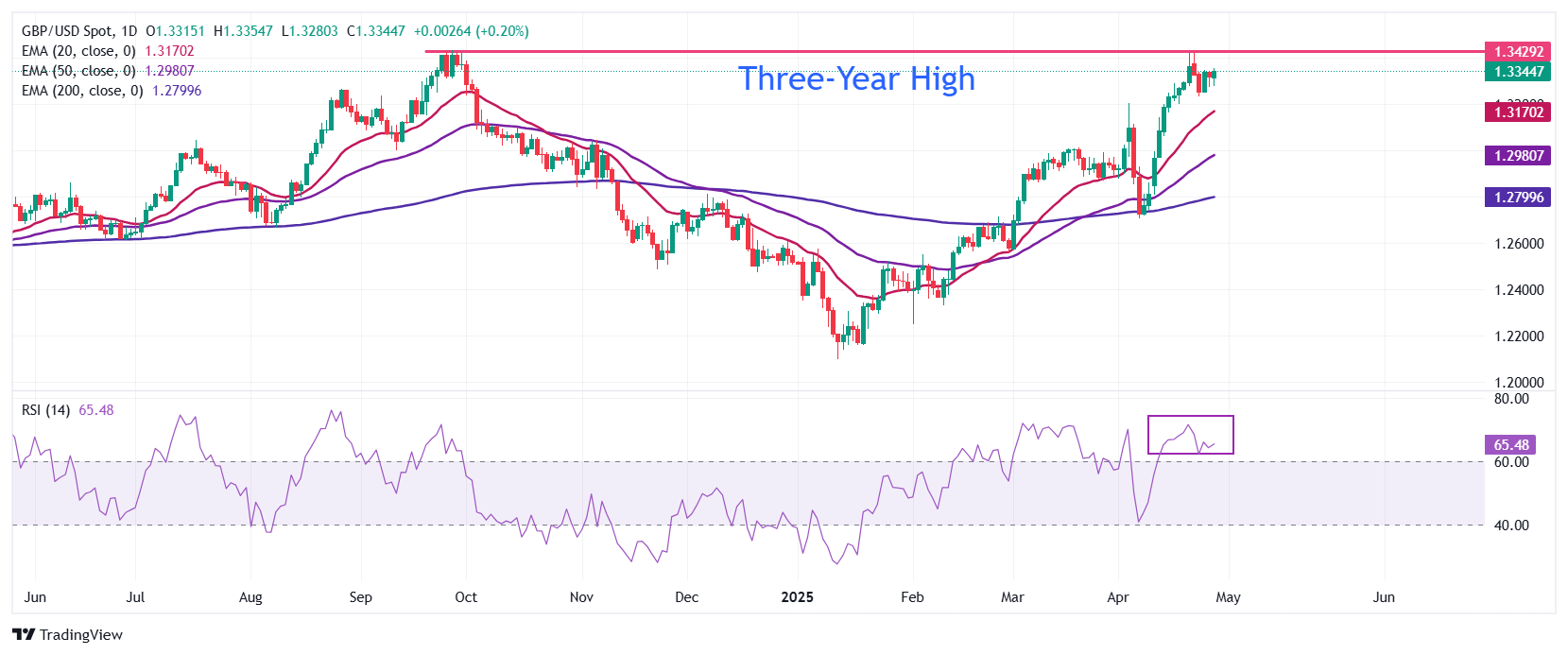
The Pound Sterling rises to near 1.3390 against the US Dollar in Monday’s North American session. The pair gains as the overall outlook remains bullish, with all short-to-long Exponential Moving Averages (EMAs) sloping higher.
The 14-day Relative Strength Index (RSI) rebounds to near 65.00 after cooling down to 60.00, indicating a resurgence in the upside trend.
On the upside, the psychological level of 1.3500 will be a key hurdle for the pair. Looking down, the April 3 high around 1.3200 will act as a major support area.
BoE FAQs
The Bank of England (BoE) decides monetary policy for the United Kingdom. Its primary goal is to achieve ‘price stability’, or a steady inflation rate of 2%. Its tool for achieving this is via the adjustment of base lending rates. The BoE sets the rate at which it lends to commercial banks and banks lend to each other, determining the level of interest rates in the economy overall. This also impacts the value of the Pound Sterling (GBP).
When inflation is above the Bank of England’s target it responds by raising interest rates, making it more expensive for people and businesses to access credit. This is positive for the Pound Sterling because higher interest rates make the UK a more attractive place for global investors to park their money. When inflation falls below target, it is a sign economic growth is slowing, and the BoE will consider lowering interest rates to cheapen credit in the hope businesses will borrow to invest in growth-generating projects – a negative for the Pound Sterling.
In extreme situations, the Bank of England can enact a policy called Quantitative Easing (QE). QE is the process by which the BoE substantially increases the flow of credit in a stuck financial system. QE is a last resort policy when lowering interest rates will not achieve the necessary result. The process of QE involves the BoE printing money to buy assets – usually government or AAA-rated corporate bonds – from banks and other financial institutions. QE usually results in a weaker Pound Sterling.
Quantitative tightening (QT) is the reverse of QE, enacted when the economy is strengthening and inflation starts rising. Whilst in QE the Bank of England (BoE) purchases government and corporate bonds from financial institutions to encourage them to lend; in QT, the BoE stops buying more bonds, and stops reinvesting the principal maturing on the bonds it already holds. It is usually positive for the Pound Sterling.
BRANDED CONTENT
Choosing a broker that aligns with your trading needs can significantly impact performance. Our list of the best regulated brokers highlights the best options for seamless and cost-effective trading.
Author

Sagar Dua
FXStreet
Sagar Dua is associated with the financial markets from his college days. Along with pursuing post-graduation in Commerce in 2014, he started his markets training with chart analysis.