Pound Sterling trades firmly despite UK Retail Sales drop again
- The Pound Sterling trades firmly against its major peers even as UK Retail Sales unexpectedly decline by 0.1% in November.
- The BoE reduced interest rates by 25 bps to 3.75% with a split 5-4 vote on Thursday.
- Investors await the announcement of the next Fed chairman, which is expected by the beginning of 2026.

The Pound Sterling (GBP) trades higher against its major peers in Friday's European session despite data from the United Kingdom (UK) showing that Retail Sales unexpectedly declined in November.
The Office for National Statistics (ONS) has reported that Retail Sales, a key measure of consumer spending, surprisingly declined by 0.1% month-on-month, while these were expected to expand by 0.4%. However, the pace of decline was significantly lower compared to the 0.9% contraction seen in October, which was downwardly revised from 1.1%. Year-on-year, the consumer spending measure grew steadily by 0.6%, slower than the 0.9% projections.
Demand for automotive fuel and lower sales receipts at non-retailing stores dragged Retail Sales; however, demand for household goods, textile clothing and footwear stores remained robust, the data showed.
Consistently declining UK Retail Sales could raise concerns about the UK economy, which is already vulnerable due to a weak hiring trend and external risks.
Moving further, the next major trigger for the Pound Sterling will be expectations for the Bank of England's (BoE) monetary policy outlook.
On Thursday, the British currency rose sharply after the BoE reduced interest rates by 25 basis points (bps) to 3.75% with a tight vote, as expected. However, the upside move didn’t last long as the BoE retained its “gradually downward” monetary policy path stance and said it remained confident that “inflation will come closer to 2%” in the second quarter of 2026.
Pound Sterling Price Today
The table below shows the percentage change of British Pound (GBP) against listed major currencies today. British Pound was the strongest against the Japanese Yen.
| USD | EUR | GBP | JPY | CAD | AUD | NZD | CHF | |
|---|---|---|---|---|---|---|---|---|
| USD | 0.06% | 0.01% | 0.88% | 0.10% | 0.07% | 0.41% | 0.11% | |
| EUR | -0.06% | -0.05% | 0.88% | 0.04% | 0.00% | 0.35% | 0.05% | |
| GBP | -0.01% | 0.05% | 0.95% | 0.10% | 0.05% | 0.40% | 0.10% | |
| JPY | -0.88% | -0.88% | -0.95% | -0.81% | -0.86% | -0.53% | -0.81% | |
| CAD | -0.10% | -0.04% | -0.10% | 0.81% | -0.04% | 0.29% | 0.01% | |
| AUD | -0.07% | 0.00% | -0.05% | 0.86% | 0.04% | 0.35% | 0.05% | |
| NZD | -0.41% | -0.35% | -0.40% | 0.53% | -0.29% | -0.35% | -0.29% | |
| CHF | -0.11% | -0.05% | -0.10% | 0.81% | -0.01% | -0.05% | 0.29% |
The heat map shows percentage changes of major currencies against each other. The base currency is picked from the left column, while the quote currency is picked from the top row. For example, if you pick the British Pound from the left column and move along the horizontal line to the US Dollar, the percentage change displayed in the box will represent GBP (base)/USD (quote).
Daily digest market move: Pound Sterling stabilizes against US Dollar
- The Pound Sterling trades calmly to near 1.3380 against the US Dollar (USD) during the European trading session on Friday. The GBP/USD pair flattens despite surprisingly weak UK Retail Sales data and a rising US Dollar.
- At the time of writing, the US Dollar Index (DXY), which tracks the Greenback’s value against six major currencies, trades 0.25% higher near 98.65.
- The DXY rises after regaining ground as traders remain confident that the Federal Reserve (Fed) won't cut interest rates in its January monetary policy meeting despite soft United States (US) Consumer Price Index (CPI) data for November. The US CPI report showed that the headline and core inflation decelerated to 2.7% and 2.6% (YoY), respectively.
- Initially, the US Dollar reacted negatively to the soft inflation data released on Thursday, but it recovered later, as market experts believe the data was distorted by the government shutdown.
- According to the CME FedWatch tool, the probability of the Fed reducing interest rates by 25 basis points (bps) to 3.25%-3.50% in the January meeting rises marginally to 25.5% from 24.4% seen on Wednesday.
- Going forward, the major trigger for the US Dollar could be the announcement of Fed Chair Jerome Powell’s successor by the White House. Latest reports show that major contenders for the next Fed chairman are White House Economic Adviser Kevin Hassett, former Fed Chairman Kevin Warsh, current Fed Governors Christopher Waller, and Michelle Bowman.
Technical Analysis: GBP/USD wobbles around 1.3400
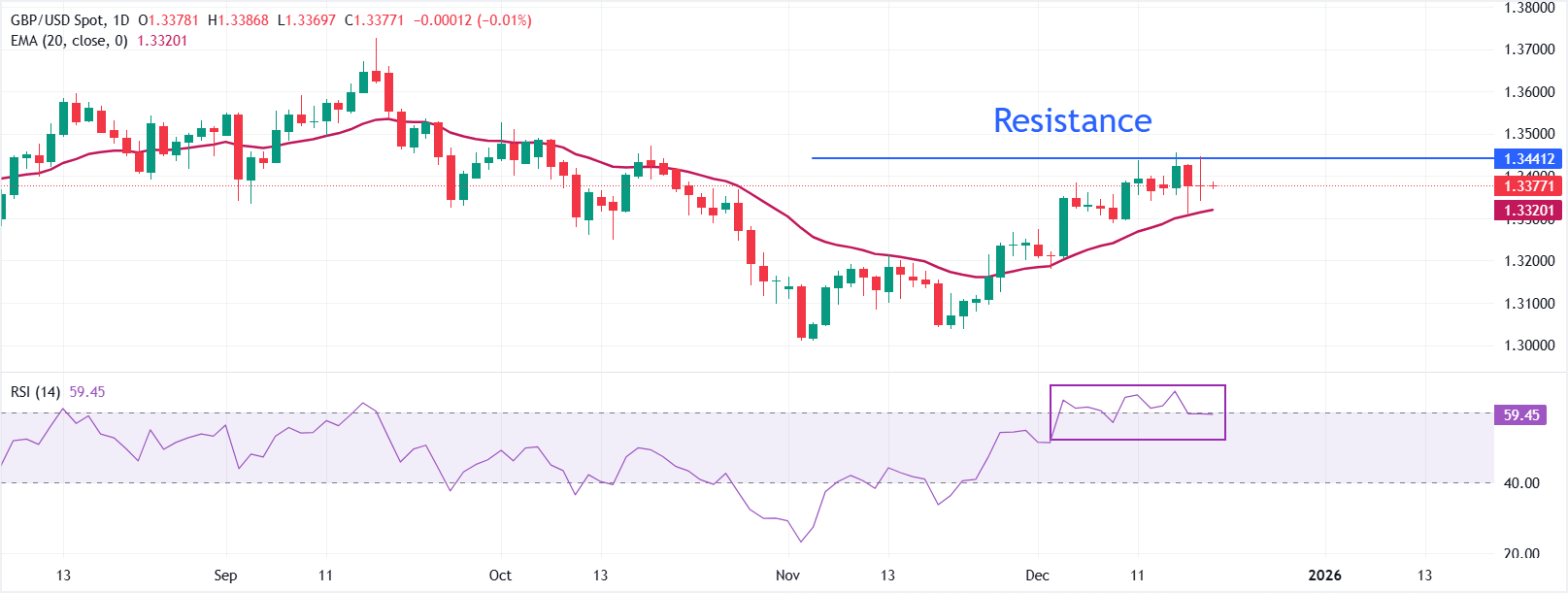
GBP/USD edges down to near 1.3377 on Friday. The 20-day Exponential Moving Average (EMA) climbs steadily, with price holding above it and preserving the topside structure. A pullback toward the average at 1.3320 would likely attract bids.
The 14-day Relative Strength Index (RSI) at 59 (neutral-bullish) has cooled from recent highs, yet momentum remains on the buyers’ side.
The rising slope of the 20-day EMA validates higher lows, while recent dips have been contained. The pair could extend toward fresh cycle highs if it manages to break above the two-month high of 1.3455. However, a daily close back below the EMA would open room for a deeper correction towards the December 3 low of 1.3203.
(The technical analysis of this story was written with the help of an AI tool.)
BoE FAQs
The Bank of England (BoE) decides monetary policy for the United Kingdom. Its primary goal is to achieve ‘price stability’, or a steady inflation rate of 2%. Its tool for achieving this is via the adjustment of base lending rates. The BoE sets the rate at which it lends to commercial banks and banks lend to each other, determining the level of interest rates in the economy overall. This also impacts the value of the Pound Sterling (GBP).
When inflation is above the Bank of England’s target it responds by raising interest rates, making it more expensive for people and businesses to access credit. This is positive for the Pound Sterling because higher interest rates make the UK a more attractive place for global investors to park their money. When inflation falls below target, it is a sign economic growth is slowing, and the BoE will consider lowering interest rates to cheapen credit in the hope businesses will borrow to invest in growth-generating projects – a negative for the Pound Sterling.
In extreme situations, the Bank of England can enact a policy called Quantitative Easing (QE). QE is the process by which the BoE substantially increases the flow of credit in a stuck financial system. QE is a last resort policy when lowering interest rates will not achieve the necessary result. The process of QE involves the BoE printing money to buy assets – usually government or AAA-rated corporate bonds – from banks and other financial institutions. QE usually results in a weaker Pound Sterling.
Quantitative tightening (QT) is the reverse of QE, enacted when the economy is strengthening and inflation starts rising. Whilst in QE the Bank of England (BoE) purchases government and corporate bonds from financial institutions to encourage them to lend; in QT, the BoE stops buying more bonds, and stops reinvesting the principal maturing on the bonds it already holds. It is usually positive for the Pound Sterling.
Author

Sagar Dua
FXStreet
Sagar Dua is associated with the financial markets from his college days. Along with pursuing post-graduation in Commerce in 2014, he started his markets training with chart analysis.