Pound Sterling trades firmly against US Dollar ahead of Fed’s policy outcome
- The Pound Sterling remains firm against its peers despite the UK core and service CPI cooling down in August.
- Investors expect the BoE to hold interest rates steady on Thursday.
- The Fed is nearly certain to cut interest rates at 18:00 GMT.

The Pound Sterling (GBP) clings to Tuesday's gains near 1.3640 against the US Dollar (USD) during the European trading session on Wednesday. The GBP/USD pair holds onto gains as the US Dollar remains on the back foot amid firm expectations that the Federal Reserve (Fed) will cut interest rates in the monetary policy announcement at 18:00 GMT.
At the time of writing, the US Dollar Index (DXY), which tracks the Greenback’s value against six major currencies, holds onto losses near a fresh two-month low of 96.60 posted on Tuesday.
According to the CME FedWatch tool, traders see a 96% chance that the Fed will reduce interest rates by 25 basis points (bps) to the 4.00%-4.25% range, while the rest support a bigger reduction of 50 bps.
As the Fed is widely anticipated to start the monetary-easing campaign, the next trigger for the US Dollar would be the Fed’s Summary of Economic Projections (SEP), which includes the dot plot, and Fed Chair Jerome Powell’s views on inflation and the labor market outlook. According to analysts at Morgan Stanley, the Fed is anticipated to cut interest rates by 25 bps in each of the remaining three policy meetings this year, indicating that borrowing rates will go lower to the range of 3.50%-3.75% by 2025.
Fed dovish expectations were intensified by growing US labor market concerns and signs that the impact of tariffs on inflation won’t be persistent. Chair Powell also warned of downside labor market risks in his speech at the Jackson Hole Symposium in August, and added they could materialize quickly if the central bank delays policy adjustment.
Additionally, investors will also focus on the newly added member, Stephen Miran, to the rate-setting committee. Market participants would like to know whether Miran's rate would be biased towards US President Donald Trump's economic agenda.
Meanwhile, Fed Governor Lisa Cook is set to join her fellow Federal Open Market Committee (FOMC) members in the monetary policy announcement as the US appeals court blocked President Trump’s firing of Cook on mortgage allegations.
Pound Sterling stays firm even as UK inflation cools down in August
- The Pound Sterling stays broadly firm against its major peers on Wednesday after the release of the United Kingdom (UK) Consumer Price Index (CPI) data for August. The British currency holds strength even as the Office for National Statistics (ONS) has reported that the service inflation rose at a moderate pace of 4.7%, compared to 5.0% in July.
- Signs of service inflation slowing would weigh on market expectations of no further interest rate cuts by the Bank of England (BoE) in the remainder of the year, which adds pressure on the Pound Sterling. Inflation in the services sector is closely tracked by the BoE Monetary Policy Committee (MPC) members while deciding on interest rates.
- The core CPI – which excludes volatile items such as food, energy, alcohol, and tobacco – also slowed down to 3.6%, as expected, from 3.8% in July.
- Meanwhile, the headline inflation has grown at a steady pace of 3.8%, but slower than the estimates of 3.9%. On a monthly basis, the headline CPI grew in line with expectations of 0.3%, faster than 0.1% in July.
- The next major trigger for the Pound Sterling is the BoE’s interest rate decision on Thursday, in which the central bank is almost certain to hold borrowing rates at their current level of 4%.
Technical Analysis: Pound Sterling holds Ascending Triangle breakout
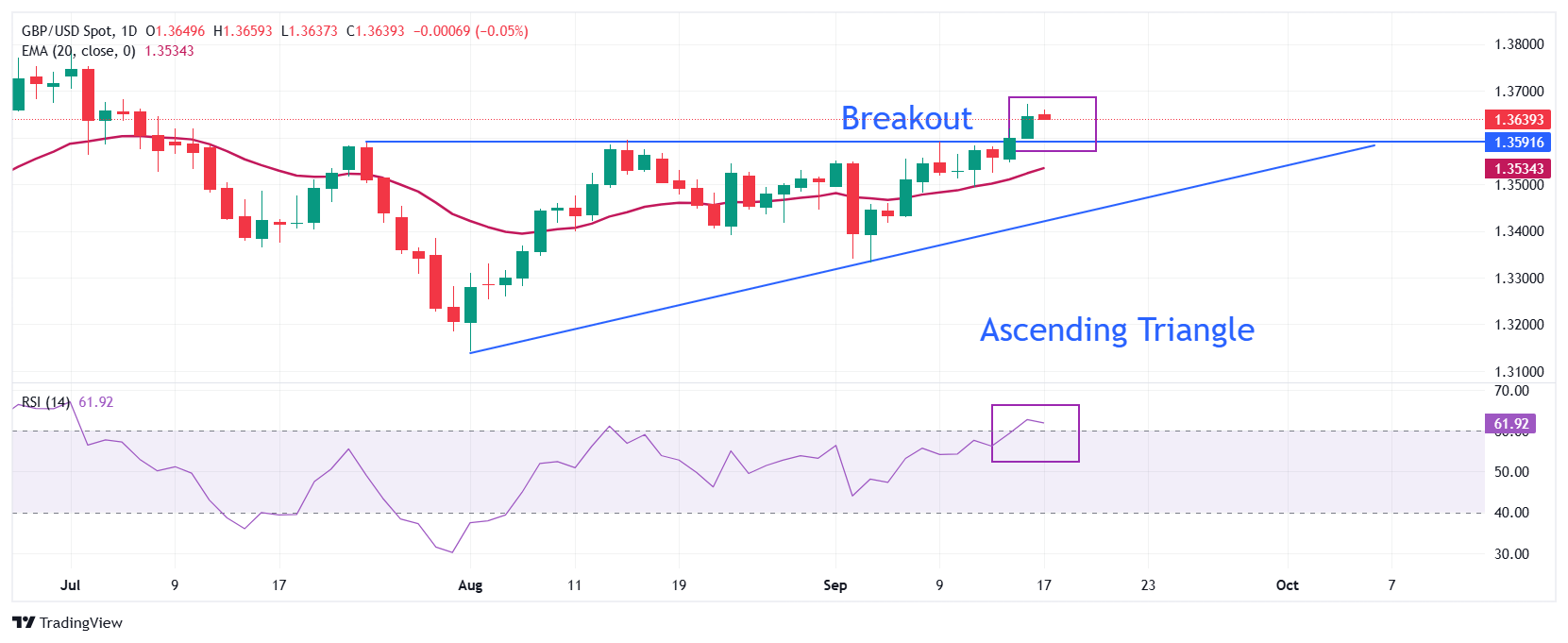
The Pound Sterling edges lower to near 1.3640 against the US Dollar on Wednesday. However, the overall trend of the GBP/USD pair remains bullish as it holds an ascending triangle formation breakout, which it delivered on Tuesday. The Cable also stays above the 20-day Exponential Moving Average (EMA), which trades around 1.3535.
The 14-day Relative Strength Index (RSI) trades above 60.00. A fresh upside momentum would emerge if the RSI holds above that level.
Looking down, the August 1 low of 1.3140 will act as a key support zone. On the upside, the July 1 high near 1.3800 will act as a key barrier.
Fed FAQs
Monetary policy in the US is shaped by the Federal Reserve (Fed). The Fed has two mandates: to achieve price stability and foster full employment. Its primary tool to achieve these goals is by adjusting interest rates. When prices are rising too quickly and inflation is above the Fed’s 2% target, it raises interest rates, increasing borrowing costs throughout the economy. This results in a stronger US Dollar (USD) as it makes the US a more attractive place for international investors to park their money. When inflation falls below 2% or the Unemployment Rate is too high, the Fed may lower interest rates to encourage borrowing, which weighs on the Greenback.
The Federal Reserve (Fed) holds eight policy meetings a year, where the Federal Open Market Committee (FOMC) assesses economic conditions and makes monetary policy decisions. The FOMC is attended by twelve Fed officials – the seven members of the Board of Governors, the president of the Federal Reserve Bank of New York, and four of the remaining eleven regional Reserve Bank presidents, who serve one-year terms on a rotating basis.
In extreme situations, the Federal Reserve may resort to a policy named Quantitative Easing (QE). QE is the process by which the Fed substantially increases the flow of credit in a stuck financial system. It is a non-standard policy measure used during crises or when inflation is extremely low. It was the Fed’s weapon of choice during the Great Financial Crisis in 2008. It involves the Fed printing more Dollars and using them to buy high grade bonds from financial institutions. QE usually weakens the US Dollar.
Quantitative tightening (QT) is the reverse process of QE, whereby the Federal Reserve stops buying bonds from financial institutions and does not reinvest the principal from the bonds it holds maturing, to purchase new bonds. It is usually positive for the value of the US Dollar.
Author

Sagar Dua
FXStreet
Sagar Dua is associated with the financial markets from his college days. Along with pursuing post-graduation in Commerce in 2014, he started his markets training with chart analysis.
















