Pound Sterling underperforms even as UK inflation rises more than expected
- The Pound Sterling declines against its peers despite UK CPI growing at a higher-than-expected pace in December to 3.4%.
- UK core inflation remained at 3.2% YoY in December, as markets expected.
- US-EU strained relations are keeping the US Dollar under pressure.

The Pound Sterling (GBP) underperforms its major peers on Wednesday after the United Kingdom's (UK) Office for National Statistics (ONS) reported that inflation grew at a faster-than-projected pace in December.
UK headline inflation rose to 3.4% year-on-year, faster than estimates of 3.3% and the November reading of 3.2%. On a monthly basis, headline CPI grew at an expected pace of 0.4% after contracting by 0.2% in November.
The UK core CPI – which strips off volatile components such as food, energy, alcohol, and tobacco – rose at a steady pace of 3.2% year-on-year (YoY), as expected.
Meanwhile, inflation in the services sector, which is closely tracked by Bank of England (BoE) officials, accelerated to 4.5% YoY from the prior reading of 4.4%.
Signs of price pressures remaining sticky are expected to weigh on market expectations for interest rate cuts by the BoE in the near term. In the December policy meeting, the BoE guided that the monetary policy will remain on a “gradual downward” path.
Going forward, investors will focus on the UK Retail Sales data for December and the preliminary S&P Global Purchasing Managers’ Index (PMI) data for January. Both indicators will be releasedon Friday.
Pound Sterling Price Today
The table below shows the percentage change of British Pound (GBP) against listed major currencies today. British Pound was the weakest against the New Zealand Dollar.
| USD | EUR | GBP | JPY | CAD | AUD | NZD | CHF | |
|---|---|---|---|---|---|---|---|---|
| USD | 0.12% | 0.22% | -0.13% | 0.03% | -0.16% | -0.16% | 0.26% | |
| EUR | -0.12% | 0.10% | -0.24% | -0.09% | -0.27% | -0.28% | 0.14% | |
| GBP | -0.22% | -0.10% | -0.36% | -0.18% | -0.38% | -0.38% | 0.04% | |
| JPY | 0.13% | 0.24% | 0.36% | 0.16% | -0.03% | -0.04% | 0.39% | |
| CAD | -0.03% | 0.09% | 0.18% | -0.16% | -0.19% | -0.20% | 0.22% | |
| AUD | 0.16% | 0.27% | 0.38% | 0.03% | 0.19% | -0.00% | 0.41% | |
| NZD | 0.16% | 0.28% | 0.38% | 0.04% | 0.20% | 0.00% | 0.42% | |
| CHF | -0.26% | -0.14% | -0.04% | -0.39% | -0.22% | -0.41% | -0.42% |
The heat map shows percentage changes of major currencies against each other. The base currency is picked from the left column, while the quote currency is picked from the top row. For example, if you pick the British Pound from the left column and move along the horizontal line to the US Dollar, the percentage change displayed in the box will represent GBP (base)/USD (quote).
Daily Digest Market Movers: Trump’s speech at WEF in Davos remains key trigger for global markets
- The Pound Sterling declines to near 1.3410 against the US Dollar (USD) during the European trading session on Wednesday. The GBP/USD pair corrects as the US Dollar trades higher, while investors await United States (US) President Donald Trump’s speech at the World Economic Forum (WEF) in Davos.
- At the time of writing, the US Dollar Index (DXY), which tracks the Greenback’s value against six major currencies, trades 0.13% around 98.70. Still, it is close to its two-week low of 98.20 posted on Tuesday.
- The US Dollar is broadly under pressure amid disputes between the US and European Union (EU) members over Greenland’s future. Over the weekend, US President Trump threatened to impose 10% tariffs on several EU members and the UK for opposing Washington’s plans to acquire Greenland.
- In response, several EU members and officials across the globe have criticized Trump’s tariff threats, referring to them as ”blackmail” . European Central Bank (ECB) President Christine Lagarde stated in an interview with CNN on Tuesday at the WEF that Trump’s tariff threats have undermined relations between the US and the EU. Lagarde added that companies from both economies struggle to gauge the “potential impact of additional duties”.
- President Trump's speech at Davos will be closely watched by investors for clues about which measures Washington can take to pressure EU members after opposing US control of Greenland.
- On the domestic front, investors await the announcement of the new Federal Reserve (Fed) Chairman, which is expected as early as next week, as stated by US Treasury Secretary Scott Bessent on Tuesday. “There are four candidates for the position presently,” Bessent added.
Technical Analysis: GBP/USD struggles above 20-day EMA
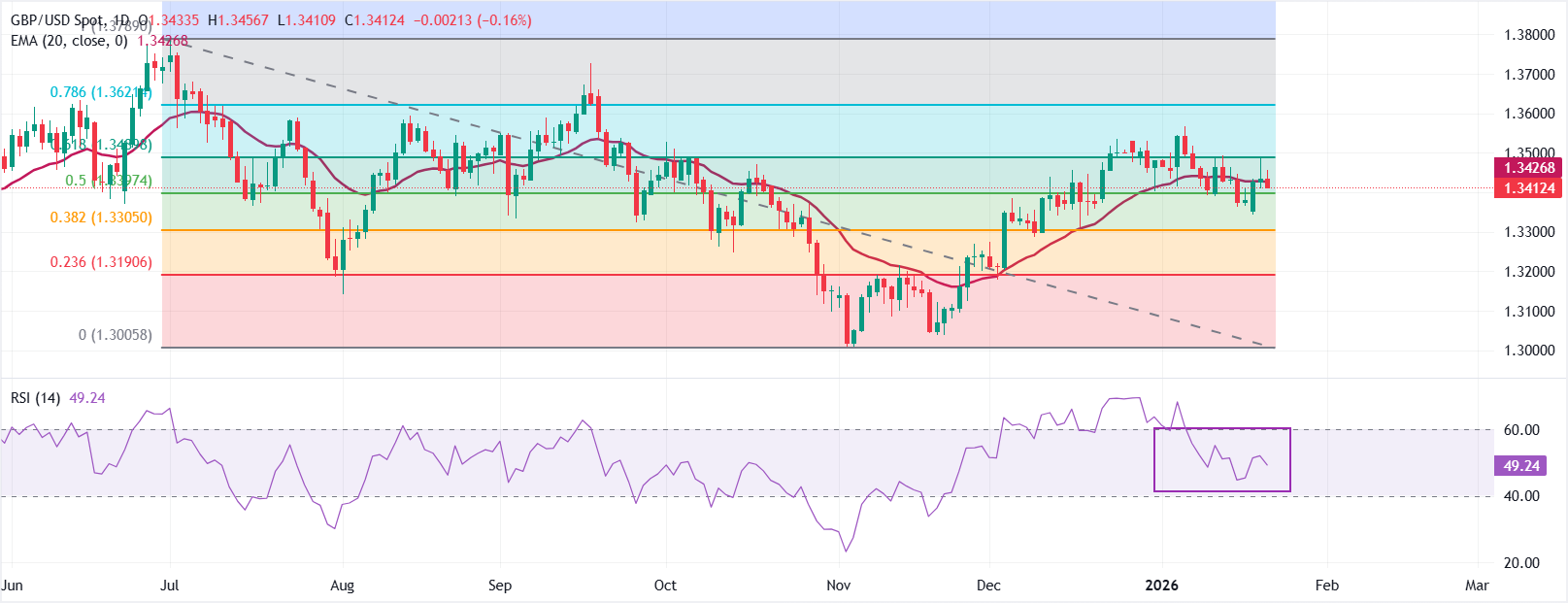
GBP/USD trades lower to near 1.3405 at the time of writing. Price holds marginally below the 20-Exponential Moving Average (EMA) at 1.3429, which has flattened after a steady climb, signaling consolidation.
The 14-day Relative Strength Index (RSI) at 53 (neutral) shows a slight improvement in momentum. Measured from the 1.3789 high to the 1.3006 low, any rebound would confront the 61.8% retracement at 1.3490, while the 50% retracement at 1.3397 is a pivotal threshold.
A push through 60 by the RSI would strengthen bullish traction, whereas a dip under 50 would reassert bearish pressure. A daily close above the retracement resistance would extend the rebound, while a break back under the 20 EMA could revive the broader pullback.
(The technical analysis of this story was written with the help of an AI tool.)
Inflation FAQs
Inflation measures the rise in the price of a representative basket of goods and services. Headline inflation is usually expressed as a percentage change on a month-on-month (MoM) and year-on-year (YoY) basis. Core inflation excludes more volatile elements such as food and fuel which can fluctuate because of geopolitical and seasonal factors. Core inflation is the figure economists focus on and is the level targeted by central banks, which are mandated to keep inflation at a manageable level, usually around 2%.
The Consumer Price Index (CPI) measures the change in prices of a basket of goods and services over a period of time. It is usually expressed as a percentage change on a month-on-month (MoM) and year-on-year (YoY) basis. Core CPI is the figure targeted by central banks as it excludes volatile food and fuel inputs. When Core CPI rises above 2% it usually results in higher interest rates and vice versa when it falls below 2%. Since higher interest rates are positive for a currency, higher inflation usually results in a stronger currency. The opposite is true when inflation falls.
Although it may seem counter-intuitive, high inflation in a country pushes up the value of its currency and vice versa for lower inflation. This is because the central bank will normally raise interest rates to combat the higher inflation, which attract more global capital inflows from investors looking for a lucrative place to park their money.
Formerly, Gold was the asset investors turned to in times of high inflation because it preserved its value, and whilst investors will often still buy Gold for its safe-haven properties in times of extreme market turmoil, this is not the case most of the time. This is because when inflation is high, central banks will put up interest rates to combat it. Higher interest rates are negative for Gold because they increase the opportunity-cost of holding Gold vis-a-vis an interest-bearing asset or placing the money in a cash deposit account. On the flipside, lower inflation tends to be positive for Gold as it brings interest rates down, making the bright metal a more viable investment alternative.
Author

Sagar Dua
FXStreet
Sagar Dua is associated with the financial markets from his college days. Along with pursuing post-graduation in Commerce in 2014, he started his markets training with chart analysis.