|

PepsiCo (NASDAQ: PEP) gains momentum as market volatility subsides

With a market capitalization of over $200 billion, PepsiCo (NASDAQ: PEP) is a global leader in the food and beverage industry. It has recently broken into new all-time highs, indicating a potentially bullish outlook for the stock. Despite ongoing market volatility and changing consumer preferences, the company’s strong revenue and profits suggest a solid business model with promising growth potential. With the stock’s recent surge, investors may want to consider the mid-term movement of the stock to take advantage of potential buying opportunities.

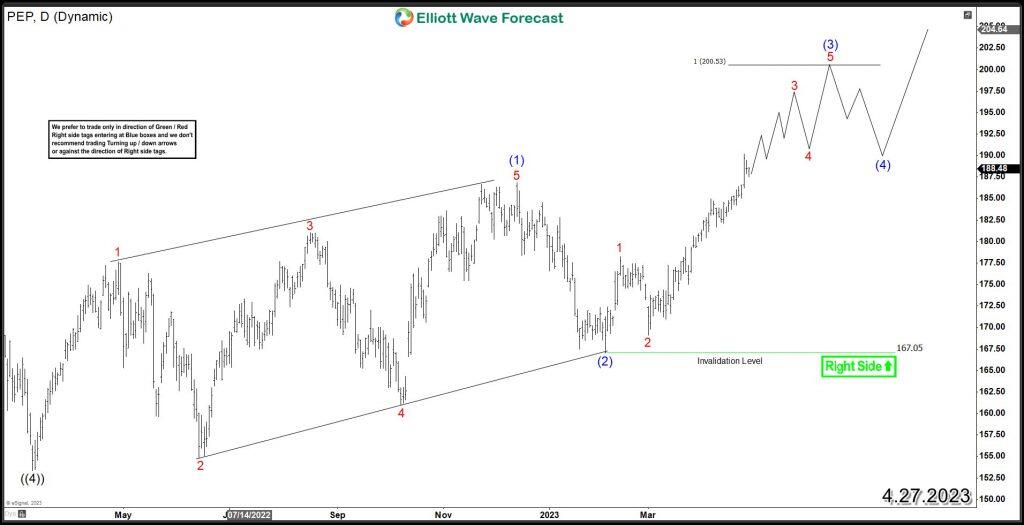
The recent surge in PEP’s price, surpassing the peak of December 2022, successfully erased the RSI divergence in the daily charts. This event is crucial, as it indicates that the cycle from March 2020 will continue and confirms that the wave (3) cycle from March 2022 is still in progress.

The rally from March 2022 low unfolded as a leading diagonal in wave (1) at $186.84, followed by a pullback in wave (2) ended at $167.05. Ideally, the move higher  in wave (3) should target the 100% Fibonacci extension area at $200.53, followed by a potential 3-wave pullback before resuming the rally. Additionally, the 123.6% – 161.8% Fibonacci extension levels, located at $208 – $221, may come into play at a later stage of the cycle. In conclusion, PEP’s Elliott Wave patterns suggest that the stock is in a bullish sequence from March 2022 low, with the wave (3) in progress. Any pullbacks in 3, 7, or 11 swings should be seen as potential buying opportunities, as long as the stock remains supported above the wave (2) low of $167.05.

PEP Elliott Wave daily chart
PEP

Author

Elliott Wave Forecast Team

Elliott Wave Forecast Team

ElliottWave-Forecast.com

More from Elliott Wave Forecast Team
Share:

Editor's Picks

AUD/USD holds above 0.7000 ahead of FOMC policy meeting

AUD/USD attracts some dip-buyers near 0.7000 during the Asian session on Tuesday, stalling the previous day's pullback from a one-month high as bets for a November RBA rate hike continue to act as a tailwind for the Aussie. Meanwhile, the US Dollar consolidates gains from the past two days ahead of the crucial two-day FOMC meeting starting later today, further supporting the currency pair.

USD/JPY consolidates above 157.50 as traders await Fed, BoJ meetings

USD/JPY trades above mid-157.00s during the Asian session on Tuesday, looking to build on its recovery from an over one-month low as speculation that the BoJ may hold off on aggressive rate hikes undermines the Japanese Yen. Meanwhile, the US Dollar sits near a one-week high, further supporting the currency pair. Bulls, however, seem hesitant ahead of Wednesday’s FOMC decision and the BoJ policy update on Friday.

Gold trades above $4,000 and a three-month low as focus remains on FOMC

Gold attracts fresh sellers during the Asian session on Tuesday, reversing part of the previous day's modest recovery from a three-month low. US bond yields rebound slightly after the recent decline to a three-week low, helping the US Dollar preserve its gains recorded over the past two days and weighing on the non-yielding bullion. The commodity, however, holds above $4,000 as bears seem hesitant ahead of Wednesday’s FOMC rate decision.

Ethereum: BitMine continues buying as ETH slips below $2,355

Ethereum (ETH) treasury firm BitMine Immersion Technologies (BMNR) extended its buying streak of the top altcoin last week while expanding its share buybacks. The company said Monday that it acquired 10,452 ETH over the past week, continuing a buying streak that stretches to June 2025.

Everyone's bracing for a hawkish central bank week. Here's why the surprise could be dovish

Five of the world's major central banks are preparing to announce monetary policy decisions this week, with investors increasingly anticipating higher interest rates as the global energy shock continues to push inflation above target.

What November 3 means for the Fed's rate path and the US Dollar

The USD faces a decisive period ahead of the November 3 midterm elections. While markets anticipate another interest rate increase from the Fed in December, the battle for control of Congress could reshape fiscal policy expectations and, indirectly, the path of US monetary policy in 2027.