|

Palladium Price Analysis: XPD/USD retests $2,600 as oversold conditions rescue bulls

  • XPD/USD attempts a bounce amid stabilizing risk sentiment.
  • Oversold conditions on the 4H chart pause the sell-off in Palladium price.
  • Impending bear cross could threaten the upside attempts.
Palladium (XPD/USD) is seeing some fresh signs of life this Tuesday, snapping its five-day losing streak, as the risk sentiment holds steadier on the session.

The industrial metal got sold-off into the global rout after concerns over the economic recovery mounted amid spiking Delta covid cases globally.

The risk-off mood bolstered the safe-haven demand for the US dollar, which exacerbated the pain in the USD-denominated Palladium price.

Price of Palladium

From a short-term technical perspective, XPD/USD is licking its wounds, moving slightly away from monthly lows of $2,571, as it battles the $2,600 barrier.

The upturn in the price of Palladium comes on the back of oversold conditions seen in the Relative Strength Index (RSI) on the four-hour chart.

The leading indicator is languishing below 30.00, currently at 14.72, suggesting that a further pullback in price is inevitable.

On its road to recovery, Palladium price is likely to meet strong resistance at the $2,650 psychological level.

The downward-sloping 21-Simple Moving Average (SMA) at $2,695 will then challenge the bullish interests.

Palladium price chart: Daily
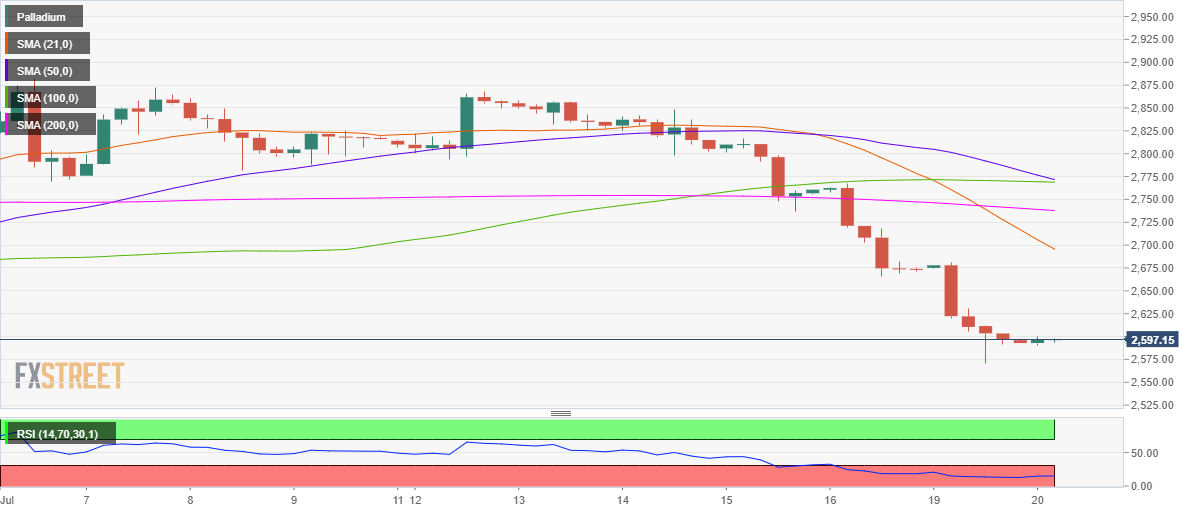
However, the bulls could face a hard time sustaining the recovery, as a bear cross looms on the said time frame, with the 50-SMA gearing up to cut the 100-SMA from above.

If the selling pressure re-ignites, a drop back towards the monthly lows cannot be ruled out.

Further south, the bears will then target the $2,550 support area.

Author

Dhwani Mehta

Dhwani Mehta

FXStreet

Residing in Mumbai (India), Dhwani is a Senior Analyst and Manager of the Asian session at FXStreet. She has over 10 years of experience in analyzing and covering the global financial markets, with specialization in Forex and commodities markets.


More from Dhwani Mehta
Share:

Editor's Picks

GBP/USD appears well offered near 1.3160

GBP/USD builds on Tuesday’s losses, although it now manages to pick up some pace and bounce off earlier multi-month troughs near 1.3140. The Greenback’s solid performance and continued political turmoil in the UK are keeping Cable under persistent pressure, with little sign of a meaningful recovery.

EUR/USD rebounds from lows, back to 1.1360

After bottoming out near 1.1320, EUR/USD gathers some traction and reclaims the 1.1350-1.1360 band as the NA session draws to a close on Wednesday. The pair’s drop to multi-month lows comes in response to the continuous leg higher in the US Dollar, which remains propped up by hawkish Fed expectations and uncertainty over the outcome of US-Iran peace negotiations.

Gold pressured near fresh 2026 lows

Gold accelerates its decline and gyrates around the key $4,000 mark per troy ounce on Wednesday, its lowest level since November 2025. In the meantime, tighter-for-longer Fed expectations and a broadly firmer US Dollar continue to weigh on the yellow metal, while uncertainty surrounding a potential US-Iran peace agreement has done little to revive demand for the safe haven space.

XRP nears key support as Fed hike risks suppress demand
Ripple (XRP) continues to face significant selling pressure, trading around $1.05 at the time of writing on Wednesday. This decline mirrors the broader weakness in the crypto market, exacerbated by mounting macroeconomic headwinds and persistent geopolitical uncertainties.
US-Iran talks: The next 60 days will decide where Oil prices go next
Oil markets received some encouraging news after weeks of rising tensions in the Middle East. But let’s not get ahead of ourselves: we’re far from victory, and markets just seem to have priced out the worst-case scenario. The US and Iran have reportedly made "substantive progress" in talks in Switzerland and agreed on a framework for working toward a broader deal within 60 days.
Regime change: Inside Kevin Warsh's first move to make the Fed unreadable on purpose

The rate did not move. That was the least interesting thing about Kevin Warsh's first meeting in charge of the Fed. The FOMC held its benchmark at 3.50%-3.75% for the fourth straight meeting, exactly as priced, and then the new chair used his first press conference to dismantle the machinery the market has leaned on for a decade.














