Oracle at its highest: Should you invest?

After years of playing catch-up in cloud computing, Oracle has found new life in the artificial intelligence boom. Long known for its dominance in relational database software, the 48-year-old company has reinvented itself as a serious cloud provider and a key infrastructure partner for AI developers, including OpenAI. Its technology now integrates with platforms run by Microsoft, Google, and Amazon, cementing Oracle’s place in the competitive cloud market.
That transformation is being rewarded on Wall Street. Yesterday, Oracle shares surged 36%—their best single-day gain since December 1992—adding an astonishing $244 billion to its market value. The rally vaulted Oracle into the ranks of the ten largest U.S. companies, with a market capitalization of $922 billion, edging closer to the $1 trillion milestone.
The momentum has not been confined to Oracle alone. The stock’s dramatic rise spilled over to the broader AI ecosystem, lifting suppliers such as Nvidia, Broadcom, AMD, Dell, Micron, CoreWeave, and TSMC. Their rally helped push the S&P 500 and Nasdaq Composite to fresh record highs.
High-rate environment, these tools provide tangible efficiency gains. The more customers adopt Oracle’s AI-driven cloud products, the more recurring revenue the company locks in, strengthening its long-term earnings profile.
From a market perspective, this AI integration is supporting Oracle’s share price because investors see two things: faster top-line growth in its cloud division and improved margins as automation reduces costs. In an environment where growth stocks are being judged on their ability to turn AI into real business value, Oracle is delivering, which helps explain the strong performance of its stock despite fierce competition.
Oracle’s Q1 2026 results: AI deals drive record backlog
Oracle’s latest earnings release gave investors a clearer picture of how much the AI wave is shaping its future. In Q1 2026, total revenue rose 12% year-on-year to $14.9 billion, with cloud revenue surging 28% to $7.2 billion. Software sales, by contrast, slipped 1% to $5.7 billion, underlining how the company’s legacy business is giving way to its cloud-first, AI-driven strategy. Net income came in at $2.93 billion, or $1.01 per share, roughly flat compared to last year.
The standout figure was Oracle’s remaining performance obligations (RPO), which ballooned more than 350% in just three months to $455 billion. RPO represents contracted revenue not yet recognized, and management claims that pipeline commitments will soon exceed $500 billion as more multibillion-dollar contracts are signed. Among the most striking wins was a $300 billion deal with OpenAI, starting in 2027, one of the largest cloud contracts ever inked in the industry.
This backlog highlights Oracle’s deepening foothold in the AI infrastructure market, with Chief Executive Safra Catz confirming four multibillion-dollar deals during the quarter and signaling that more are imminent. Such orders provide long-term visibility and suggest that Oracle could more than double its revenue base within three years if execution holds.
Are Oracle shares still a buy?
Oracle’s stock has been on a remarkable run in 2025, nearly doubling since January with a 95% gain, including a blistering 45% surge in just the past month. The rally reflects investors’ confidence that the company has carved out a rare and valuable position in the global AI race, winning massive cloud contracts and securing partnerships with some of the biggest names in technology.
Yet, this sharp ascent also raises questions about sustainability. Oracle is pouring billions into expanding its infrastructure, racing to secure scarce Nvidia GPUs, and navigating the complex power and permitting demands of large AI data centers. This strategy is a sharp break from its legacy model, when operating margins hovered near 50% on software alone. Now, investors must balance the potential for exponential revenue growth against thinner margins and heavy upfront costs.
At today’s valuation, much of the optimism rests on Oracle’s ability to execute flawlessly in an industry that evolves at breakneck speed. Contracts and commitments may signal a bright future, but only consistent delivery and cash flow conversion will determine whether the rally has further to run—or whether expectations have gotten ahead of reality.
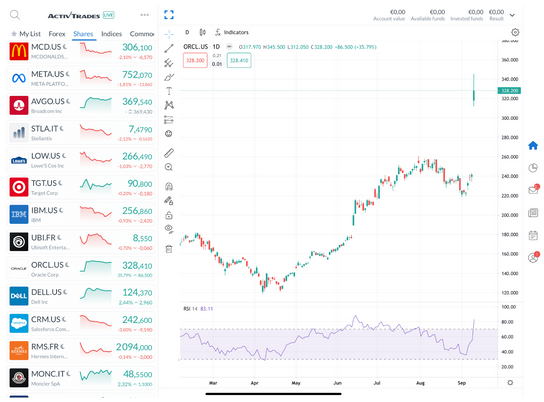
Daily Oracle Chart - Source: ActivTrader
How is Oracle benefiting from AI?
Artificial intelligence has become one of the most powerful investment themes driving equity markets, and Oracle has positioned itself as one of the beneficiaries of this trend. The company’s strength lies in the way AI is being woven into its cloud business, which has become a central growth engine and a key reason investors are re-rating its stock.
On the infrastructure side, Oracle Cloud Infrastructure (OCI) is attracting customers who need massive computing power to train and run AI models. The firm has secured access to Nvidia’s high-performance GPUs, the backbone of AI workloads, allowing it to compete more effectively with hyperscale rivals like Amazon, Microsoft, and Google. This combination of advanced hardware and scalable cloud services makes Oracle an increasingly credible option for enterprises looking to deploy AI at scale.
At the application level, Oracle has embedded generative AI and machine learning into its Fusion Cloud Applications, from HR to finance to supply chain management. These enhancements give clients real-time analytics, predictive insights, and automation that can cut costs and improve productivity. For companies under pressure to do more with less in a high-rate environment, these tools provide tangible efficiency gains. The more customers adopt Oracle’s AI-driven cloud products, the more recurring revenue the company locks in, strengthening its long-term earnings profile.
From a market perspective, this AI integration is supporting Oracle’s share price because investors see two things: faster top-line growth in its cloud division and improved margins as automation reduces costs. In an environment where growth stocks are being judged on their ability to turn AI into real business value, Oracle is delivering, which helps explain the strong performance of its stock despite fierce competition.
Oracle’s Q1 2026 results: AI deals drive record backlog
Oracle’s latest earnings release gave investors a clearer picture of how much the AI wave is shaping its future. In Q1 2026, total revenue rose 12% year-on-year to $14.9 billion, with cloud revenue surging 28% to $7.2 billion. Software sales, by contrast, slipped 1% to $5.7 billion, underlining how the company’s legacy business is giving way to its cloud-first, AI-driven strategy. Net income came in at $2.93 billion, or $1.01 per share, roughly flat compared to last year.
The standout figure was Oracle’s remaining performance obligations (RPO), which ballooned more than 350% in just three months to $455 billion. RPO represents contracted revenue not yet recognized, and management claims that pipeline commitments will soon exceed $500 billion as more multibillion-dollar contracts are signed. Among the most striking wins was a $300 billion deal with OpenAI, starting in 2027, one of the largest cloud contracts ever inked in the industry.
This backlog highlights Oracle’s deepening foothold in the AI infrastructure market, with Chief Executive Safra Catz confirming four multibillion-dollar deals during the quarter and signaling that more are imminent. Such orders provide long-term visibility and suggest that Oracle could more than double its revenue base within three years if execution holds.
Are Oracle shares still a buy?
Oracle’s stock has been on a remarkable run in 2025, nearly doubling since January with a 95% gain, including a blistering 45% surge in just the past month. The rally reflects investors’ confidence that the company has carved out a rare and valuable position in the global AI race, winning massive cloud contracts and securing partnerships with some of the biggest names in technology.
Yet, this sharp ascent also raises questions about sustainability. Oracle is pouring billions into expanding its infrastructure, racing to secure scarce Nvidia GPUs, and navigating the complex power and permitting demands of large AI data centers. This strategy is a sharp break from its legacy model, when operating margins hovered near 50% on software alone. Now, investors must balance the potential for exponential revenue growth against thinner margins and heavy upfront costs.
At today’s valuation, much of the optimism rests on Oracle’s ability to execute flawlessly in an industry that evolves at breakneck speed. Contracts and commitments may signal a bright future, but only consistent delivery and cash flow conversion will determine whether the rally has further to run—or whether expectations have gotten ahead of reality.
Stay up to date with what's moving and shaking on the world's markets and never miss another important headline again! Check ActivTrades daily news and analyses here.
Stay up to date with what's moving and shaking on the world's markets and never miss another important headline again! Check ActivTrades daily news and analyses here.
Author
Carolane de Palmas
ActivTrades
Carolane graduated with a Masters in Corporate Finance & Financial Markets and got the AMF Certification (Financial Markets Regulator in France). Afterward, she became an independent trader, investing mostly in European and American stocks/indices.

















