|

OKLO’s AI nuclear hype meets a cold technical reality

Oklo Inc. (OKLO) has become a favorite for investors looking to play the intersection of advanced nuclear technology and the massive power demands of AI data centers. Their fast fission reactors are a compelling story, but the fundamental timeline remains a major hurdle. As of today, Oklo has zero operational plants. Furthermore, management doesn't expect to have a plant online until late 2027 or early 2028. This leaves the company with a multi-year gap where no continuous revenue is being generated, making the stock highly sensitive to technical shifts and market sentiment.

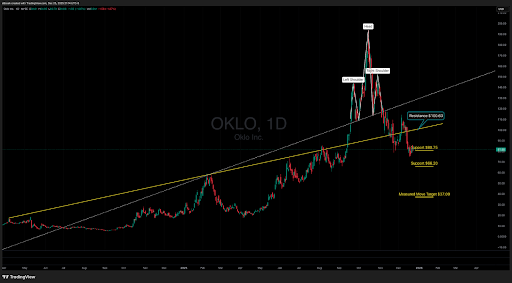
When we look at the daily chart, the technical picture is flashing warning signs. From September through early November, OKLO carved out a clear head and shoulders pattern. This bearish formation has already triggered, and based on the height of the pattern, it carries a measured move target of $37.09.

Since the end of November, price action has been fighting to hold support at the $80.75 level. It has bounced off this area several times, but each attempt looks weaker than the last. If this $80.75 level gives way, the selling pressure will likely accelerate. The next support sits at $66.20, with the ultimate target being that $37.09 measured move.

On the upside, any relief rallies will be met with heavy selling pressure. There is stiff resistance waiting at $100.63. This level is marked by an inclining trendline that stretches back to April 2024, and until OKLO can reclaim that line, the path of least resistance remains to the downside.
Author

Drew Dosek

Drew Dosek

Verified Investing

Passionate technical and cycle analyst committed to empowering traders through data-driven insights.


More from Drew Dosek
Share:

Editor's Picks

AUD/USD keeps range near mid-0.7100s as USD bulls await US CPI

AUD/USD steadies near mid-0.7100s in the Asian session on Friday, stalling the previous day's sharp decline to an over one-week low. The August PPI report reaffirmed Fed rate-hike bets and boosted the US Dollar on Thursday, which weighed heavily on the pair. However, hawkish RBA expectations limited losses for the Aussie as USD bulls now await the release of the US consumer inflation figures before placing fresh bets.

USD/JPY holds lower ground toward 154.00; looks to US CPI

USD/JPY holds lower ground toward 154.00 in the Asian session on Friday after hot Japanese PPI data bolster a more hawkish BoJ repricing and provide fresh impetus to the Japanese Yen. However, the downside appears capped as the US Dollar preserves overnight gains ahead of the latest US consumer inflation data.

Gold moves away from one-week low, climbs above $4,450 as USD edges lower ahead of CPI

Gold builds on its modest intraday recovery from the $4,300 neighborhood, or a one-and-a-half-week low, touched earlier this Friday, and climbs above $4,350 heading into the European session. The upside potential, however, seems limited as traders opt to wait for the release of US consumer inflation figures before placing directional bets.

Cardano approaches critical support as correction risks grow
Cardano (ADA) recovers slightly, trading at $0.206 at the time of writing on Friday, inches above the critical support zone after losing more than 6% so far this week. Weakening derivatives data and fading bullish momentum suggest a bearish near-term outlook, with a decisive close below the support zone potentially triggering a deeper correction for ADA.
US core CPI data set to ease in August as markets reprice Fed September rate decision

The US Bureau of Labor Statistics will publish the August Consumer Price Index data on Friday. The report is expected to show a small decline in annual core inflation. Any divergence from analysts’ estimates could influence the Federal Reserve’s policy outlook and impact the US Dollar’s valuation.

Venezuela’s 65-billion-barrel Oil deal could reshape America’s inflation fight
The United States (US) has secured unprecedented access to part of Venezuela’s vast Oil reserves. The timing is particularly significant as the war with Iran is disrupting Middle Eastern supplies, keeping energy prices elevated and reviving concerns about inflation.