Oil services: Who will lead the rebound?

The results from oil services companies like Baker Hughes (NYSE: BKR), Haliburton (NYSE: HAL), and Schlumberger (NYSE: SLB) were mixed to be sure but there is one common thread among them. The outlook for spending on oil-field services remains strong and supportive of a multi-year upcycle for the industry. Even Baker Hughes, which gave the weakest report in the Q2 cycle, is forecasting an increase in spending that will support not only revenue and earnings but healthy dividend payments as well.
“On the other hand, due to years of underinvestment globally and the potential need to replace Russian barrels, broader supply constraints can realistically keep commodity prices at elevated levels even in a scenario of moderate demand destruction. As a result, we believe the outlook for oil prices remains volatile, but still supportive of strong activity levels as higher spending is required to re-order the global energy map and likely offsets demand destruction in most recessionary scenarios,” says Baker Hughes chairman and CEO Lorenzo Simonelli.
Dividend increases will drive oil services stocks higher
Baker Hughes has the best dividend yield of the three stocks in question but there are some caveats to be aware of. The stock is yielding about 2.85% with shares near $24.75 but the payout ratio is a high 72% of the FY consensus estimate and the outlook for growth is far dimmer than for Haliburton and Schlumberger. The difference is that Baker Hughes did not cut its dividend during the pandemic like the others and the others are in a very good position to increase their payouts over the next few years if not few quarters. Not only is business accelerating but the payout metrics are already favorable to increases at 22% for HAL and 35% for SLB. The difference between them is a distribution increase to the prepandemic levels would equal 35% for the former and nearly 200% for the latter.
"In North America, I expect Halliburton to uniquely maximize value in this strong, steadily growing, and all but sold-out market," said CEO Jeff Miller in the Q2 press release. "Pricing gains across all product service lines supported significant sequential margin expansion.”
Schlumberger CEO Olivier Le Peuch said “The second quarter marked a significant inflection point for Schlumberger with a strong acceleration of revenue and earnings growth … Growth was broad-based, driven by an increase in activity internationally, in North America, and across all Divisions. The quarter was also characterized by a favorable mix of exploration and offshore activity and the increasing impact of improved pricing, resulting in the largest sequential quarterly growth since 2010.
There’s value in the oil services sector, too
The oil services stocks are a bit highly-valued relative to the broad market but these stocks are facing an expansionary period versus gloom-and-doom for the broader market so there is a reason. Within that, Baker Hughes is the most highly valued of them all trading at 25X this year’s consensus estimate and 15X next year’s. Schlumberger, however, trades at a much lower 18X this year’s earnings and 11X next year’s while Haliburton is trading at an even lower 14X and 11X its earnings.
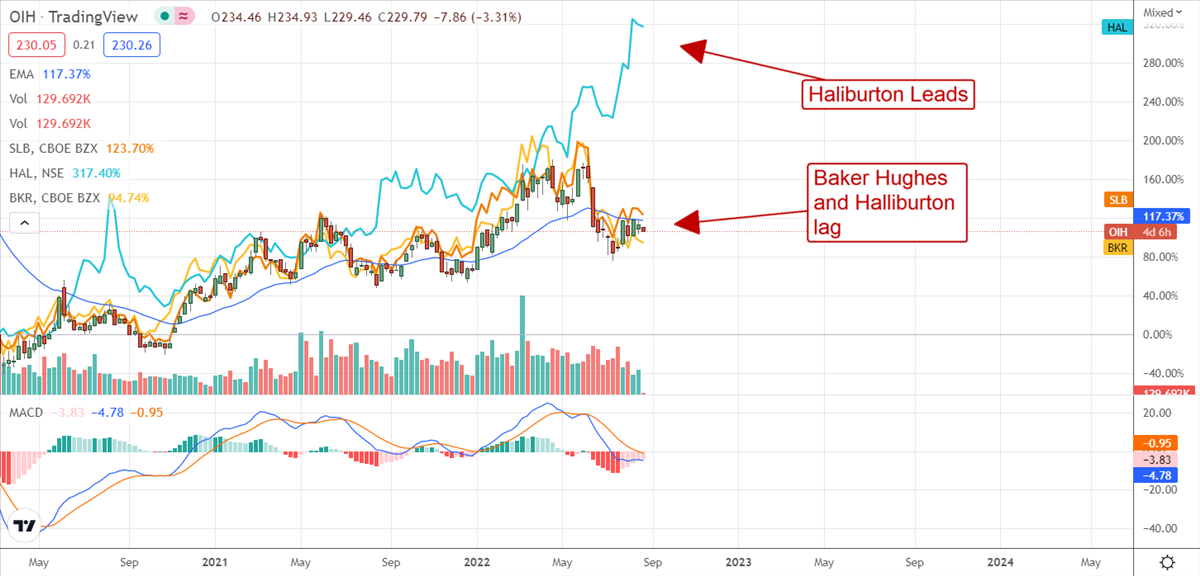
Turning to the chart, all three companies are at least performing in line with the Van Eck Oil Services ETF (NYSEARCA:OIH) but Haliburton is clearly outperforming the group. Haliburton is up more than 300% since the pandemic bottom and is outperforming the OIH ETF by more than 200%. While it looks like Haliburton may continue to lead the group, on a pair-trade basis it looks like one of the others is a better choice for new investments at this time.
Author

Jacob Wolinsky
ValueWalk
Jacob Wolinsky is the founder of ValueWalk, a popular investment site. Prior to founding ValueWalk, Jacob worked as an equity analyst for value research firm and as a freelance writer. He lives in Passaic New Jersey with his wife and four children.