NZD/USD stops the bleeding, still vulnerable below 0.6000
- NZD/USD trades flat near 0.5930 after a consecutive week of losses.
- US Treasury yields are edging higher after hawkish FOMC minutes.
- Governor Orr from the RBNZ commented that a mild recession is needed.


On Thursday, the NZD/USD traded with mild losses near 0.5930. On the one hand, the US reported Jobless Claims data from the second week of August and seemed to get traction on the back of higher US yields after the release of the Federal Open Market Committee (FOMC) minutes from the July meeting. On the other hand, the NZD trades weak against most of its rivals amid the spooky outlook given by the Reserve Bank of New Zealand’s Governor.
On the data front, Jobless Claims for the second week of August came in lower than expected at 239,000 vs the 240,000 expected and lower from the previous weekly reading of 250,000. In addition, the Philadelphia Federal Reserve’s (Fed) manufacturing index came in higher than expected at 12 vs the expectations of -10.
What is driving to the upside, the USD is the US 10-year bond yield rising to its highest level since October 2022 at 4.28% while the other othe shorter-term yields stand at monthly highs with the 2 and 5-year rates at 4.95% and 4.40%, respectively. This could be attributed to higher tightening expectations for the Fed as the US economy holds firm, and the Federal Open Market Committee (FOMC) minutes from the July meeting showed that members were concerned with the upside risks of inflation and left the door open to another hike.
On the Kiwi’s side, the RBNZ held rates on Wednesday at 5.5%, as expected. Regarding forward guidance, the statement mentioned that the decisions would be data-driven and seem to have left the door open to another hike if inflation resurges. On the negative side, Governor Orr commented that a mild recession “is the bare minimum we need to see” to bring back inflation to target. In that sense, this negative outlook seems to be weighing on the NZD.
NZD/USD Levels to watch
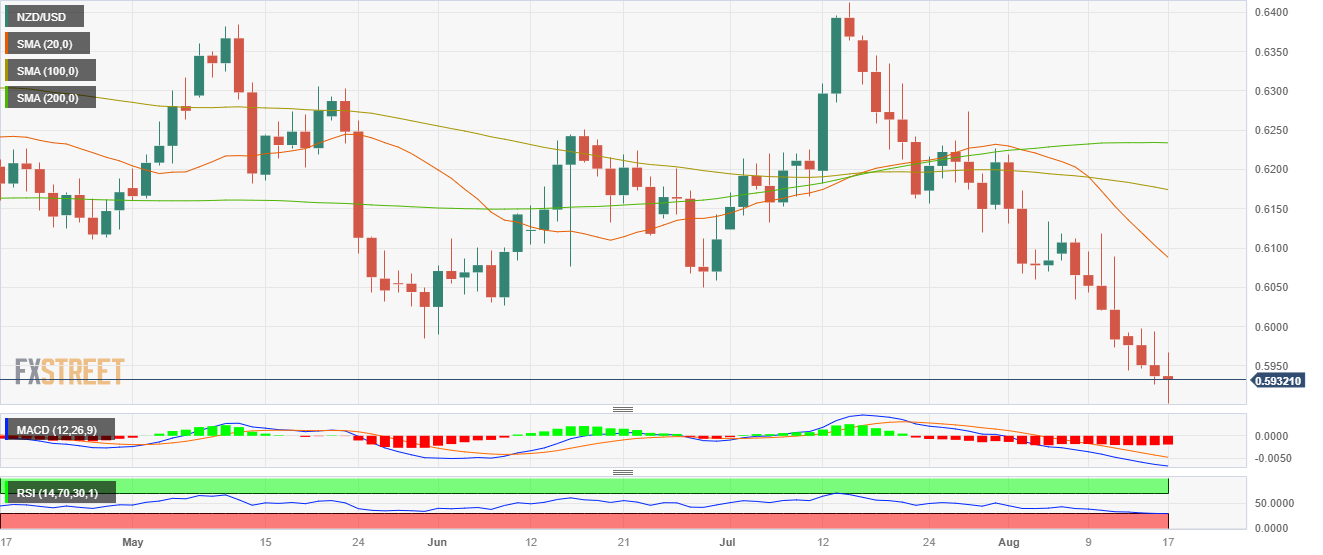
The current technical outlook for NZD/USD is bearish but as indicators are in oversold territory, it suggests a potential short-term technical recovery is on the horizon as buying pressure might increase. Exhibiting a pronounced downward trend below its midline, the Relative Strength Index (RSI) points to significant oversold conditions, while the Moving Average Convergence (MACD) histogram exhibits rising red bars. Also, the pair is below the 20,100 and 200-day Simple Moving Averages (SMAs), suggesting that the bears are firmly in control of the bigger picture. Additionally, the four-hour chart displays bearish indicators, highlighting a solid selling momentum and a clear bear dominance over the buyers.
Support levels: 0.5930, 0.5910, 0.5900.
Resistance levels: 0.6000, 0.6020, 0.6050.
NZD/USD Daily chart
Author
Patricio Martín
FXStreet
Patricio is an economist from Argentina passionate about global finance and understanding the daily movements of the markets.