NZD/USD Price Forecast: Trades cautiously around 0.6000
- NZD/USD wobbles inside Thursday’s trading range around 0.6000 as investors seeks clarity on US-Iran tensions.
- The White House signaled on Thursday that it has no plans to strike Iran in coming days.
- The PBoC left its one-year and five-year LPRs steady at their current levels.

The NZD/USD pair trades in a limited range near the psychological level of 0.6000 during European trading hours on Friday. The Kiwi pair consolidates as investors seek clarity on the next action by the United States (US) on Iran.
On Thursday, the comments from the White House signaled that Washington has no plans to involve in the Israel-Iran war directly and will decide about that in next two weeks. This has increased the risk-appetite of investors, potentially increasing demand for riskier assets, such as the New Zealand Dollar (NZD).
Apparently, the safe-haven demand of the US Dollar (USD) has diminished, which has sent the US Dollar Index (DXY) lower to 98.60 from the weekly high of 99.15 posted on Thursday.
Meanwhile, the People’s Bank of China (PBoC) has held its interest rates unchanged, as expected, in the policy meeting earlier in the day. The PBoC kept the one-year and five-year loan prime rate (LPR) at 3.00% and 3.50%, respectively. The PBoC guided that it is committed to liquidity injections rather than additional rate cuts to protect banks’ net interest margins, Reuters reported.
Monetary policy decisions from the PBoC impacts the New Zealand Dollar significantly, given that the New Zealand (NZ) economy relies heavily on its exports to China.
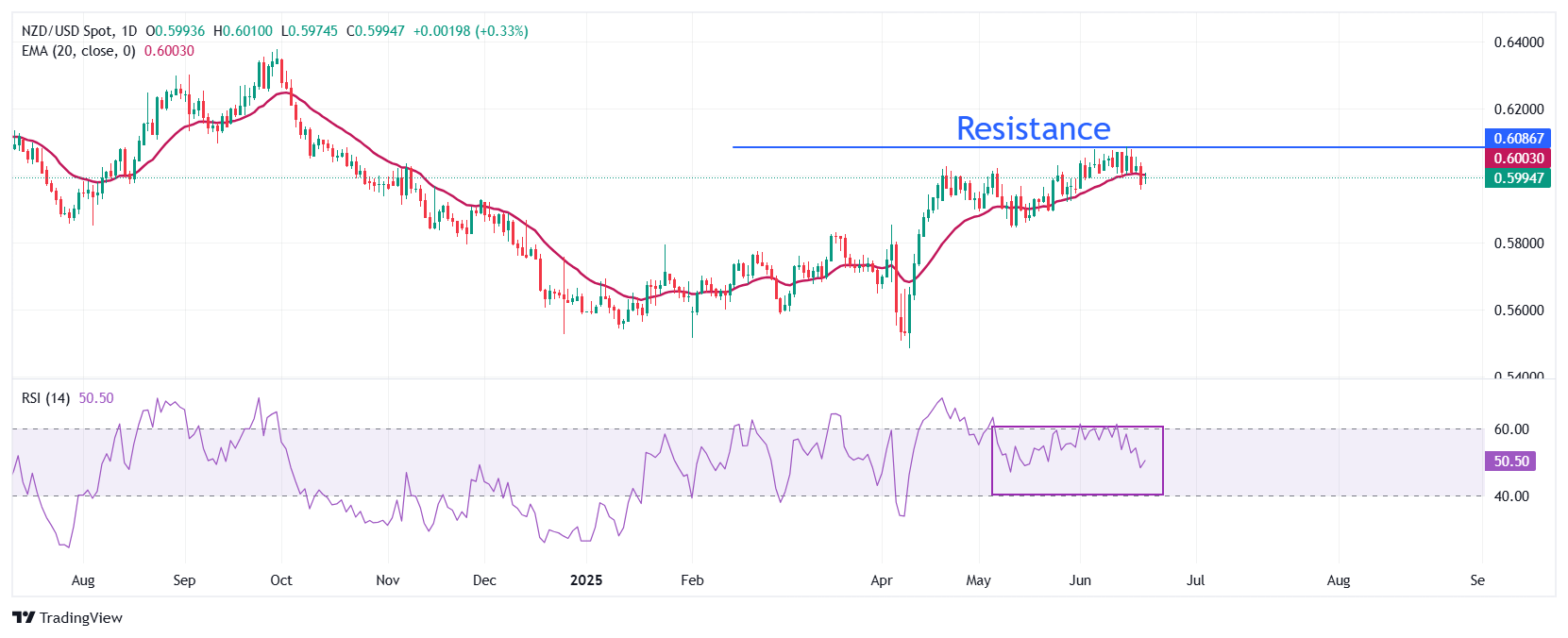
NZD/USD oscillates well inside the Thursday’s trading range, exhibiting a volatility contraction. The Kiwi pair wobbles around the 20-day Exponential Moving Average (EMA) near 0.6003, indicating a sideways trend.
The 14-day Relative Strength Index (RSI) oscillates inside the 40.00-60.00 range, suggesting indecisiveness among investors.
The Kiwi pair is expected to rise towards the September 11 low of 0.6100 and the October 9 high of 0.6145 if it manages to break above the June 19 high of 0.6040.
In an alternate scenario, a downside move below the May 12 low of 0.5846 will expose it to the round-level support of 0.5800, followed by the April 10 high of 0.5767.
NZD/USD daily chart
New Zealand Dollar FAQs
The New Zealand Dollar (NZD), also known as the Kiwi, is a well-known traded currency among investors. Its value is broadly determined by the health of the New Zealand economy and the country’s central bank policy. Still, there are some unique particularities that also can make NZD move. The performance of the Chinese economy tends to move the Kiwi because China is New Zealand’s biggest trading partner. Bad news for the Chinese economy likely means less New Zealand exports to the country, hitting the economy and thus its currency. Another factor moving NZD is dairy prices as the dairy industry is New Zealand’s main export. High dairy prices boost export income, contributing positively to the economy and thus to the NZD.
The Reserve Bank of New Zealand (RBNZ) aims to achieve and maintain an inflation rate between 1% and 3% over the medium term, with a focus to keep it near the 2% mid-point. To this end, the bank sets an appropriate level of interest rates. When inflation is too high, the RBNZ will increase interest rates to cool the economy, but the move will also make bond yields higher, increasing investors’ appeal to invest in the country and thus boosting NZD. On the contrary, lower interest rates tend to weaken NZD. The so-called rate differential, or how rates in New Zealand are or are expected to be compared to the ones set by the US Federal Reserve, can also play a key role in moving the NZD/USD pair.
Macroeconomic data releases in New Zealand are key to assess the state of the economy and can impact the New Zealand Dollar’s (NZD) valuation. A strong economy, based on high economic growth, low unemployment and high confidence is good for NZD. High economic growth attracts foreign investment and may encourage the Reserve Bank of New Zealand to increase interest rates, if this economic strength comes together with elevated inflation. Conversely, if economic data is weak, NZD is likely to depreciate.
The New Zealand Dollar (NZD) tends to strengthen during risk-on periods, or when investors perceive that broader market risks are low and are optimistic about growth. This tends to lead to a more favorable outlook for commodities and so-called ‘commodity currencies’ such as the Kiwi. Conversely, NZD tends to weaken at times of market turbulence or economic uncertainty as investors tend to sell higher-risk assets and flee to the more-stable safe havens.
Author

Sagar Dua
FXStreet
Sagar Dua is associated with the financial markets from his college days. Along with pursuing post-graduation in Commerce in 2014, he started his markets training with chart analysis.