NZD/USD Price Forecast: Struggles near 0.5820, below 200-day on RBNZ's dovish stance
- NZD/USD remains depressed on the back of the RBNZ’s dovish rate cut on Wednesday.
- Reduced bets for a jumbo Fed rate cut underpin the USD and further weigh on the pair.
- The technical setup favors bears and backs the case for a further depreciating move.

The NZD/USD pair touches a fresh low since April 14, around the 0.5815 region, during the Asian session on Thursday and looks to extend the previous day's dovish Reserve Bank of New Zealand (RBNZ) inspired slump.
In fact, the RBNZ stated that if medium-term inflation pressures continue to ease in line with the projection, the Committee expects to lower the interest rates further. This, along with a cautious market mood, continues to undermine the risk-sensitive Kiwi. The US Dollar (USD), on the other hand, holds steady near its highest level in more than one week amid reduced bets for a more aggressive policy easing by the Federal Reserve (Fed) and further weighs on the NZD/USD pair.
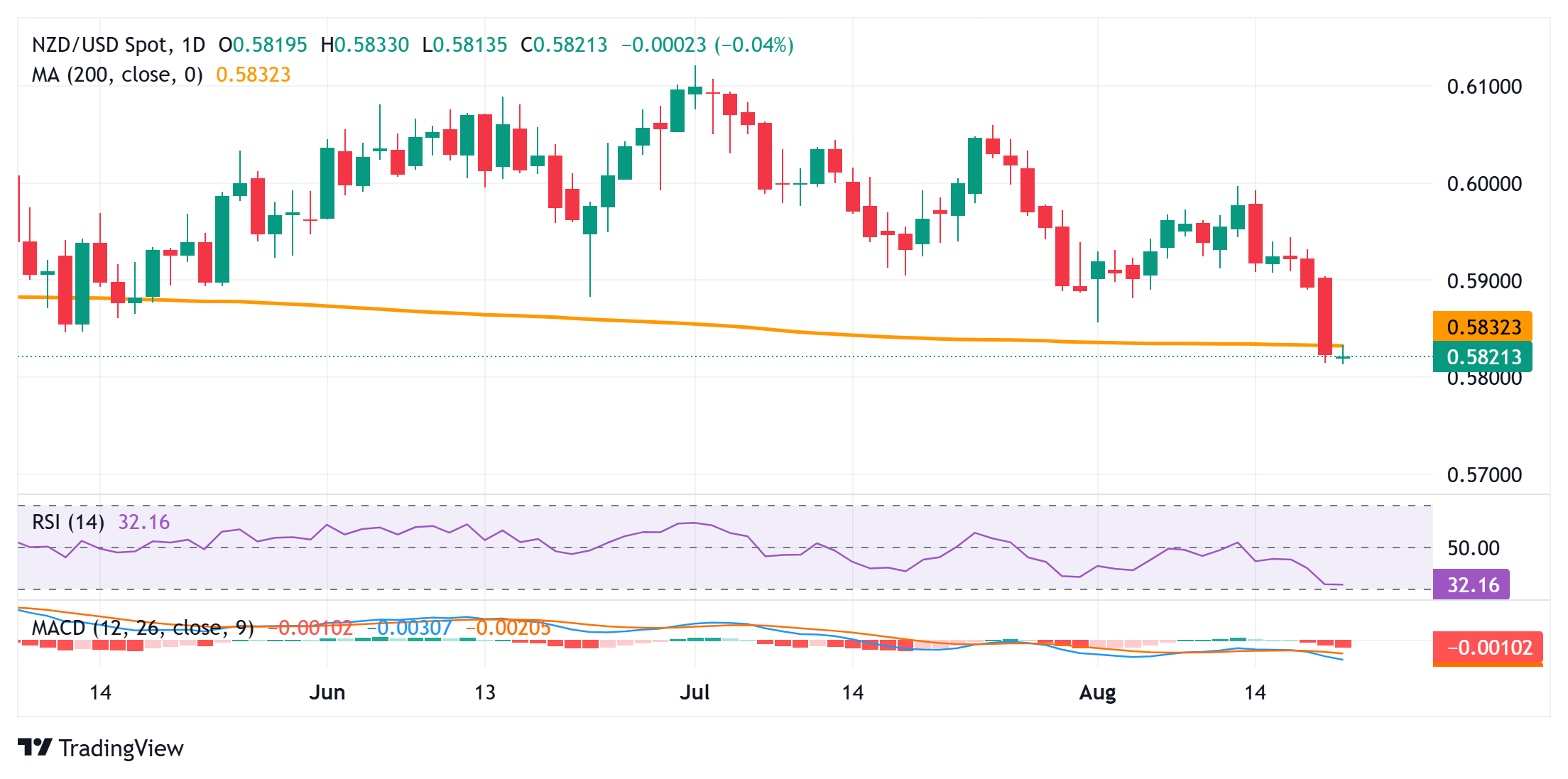
From a technical perspective, the overnight breakdown and a close below the very important 200-day Simple Moving Average (SMA) – for the first time since mid-May – was seen as a key trigger for bearish traders. Adding to this, negative oscillators on the daily chart suggest that the path of least resistance for the NZD/USD pair is to the downside. That said, the daily Relative Strength Index (RSI) has moved on the verge of breaking into the oversold zone and warrants caution.
Hence, it will be prudent to wait for some near-term consolidation or a modest bounce before positioning for the next leg of a directional move. However, any attempted recovery beyond the 0.5835 region, or the 200-day SMA, could be seen as a selling opportunity and runs the risk of fizzling out rather quickly near the 0.5880-0.5885 area. This is followed by the 0.5900 mark, which, if cleared decisively, should pave the way for some meaningful recovery in the near term.
On the flip side, weakness below the 0.5800 mark will reaffirm the negative outlook and make the NZD/USD pair vulnerable to accelerate the fall towards the next relevant support near the 0.5765-0.5760 area. The downward trajectory could extend further towards the 0.6730-0.6725 congestion zone before spot prices weaken below the 0.5700 mark, towards testing the 0.5675 support zone.
Author

Haresh Menghani
FXStreet
Haresh Menghani is a detail-oriented professional with 10+ years of extensive experience in analysing the global financial markets.


![How Wall Street rigs the game [Video]](https://editorial.fxsstatic.com/images/i/market-chaos-01.jpg)