|

NZD/USD Price Analysis: Pair trades steady near 0.5900 with bullish bias ahead of Asia

  • NZD/USD trades around the 0.5900 zone after a quiet Wednesday European session.
  • Mixed momentum signals but moving averages reinforce the bullish tone.
  • Support seen at 0.5930 and 0.5908; resistance stands at 0.5969.

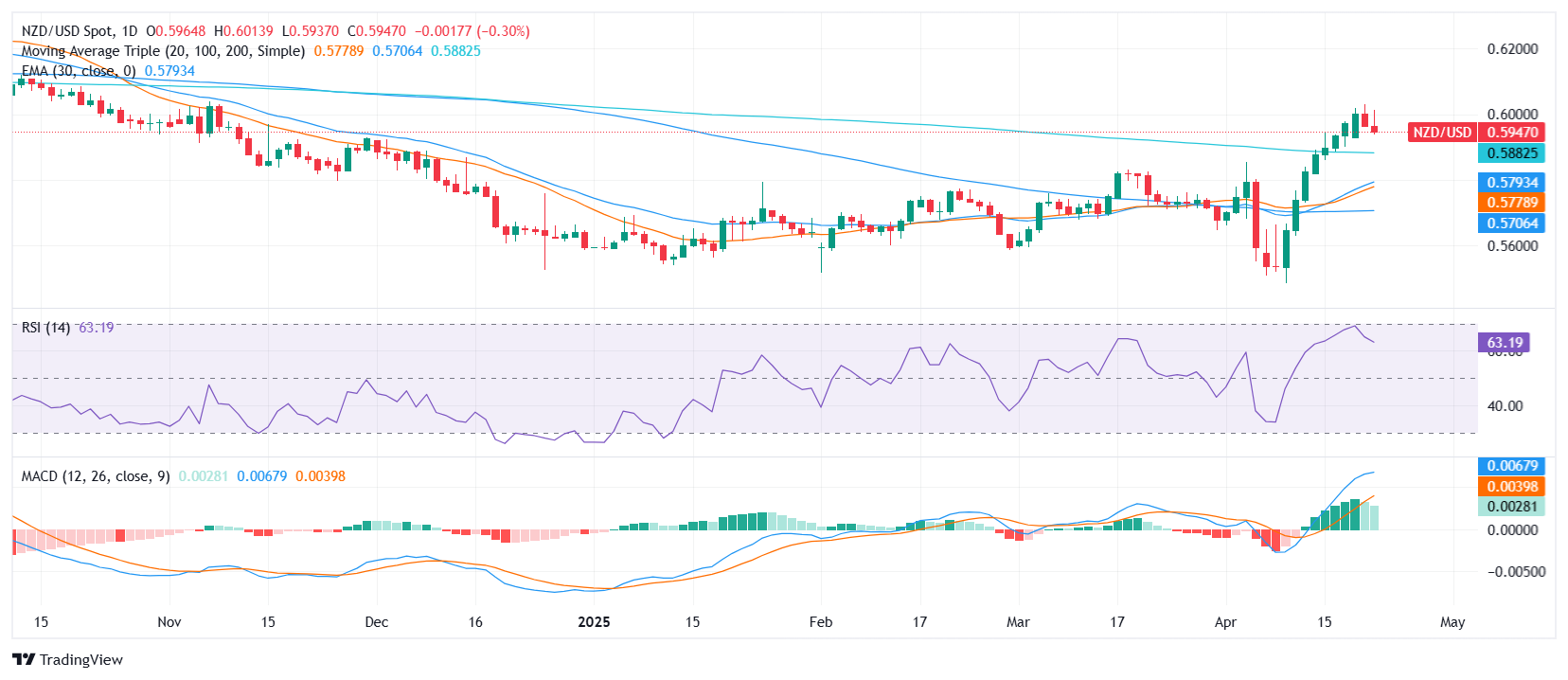
The NZDUSD pair held steady near the 0.5900 mark on Wednesday, posting a marginal daily gain as traders positioned ahead of the Asian session. The pair continues to consolidate in a tight range after recent upward momentum, suggesting a pause rather than a reversal.

From a technical standpoint, the outlook remains broadly constructive. The Moving Average Convergence Divergence (MACD) indicates a buy signal, while the Relative Strength Index hovers around 62, signaling neutral momentum. Meanwhile, the Average Directional Index near 26 highlights a modest trend strength without strong conviction. On the downside, the Stochastic RSI Fast suggests overbought conditions and flashes a mild sell signal.

Despite the mixed short-term oscillators, the moving average setup is clearly bullish. The 20-day simple moving average at 0.5800, alongside the 100-day and 200-day SMAs at 0.5713 and 0.5886 respectively, all point upward. Additional short-term support is backed by the 10-day EMA at 0.5908 and the 10-day SMA at 0.5930.

Key support levels are aligned at 0.5930, 0.5908, and 0.5886. Resistance, meanwhile, is seen at 0.5969, which could cap further upside in the near term unless momentum builds decisively. For now, the pair trades within a tight band, retaining a bullish tilt as long as it holds above the 0.5880 area.

Daily chart
Author

Patricio Martín

Patricio is an economist from Argentina passionate about global finance and understanding the daily movements of the markets.


More from Patricio Martín
Share:

Editor's Picks

GBP/USD weakens below 1.3250 on UK political risks, BoE repricing

The GBP/USD pair trades in negative territory around 1.3245 during the early Asian trading hours on Wednesday. Traders await the UK political developments, focusing on potential leadership by Andy Burnham and adherence to existing fiscal rules. Bank of England Governor Andrew Bailey is set to speak later in the day. On Thursday, all eyes will be on the US jobs data for June.

EUR/USD declines to near 1.1400 as softer German inflation undercuts ECB hike bets

The EUR/USD pair loses momentum to near 1.1410 during the early Asian trading hours on Wednesday, pressured by receding bets for aggressive tightening by the European Central Bank (ECB). Traders will take more cues from the preliminary reading of the Harmonized Index of Consumer Prices from the Eurozone and US Manufacturing Purchasing Managers Index report, which are due later in the day.

Gold's path of least resistance remains to downside ahead of Warsh

Gold comes under renewed selling pressure early Wednesday and gives up $4,000 yet again. The US Dollar stands tall on surging USD/JPY, Mideast woes and hawkish Fed bets. Gold remains poised to crack November 2025 lows near $3,930 amid bearish technicals.

Bitcoin drops near $58K as ETF outflows surge, downside risks persist

Bitcoin could see a short-term relief from heavy selling pressure as quarter-end portfolio rebalancing could potentially revive spot BTC exchange-traded funds inflows, according to a K33 report on Tuesday.

Why a hawkish Bank of Japan could trigger the next Bitcoin sell-off

The Japanese Yen hits a 40-year low of 162.00 against the US Dollar, raising concerns about intervention or additional rate hikes by the Bank of Japan. BoJ may sell US Treasuries to buy back Yen, potentially pushing US bond yields higher and making Bitcoin less attractive to investors.

Kevin Warsh isn't expected to say much in Sintra: That's exactly why markets will listen

Financial markets could find an important catalyst in the enchanting, fairytale-like landscape of Sintra this week. The ECB Forum will, as it does every year, gather the crème de la crème of central banks. The new boss at the Fed, who has clearly said that the Fed should stop explaining everything, will need to talk – and traders should listen.