|

NZD/USD Price Analysis: Pair rises near 0.5700, but bearish pressure still dominates

  • NZD/USD trades near the 0.5700 zone after modest gains ahead of the Asian session.
  • Despite short-term buy signals, broader trend remains bearish due to pressure from key moving averages.
  • Support rests at 0.5692 while resistance lies around 0.5708–0.5718; 200-day SMA reinforces downside risks.

The NZD/USD pair showed modest bullish momentum on Tuesday’s session, climbing slightly and hovering around the 0.57 zone ahead of the Asian session. Despite the upside move, the broader setup remains bearish as the price continues to be capped by long-term moving averages and oscillators still suggest underlying weakness.

Daily chart
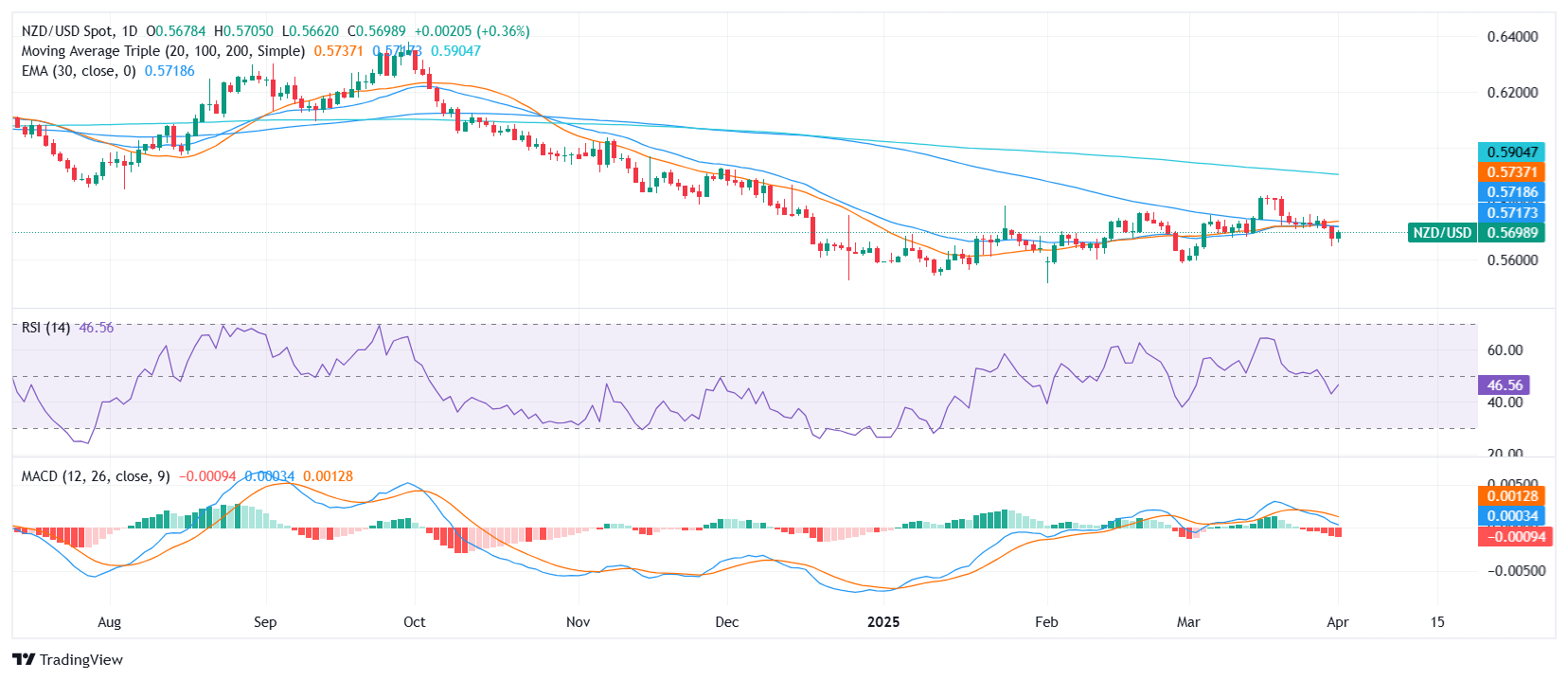
The standard 14-period RSI stands at 46.01, offering a neutral outlook, while the Awesome Oscillator shows a slight bearish bias, remaining below zero.

Bearish momentum is further highlighted by the behavior of key moving averages. The 20-day Simple Moving Average (SMA) at 0.5736, 100-day SMA at 0.5724, and 200-day SMA at 0.5910 all suggest selling pressure is dominant. The 10-day EMA at 0.5721 and 30-day SMA at 0.5733 confirm that the pair is currently trading below important resistance zones.

Immediate support is seen near 0.5692, with further downside targets around 0.5660 if sellers regain control. On the flip side, resistance is noted at 0.5700, followed by 0.5708 and 0.5718, where prior highs and moving averages converge. A sustained break above this area would be needed to shift the short-term bias toward the upside.

Author

Patricio Martín

Patricio is an economist from Argentina passionate about global finance and understanding the daily movements of the markets.


More from Patricio Martín
Share:

Markets move fast. We move first.

Orange Juice Newsletter brings you expert driven insights - not headlines. Every day on your inbox.

By subscribing you agree to our Terms and conditions.

Editor's Picks

EUR/USD gathers strength above 1.1750 as Fed rate cut prospects pressure US Dollar

The EUR/USD pair trades in positive territory around 1.1775 during the early Asian session on Monday. The prospect of a US Federal Reserve rate cut in 2026 weighs on the US Dollar against the Euro. Markets brace for US President Donald Trump to nominate a Fed chair to replace Jerome Powell, whose term ends in May. 

GBP/USD edges lower near 0.7400, eyes Fed rate cut outlook

GBP/USD edges lower after a gap-up open, trading around 0.7410 during the Asian hours on Monday. However, the pair may gain ground as the US Dollar faces challenges, which could be attributed to growing expectations of two more rate cuts by the Federal Reserve in 2026.

Gold retreats from record highs, heads toward $4,550

Gold retreats after setting a new record-high at $4,550 earlier in the Asian session on Monday and eases toward $4,500 as trading volumes thin out ahead of the New Year break. The US Dollar bearish bias remains unabated on the back of dovish Fed expectations, which continues to act as a tailwind for the bullion amid persistent geopolitical risks.

Ethereum Annual Price Forecast: ETH poised for growth in 2026 amid regulatory clarity and institutional adoption

Ethereum lost 12% of its value in 2025, declining from $3,336 at the beginning of the year to $2,930 as of the third week of December, a stark contrast from 2024's 48% gain. But that percentage doesn't do justice to the wild year ETH had in 2025.

Economic outlook 2026-2027 in advanced countries: Solidity test

After a year marked by global economic resilience and ending on a note of optimism, 2026 looks promising and could be a year of solid economic performance. In our baseline scenario, we expect most of the supportive factors at work in 2025 to continue to play a role in 2026.

Avalanche struggles near $12 as Grayscale files updated form for ETF

Avalanche trades close to $12 by press time on Wednesday, extending the nearly 2% drop from the previous day. Grayscale filed an updated form to convert its Avalanche-focused Trust into an ETF with the US Securities and Exchange Commission.