|

NZD/USD Price Analysis: Kiwi jumps to test critical resistance around 0.6620

  • Kiwi outperforming during the American session as USD tumbles and modest improvement in risk sentiment.
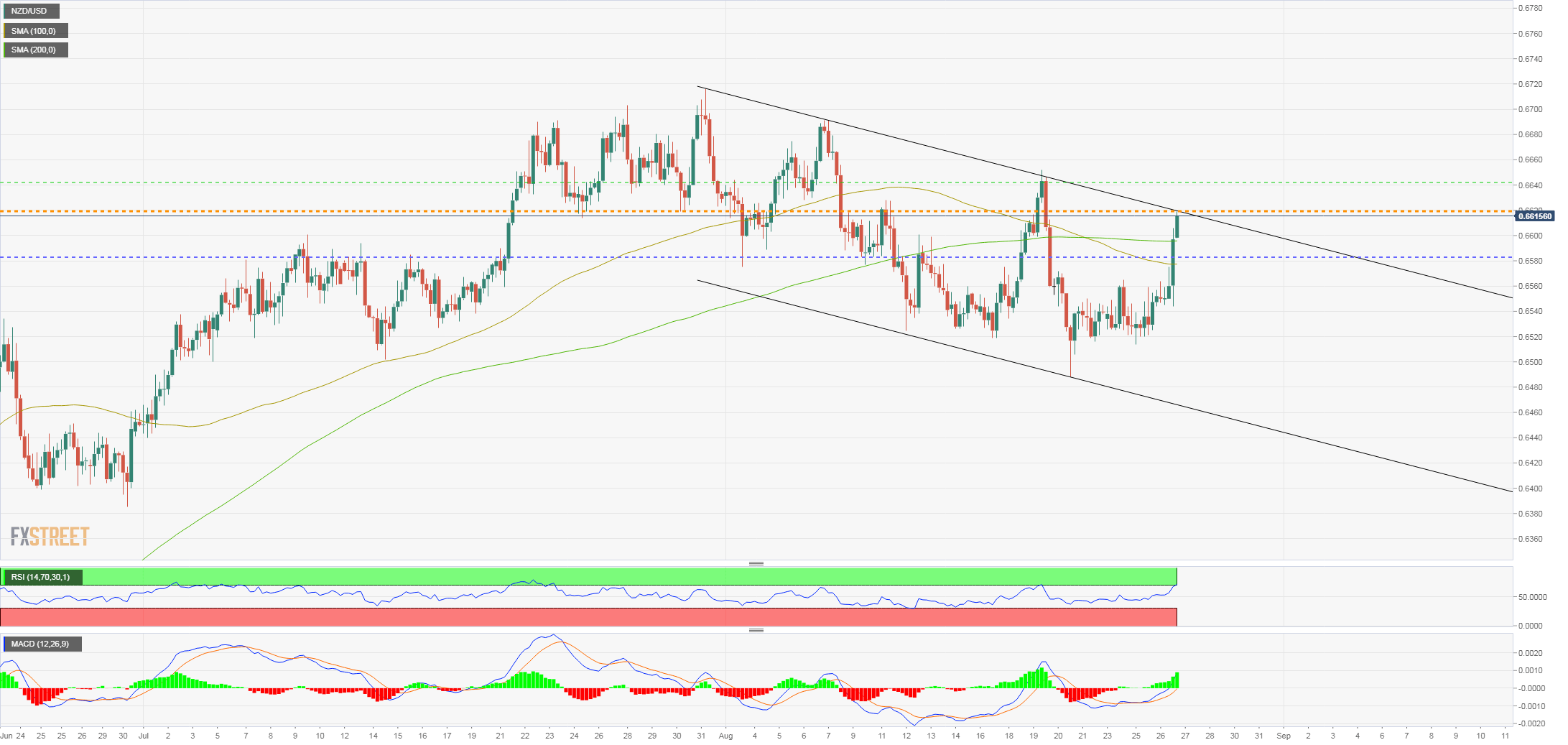
  • NZD/USD rises to the upper limited of a short-term descendant channel.

A weaker US dollar across the board boosted the NZD/USD pair that outperformed on the back of a stronger kiwi. The pair broke above the 0.6570 resistance, gaining more strength.

So far, NZD/USD peaked at 0.6619, the highest level in a week. It continues to trade around the 0.6615/20 area, a key short-term barrier that contains an horizontal resistance and the upper border of a descendant channel.

A consolidation above 0.6620 would point to more gains targeting 0.6640 and above the last week high at 0.6650. While if NZD/USD fails at the current level, the channel will remain in place, suggesting weakness ahead. The immediate support stands at 0.6595 followed by 0.6565.

NZD/USD 4-hour chart
nzdusd

NZD/USD

Overview
Today last price0.6611
Today Daily Change0.0063
Today Daily Change %0.96
Today daily open0.6548
 
Trends
Daily SMA200.6594
Daily SMA500.6557
Daily SMA1000.6358
Daily SMA2000.6374
 
Levels
Previous Daily High0.6559
Previous Daily Low0.6514
Previous Weekly High0.6652
Previous Weekly Low0.6488
Previous Monthly High0.6716
Previous Monthly Low0.644
Daily Fibonacci 38.2%0.6542
Daily Fibonacci 61.8%0.6531
Daily Pivot Point S10.6521
Daily Pivot Point S20.6495
Daily Pivot Point S30.6476
Daily Pivot Point R10.6566
Daily Pivot Point R20.6585
Daily Pivot Point R30.6611

Author

Matías Salord

Matías started in financial markets in 2008, after graduating in Economics. He was trained in chart analysis and then became an educator. He also studied Journalism. He started writing analyses for specialized websites before joining FXStreet.


More from Matías Salord
Share:

Editor's Picks

GBP/USD grinds higher to 1.3650 as USD recovery falters

GBP/USD grinds higher to near 1.3650 in Tuesday's European session. The US Dollar recovery falters, despite US sanctions on Iran, as hopes for diplomatic efforts creep back amid reports that Pakistan is carrying an offer to Iran to halt the siege and lift sanctions under the Memorandum of Understanding.

EUR/USD recovers toward 1.1700 as USD loses traction

EUR/USD is recovering ground toward 1.1700 in European trading on Tuesday. The pair draws support as the US Dollar rebound loses traction amid fresh diplomacy hopes in the Middle East conflict. An upbeat German IFO Survey also aids Euro bulls.

Gold remains depressed below $4,650 on firmer USD, Fed risks, and Middle East tensions

Gold remains on the back foot below $4,650 through the first half of the European session. However, the lack of follow-through selling warrants caution before positioning for an extension of the intraday retracement slide from the $4,700 neighborhood, or the highest level since May 14, touched earlier this Tuesday. The US Dollar is seen building on its recovery from a three-month low as inflation risks stemming from volatile energy prices keep bets for at least one interest rate hike by the US Federal Reserve on the table.

Bitcoin's rally above $80,000 shows signs of overheating 

Bitcoin extends gains, trading above $80,000 at the time of writing on Tuesday following its strongest weekly rise in more than three years. Institutional demand continues to support this rally, with spot Exchange Traded Funds recording positive inflows on Monday.

Iran and Fed outlook remain uncertain after Bessent’s comments and ahead of Jackson Hole

Asia Market Update: Directionless trading continues for a 2nd straight session; Iran and Fed outlook remain uncertain after Bessent’s comments and ahead of Jackson Hole; Oman’s Foreign Minister will visit Tehran to Tues, Pakistan commented on MOU.

$20 billion offered, $2 billion taken: Why Treasury doubled its buyback cap

The US Treasury moved off its own calendar on Wednesday, and that is the part worth sitting with. At 12:32 GMT, the department said it would at least double the size of liquidity support buyback operations in the 10-year to 20-year and 20-year to 30-year sectors, lifting the maximum from $2 billion per operation to at least $4 billion, effective September 9 and running to November 4.