|

NZD/USD Price Analysis: Forms bearish candlestick at top of range

  • NZD/USD has formed a bearish reversal candlestick at its range highs and declined. 
  • This suggests the possibility it could be about to move down towards the range lows. 
  • The pair may be entering a sideways trend with odds favoring an extension of the range. 

NZD/USD may be entering a sideways trend after touching the top of a multi-week range and rolling over. If it is in a sideways trend and given “the trend is your friend” it is more likely than not to continue oscillating within the confines of the range. 

NZD/USD surged to a high of 0.6248 on August 20 before falling back down just as rapidly. The swift change in price led to the formation of a bearish Gravestone Doji Japanese candlestick formation (circled) which was followed by a red candlestick in the subsequent period providing added bearish confirmation. Such a pattern signals a short-term reversal. 

NZD/USD 4-hour Chart 
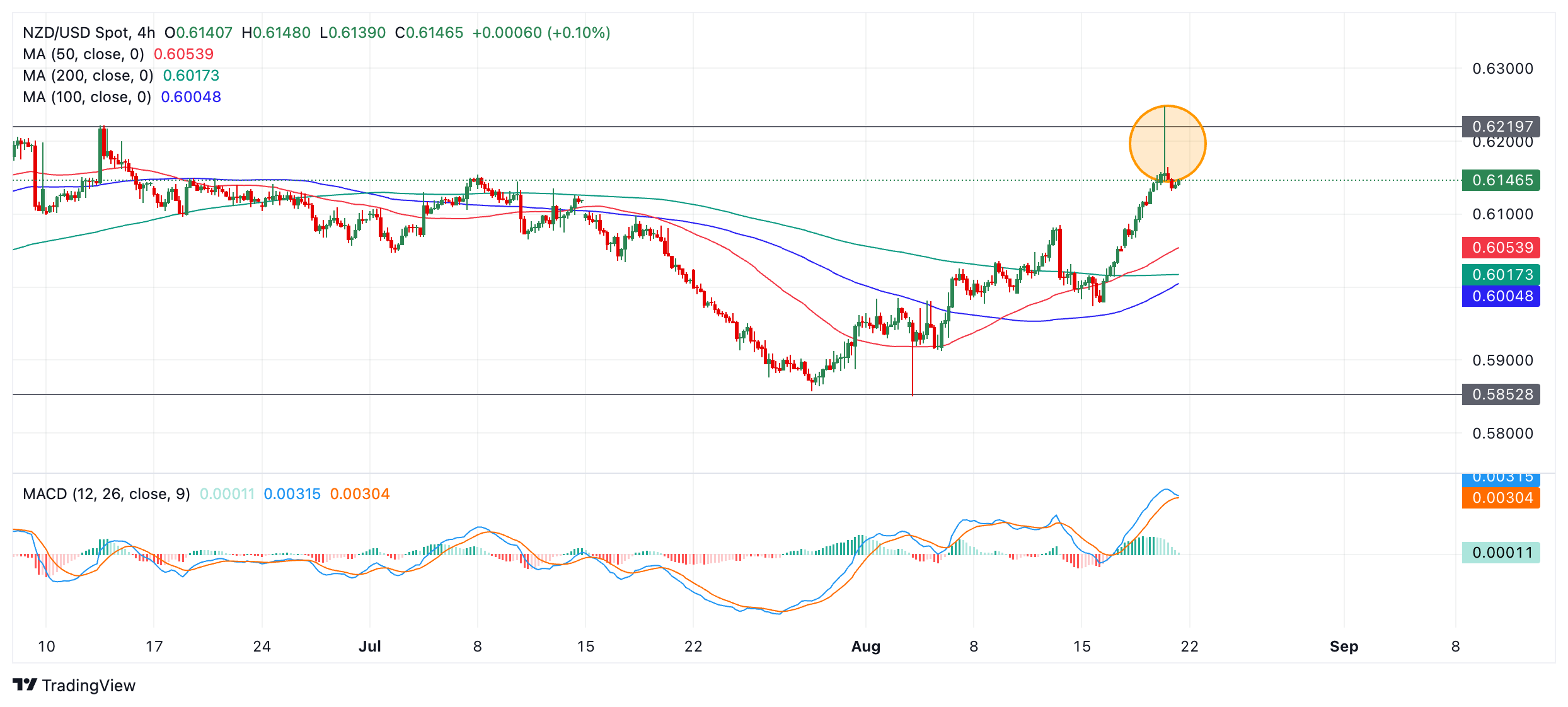


Forming as it did at the top of the range, the Gravestone Doji suggests a move back down towards the range lows of around 0.5852 is on the horizon. A close below 0.6130 would provide added confirmation of more downside. 

The Moving Average Convergence Divergence (MACD) line has nearly crossed below the red signal line. If it does – which looks likely – it will provide further bearish confirmation. 

Author

Joaquin Monfort

Joaquin Monfort is a financial writer and analyst with over 10 years experience writing about financial markets and alt data. He holds a degree in Anthropology from London University and a Diploma in Technical analysis.


More from Joaquin Monfort
Share:

Editor's Picks

AUD/USD remains above 0.7200 after China's trade data

AUD/USD sits above 0.7200 in the Asian session on Tuesday, near its highest level since May 14. The US Dollar stays under pressure as a rallying Japanese Yen outweighs support from hawkish Fed bets and geopolitical tensions. This, along with firming expectations for another RBA rate hike later this month, acts as a tailwind for the Aussie. However, mixed China trade balance data keep the pair restricted.

USD/JPY stabilizes at around 154.00 as markets assess BoJ outlook

USD/JPY fluctuates at around 154.00 in the American session on Tuesday after rebounding from the six-month low it touched below 153.00 earlier in the day. Nevertheless, the upside attempts resemble technical corrections for now as Japan's upbeat wage growth data and Q2 GDP revision cement bets on a BoJ rate hike next week and continue to support the Japanese Yen.

Gold holds around $4,400, but for how long?
Gold (XAU/USD) remains on the back foot during American trading hours on Tuesday, even as the US Dollar (USD) remains on the defensive. Rising Oil prices and expectations of a Federal Reserve (Fed) rate hike weigh on the precious metal. At the time of writing, XAU/USD trades around $4,400 after reaching an intraday high near $4,443.
Bitcoin remains highly sensitive to macro signals amid changing derivatives narrative
Bitcoin’s (BTC) sensitivity to US economic data has become increasingly evident this year. As the market approaches several important data dumps this week, BTC traders are keenly aware of the significance just like their counterparts in TradFi. And just like the stock market, crypto traders are focused squarely on the US central bank's interest rate policy.
Europe in focus: September 2026
Six major net contributors demanded substantial cuts to the European Commission’s proposed 2028–2034 EU budget. Germany, Denmark, the Netherlands, Austria, Finland and Sweden issued a joint position on 27 August calling for the nearly €2 trillion proposal to be reduced by several hundred billion euros and rejecting additional common EU borrowing.
Diesel’s record $100 warning: The oil shock hiding in plain sight

The Oil market may look calmer than it did a few months ago, but diesel is sending a very different message. The US diesel crack spread, the premium of ultra-low sulphur diesel futures over WTI, recently surged above $100 per barrel for the first time, reaching an intraday record of just over $102.00.















