|

NZD/USD Price Analysis: Bulls struggle with 20-day SMA resistance

  • NZD/USD loses momentum, gets rejected by the 20-day SMA.
  • Bulls struggle to claim control and get stuck in the 0.6070-0.6100 channel.
  • Indicators paint a neutral to bearish picture on the daily chart.

In Monday's trading session, the NZD/USD showed weakened momentum, declining by 0.60% to 0.6080. Buyers found the 20-day Simple Moving Average (SMA) at around 0.6100, a strong resistance that quickly rejected the bullish force.

Daily technical indicators reflect a cautionary scenario for bullish traders. The Relative Strength Index (RSI) is currently at 46, a decrease from above 50 levels and now placing it in negative zone. This dip represents a decrease in buying pressure. On the contrary, the Moving Average Convergence Divergence (MACD) presents flat red bars, suggesting a somewhat stagnant bearish momentum.

NZD/USD daily chart
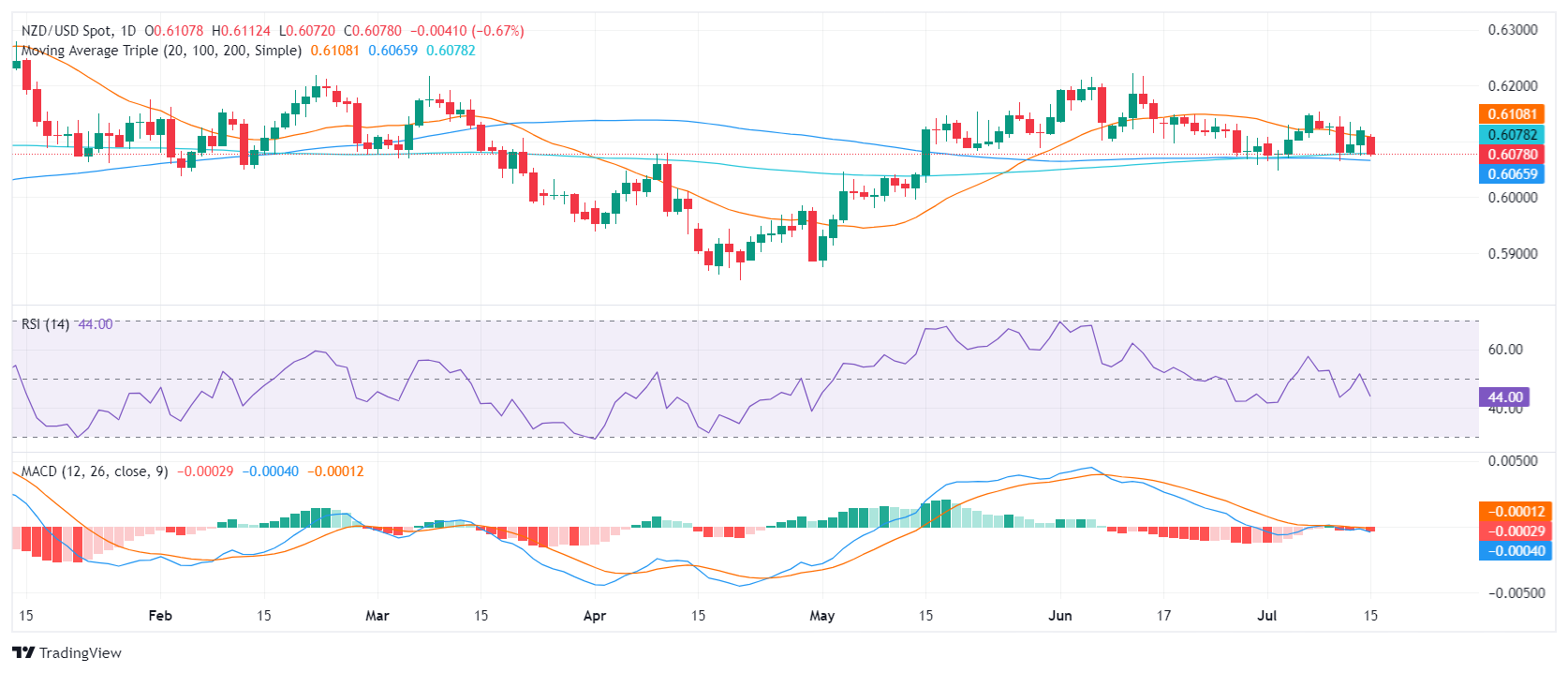
The bulls have got their work cut out as they face resistance at 0.6100 around the 20-day SMA, followed by the higher barriers at 0.6150 and 0.6200. A convincing close above these levels would be necessary to enforce bullish control and steer the focus northwards.

On the flip side, the 0.6070 mark acts as a staunch support, holding the line in the face of downward pressure, being closely trailed by further support lines at 0.6050 and 0.6030. A decisive plunge below these levels would indicate a shift back to a bearish perspective, potentially paving the way for a correction toward even lower levels.

Author

Patricio Martín

Patricio is an economist from Argentina passionate about global finance and understanding the daily movements of the markets.


More from Patricio Martín
Share:

Editor's Picks

AUD/USD breaks below 0.7000 ahead of inflation data

AUD/USD has accelerated its downward trend on Tuesday, breaching below the key 0.7000 yardstick ahead of the opening bell in Asia on Wednesday. Indeed, spot has retreated for the second day in a row despite the hawkish hike by the RBA early on Tuesday and in response to the continuation of the move higher in the Greenback. Looking ahead, all the attention will be on the release of Australia’s inflation data on Wednesday.

USD/JPY consolidates near 157.50 as a bullish USD counters intervention risks

USD/JPY struggles to capitalize on the overnight bounce from a one-week low, consolidating around 157.50 in the Asian session on Tuesday. Trump's concerns about the Japanese Yen's weakness fueled speculation about another US-Japan joint intervention. This, along with the hawkish BoJ, underpins the JPY and caps the currency pair. Meanwhile, rising Fed rate-hike bets and oil-driven inflation fears continue to push US bond yields to multi-year highs, keeping the US Dollar pinned near a two-month high and supporting the pair.

Gold trims gains; back toward $4,150

Gold now surrenders some of its initial advance and retests the $4,150 zone per troy ounce on Tuesday. Meanwhile, the move higher in the yellow metal comes despite the firmer US Dollar and rising US Treasury yields across the board, while escalating geopolitical tensions appear to limit the downside potential.

XRP advances within a robust technical structure
Ripple (XRP) shows signs of stabilizing after reclaiming support at $1.50 on Tuesday. A robust technical structure underpins the token’s short to medium-term bullish outlook. Still, XRP is not out of the woods yet, as profit-taking and buyer exhaustion could weigh on price action and extend the recent correction from September highs around $1.66.
RBA recap: Rate hikes are on the table as demand stays too strong

The Reserve Bank of Australia unanimously tightened monetary policy, warning that inflation remained too high and that several upside risks had begun to materialise. Governor Michele Bullock said the Board would raise rates again if necessary.

Silver is more volatile than Gold ahead of PCE and NFP. This chart shows the positioning gap
The market’s attention is focused on American data this week, but there’s something only those with a trained eye may be looking at: Gold and Silver positioning gap. Financial markets are moving on fears, mostly related to persistently high energy prices driven by the Middle East war. Sure, the US Dollar (USD) is strong, but at what cost?