|

NZD/USD Price Analysis: Bulls back off, consolidation may be incoming

  • The hourly chart signals a possible short-term rise in selling pressure with a shar decline in the RSI.
  • The negative outlook remains on the daily chart.
  • The bearish crossover between the 20 and 200-day SMAs implies a strong negative momentum.

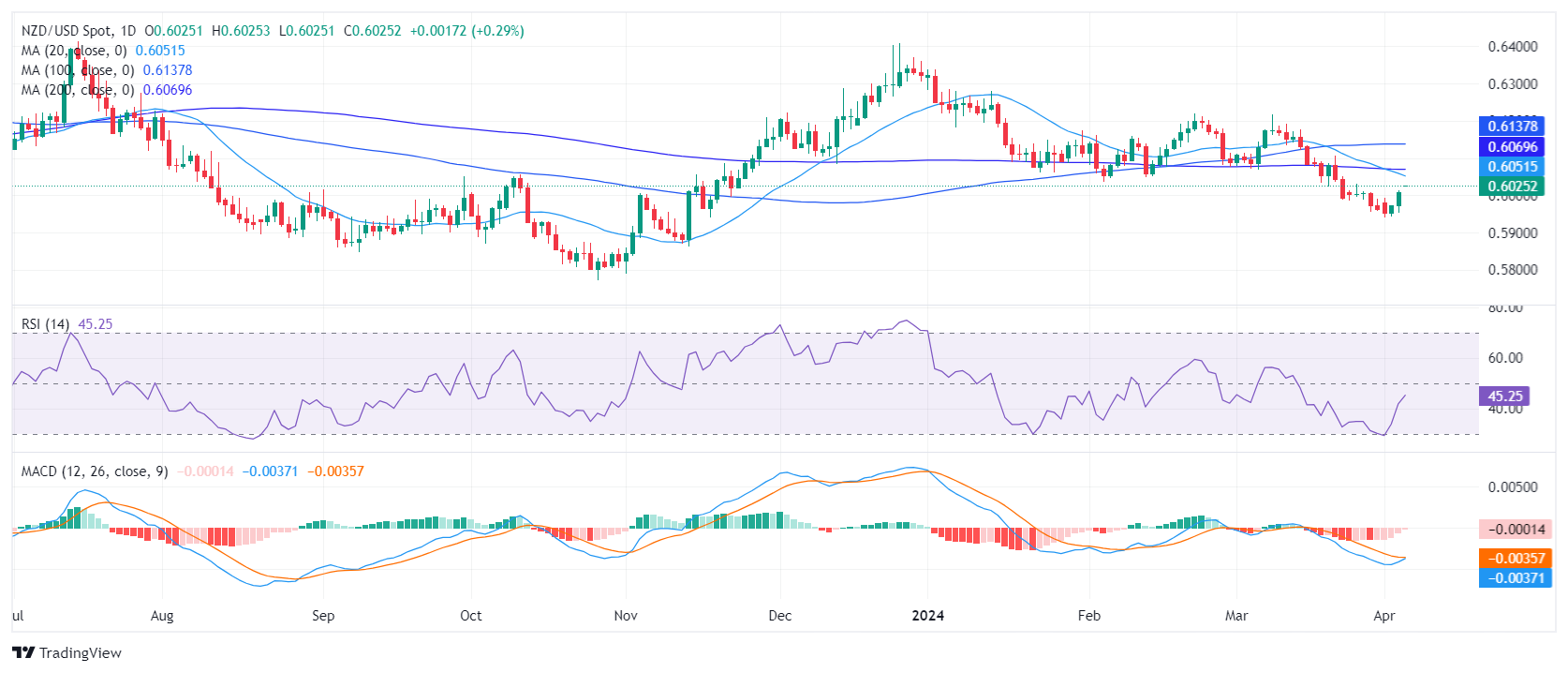
The NZD/USD pair is trading at around 0.6025 and trimmed most of its daily gains on Thursday. After getting rejected by the 20-day Simple Moving Average (SMA) the latest upwards movements seem to have been short-lived and didn’t present a battle to the bearish overall trend.

On the daily chart, the Relative Strength Index (RSI) has shown slow movement from negative to positive territory over past sessions and now resides at around 47.15. However, the flat red bars of the Moving Average Convergence Divergence (MACD) indicate a steady negative momentum.

NZD/USD daily chart
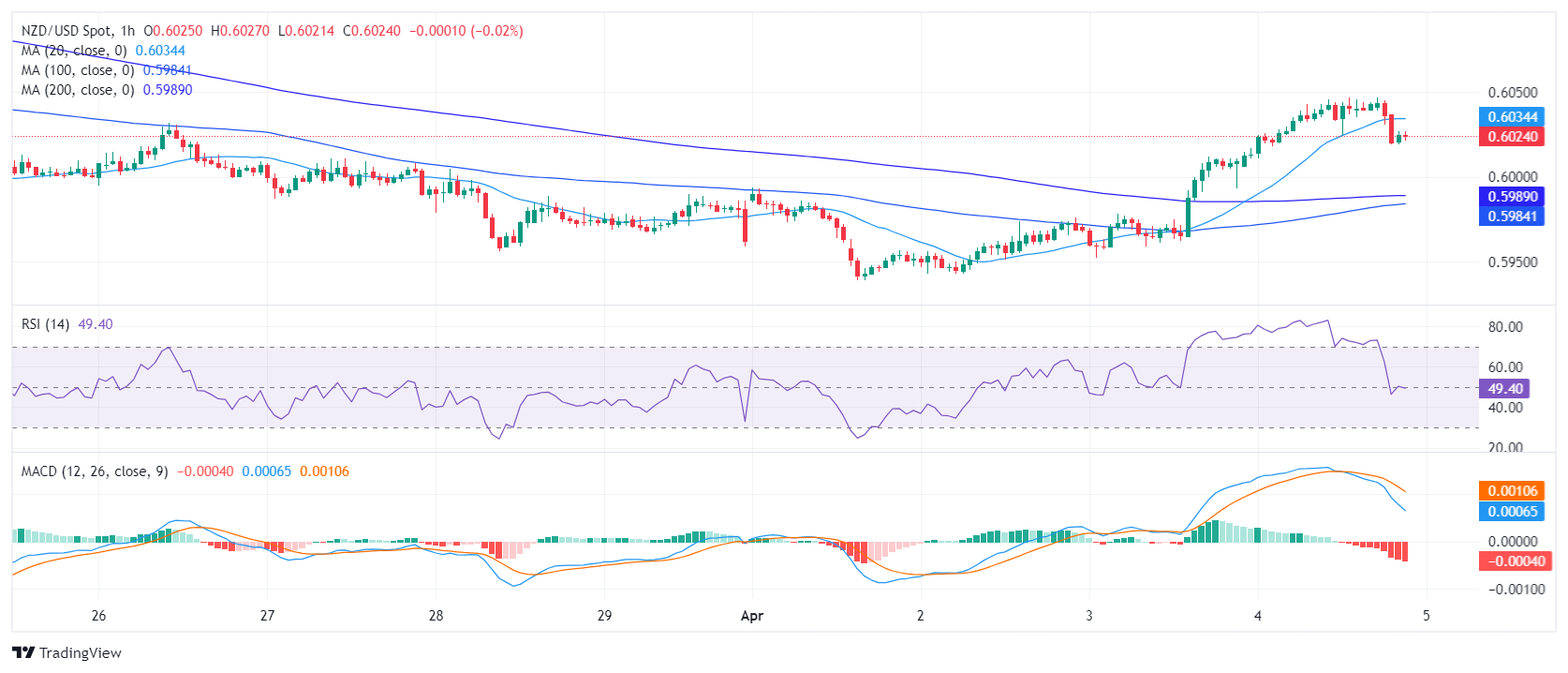
On the hourly chart, the RSI proved more erratic, reaching a positive value of 70 earlier in the session and dropping to 50. This fluctuation suggests a possible short-term shift in momentum favoring the sellers. The MACD, continues to print red flat bars, indicating sustained negative momentum throughout recent hours.

NZD/USD hourly chart
Concerning its Simple Moving Averages (SMAs), the NZD/USD is below the 20,100 and 200-day SMAs. Thursday’s 20-day SMA rejection adds further arguments that the bullish momentum is weak. Moreover, the mentioned average completed a bearish crossover with the 200-day SMA which may eventually limit any upward momentum.

NZD/USD

Overview
Today last price0.6025
Today Daily Change0.0017
Today Daily Change %0.28
Today daily open0.6008
 
Trends
Daily SMA200.6059
Daily SMA500.6096
Daily SMA1000.6137
Daily SMA2000.607
 
Levels
Previous Daily High0.6012
Previous Daily Low0.5952
Previous Weekly High0.6032
Previous Weekly Low0.5956
Previous Monthly High0.6218
Previous Monthly Low0.5956
Daily Fibonacci 38.2%0.5989
Daily Fibonacci 61.8%0.5975
Daily Pivot Point S10.5969
Daily Pivot Point S20.5931
Daily Pivot Point S30.5909
Daily Pivot Point R10.6029
Daily Pivot Point R20.6051
Daily Pivot Point R30.6089

Author

Patricio Martín

Patricio is an economist from Argentina passionate about global finance and understanding the daily movements of the markets.


More from Patricio Martín
Share:

Editor's Picks

AUD/USD defies Iran war jitters as RBA hike bets double

The Australian Dollar rallies for the fourth straight day against the US Dollar as market mood remains positive amid high tensions in the Middle East, pointing to a resumption of hostilities, as reported by recent news. Despite this, the AUD/USD trades at 0.7027, up 0.44%.

USD/JPY remains confined in a familiar range below 158.50

USD/JPY sees some dip-buying in the Asian session on Wednesday, though it remains confined within a multi-week range near 158.50 as the uncertainty over the timing of the next BoJ rate hike keeps Japanese Yen bulls on the defensive. Meanwhile, hawkish Fed expectations, bolstered by inflation risks stemming from volatile oil prices, underpin the US Dollar. However, looming intervention fears could limit JPY losses and cap the currency pair.

Gold advances modestly; targets $4,150

Gold prices manage to reverse three consecutive daily declines, trading just below the $4,150 mark per troy ounce on Wednesday. The precious metal’s recovery comes amid a slight drop in the US Dollar, mixed US Treasury yields across the board and a widespread cautious tone from the US-Iran front.

XRP and XLM regain momentum as derivatives activity picks up

Ripple and Stellar are regaining momentum on Wednesday, mirroring gains across major digital assets. XRP has climbed above $1.36, while XLM has reached $0.1854, reinforcing support levels recently tested. This gradual price increase comes amid sticky inflation in the United States and ahead of the Federal Reserve’s monetary decision next week.

What the midterm elections mean for Treasury yields, the Dollar and Gold
Democrats are priced to take the House, so November 3 comes down to the Senate and how much Washington can borrow without the other party. Treasury yields will show the answer first, then the Dollar and Gold. On November 3, Americans vote for all 435 House seats and 35 Senate seats. For bond prices, the result comes down to one thing: how much the government will borrow over the next two years.
The US Dollar fell. Gold didn't rally. That tells you everything
Gold (XAU/USD) is struggling to capitalize on a weaker US Dollar (USD), after repeatedly failing to establish itself above the $4,200 level. The precious metal remains confined to a relatively narrow trading range despite a combination of developments that would normally support higher prices.














