|

NZD/USD Price Analysis: Bearish dominance persists, signs of short-term bullish recovery detected

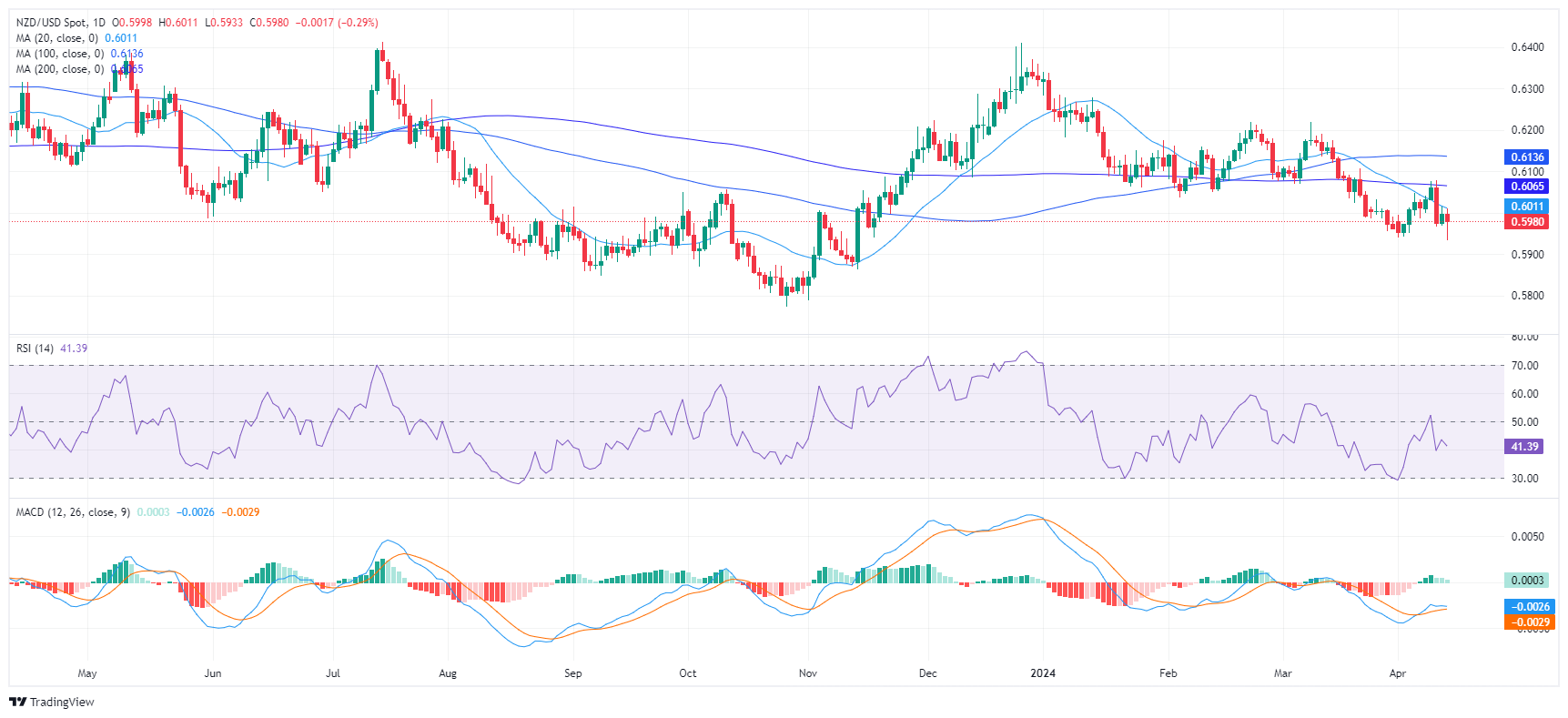
  • The daily RSI of the NZD/USD reveals that sellers remain in command with values below 50.
  • The daily MACD shows a slowdown in selling pressure as flat green bars begin to form.
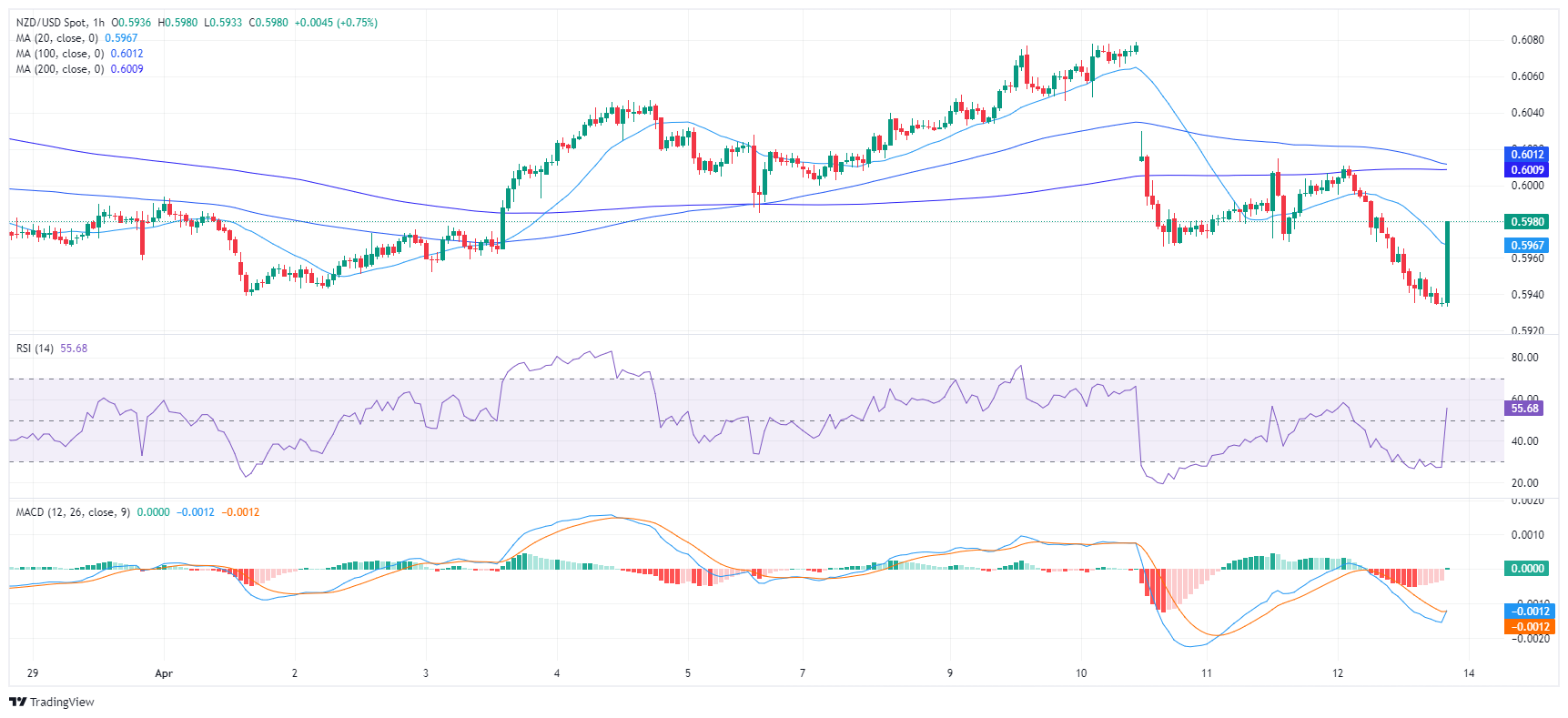
  • Buyers hint at gaining minor traction in the short term, with hourly indicators recovering.

The NZD/USD pair reflects the ongoing dominance of sellers, declining towards the 0.5935 mark. While signs of bearish control are evident, there is a clue of bullish resilience, hinting at a neutral to bearish outlook in the short term.

The daily  Relative Strength Index (RSI) maintains a consistent presence in the negative territory below 50, with the latest value at 38 which indicates that sellers are in command. That being said, green bars take shape on the Moving Average Convergence Divergence (MACD) histogram, indicating a slowing of the bearish momentum.

NZD/USD daily chart
In contrast, the hourly chart indicates a gradually increasing RSI with the latest reading at 47. This suggests a mild recovery of buying interest after dropping into oversold conditions earlier in the session. Moreover, the MACD histogram shows a fresh green bar, implying a positive change in the short term momentum.

NZD/USD hourly chart
With respect to the broader trend, the outlook is bearish with the pair below the 20,100 and 200-day Simple Moving Averages (SMAs). However, the pair is close to its 20-day average and if buyers regain additional ground and recapture it, the outlook may start to shift in favor of the bulls.

NZD/USD

Overview
Today last price0.598
Today Daily Change-0.0017
Today Daily Change %-0.28
Today daily open0.5997
 
Trends
Daily SMA200.6016
Daily SMA500.6084
Daily SMA1000.6137
Daily SMA2000.6066
 
Levels
Previous Daily High0.6015
Previous Daily Low0.5969
Previous Weekly High0.6047
Previous Weekly Low0.5939
Previous Monthly High0.6218
Previous Monthly Low0.5956
Daily Fibonacci 38.2%0.5997
Daily Fibonacci 61.8%0.5987
Daily Pivot Point S10.5973
Daily Pivot Point S20.5948
Daily Pivot Point S30.5927
Daily Pivot Point R10.6019
Daily Pivot Point R20.604
Daily Pivot Point R30.6065

Author

Patricio Martín

Patricio is an economist from Argentina passionate about global finance and understanding the daily movements of the markets.


More from Patricio Martín
Share:

Editor's Picks

AUD/USD defends 0.7000 ahead of RBA on Tuesday

AUD/USD is defending 0.7000 at the start of a new week, trading near its lowest level since August 4 amid a bullish US Dollar. US yields hold near multi-year highs amid inflation risks from higher oil prices and rising bets on an October Fed rate hike. This, along with the US-Iran standoff, continues to underpin the safe-haven buck and weigh on the pair ahead of Tuesday's RBA policy announcements.

USD/JPY climbs back toward 158.00 after BoJ minutes amid firm USD

USD/JPY finds dip-buyers and reverses part of Friday's slide driven by speculation that authorities will step in again to prop up the Japanese Yen. However, the BoJ's dovish Minutes cap the JPY. Meanwhile, the US Dollar regains traction as the US-Iran standoff supports crude oil prices, fueling inflation fears and reaffirming bets for an October Fed rate hike. This further supports the pair, driving it back toward 158.00.

Gold tumbles further; focus shifts to $4,100

Gold kicks in the week on the back foot, selling off to the vicinity of the $4,100 mark per troy ounce, levels last traded back in early August. The resurgence of geopolitical concerns in combination with the firmer US Dollar and rising US Treasury yields keep the yellow metal under heavy pressure on Monday.

Bitcoin dips as ETF inflows meet Fed headwinds

Bitcoin trades below $82,800 at the time of writing on Monday after gaining over 4% last week, with the rally losing momentum near recent highs. Strong institutional demand, supported by spot Bitcoin Exchange Traded Fund inflows, continues to drive demand.

The week ahead: A key moment for the global economy as threats rise

UK diesel hits a record, as economic concerns rise. The market expects an aggressive Fed rate hiking cycle, but is it necessary? Oil supply concerns ease, even as oil prices rise. What’s next for the AI trade.

Fed vs BoJ: Both hiked. The market only believes one of them – and the chart shows which

The Fed and the BoJ have just done something remarkably similar. Both central banks raised interest rates by 25 bps last week, both are confronting inflation risks, and both signal that future decisions will depend on incoming economic data.