NZD/USD continues bearish slump amid global trade stress resurgence
- NZD/USD remains mired in seven-month lows near 0.5700.
- Holiday-thinned US markets keep price action restrained.
- The Trump administration’s newest tariff threats against China have reset investor concerns.

NZD/USD is still stuck near multi-month lows approaching the 0.5700 handle, opening up a fresh trading week with limited day-to-day changes but still leaning into the weak side. Federal Reserve (Fed) rate cut expectations and refreshed US-China trade war concerns are driving global markets, spearheaded by strong flows in US Dollar (USD) positioning.
The USD side of the docket will dominate Kiwi flows this week, with little of note on the New Zealand side of market focus. The Federal Reserve (Fed) appears to be on pace to deliver two more interest rate cuts through the end of the year, and rate markets are watching headlines from Fed officials closely throughout the week.
US Producer Price Index (PPI) inflation metrics were slated for release this Thursday, but the US government’s ongoing shutdown has stymied the Bureau of Labor Statistics’ (BLS) ability to release official datasets. Markets are scurrying to add fresh weight to private datasets, and traders are banking on a lack of official data forcing the Fed to stay the course on interest rate expectations.
US President Donald Trump announced a fresh wave of 100% tariffs on Chinese goods late last Friday, sending markets for a risk-off loop. Trump is having an extreme reaction to China imposing strict export controls and limits on the sale of critical rare earth minerals last week, which overturned months of back-and-forth trade negotiations between the two countries.
NZD/USD price forecast
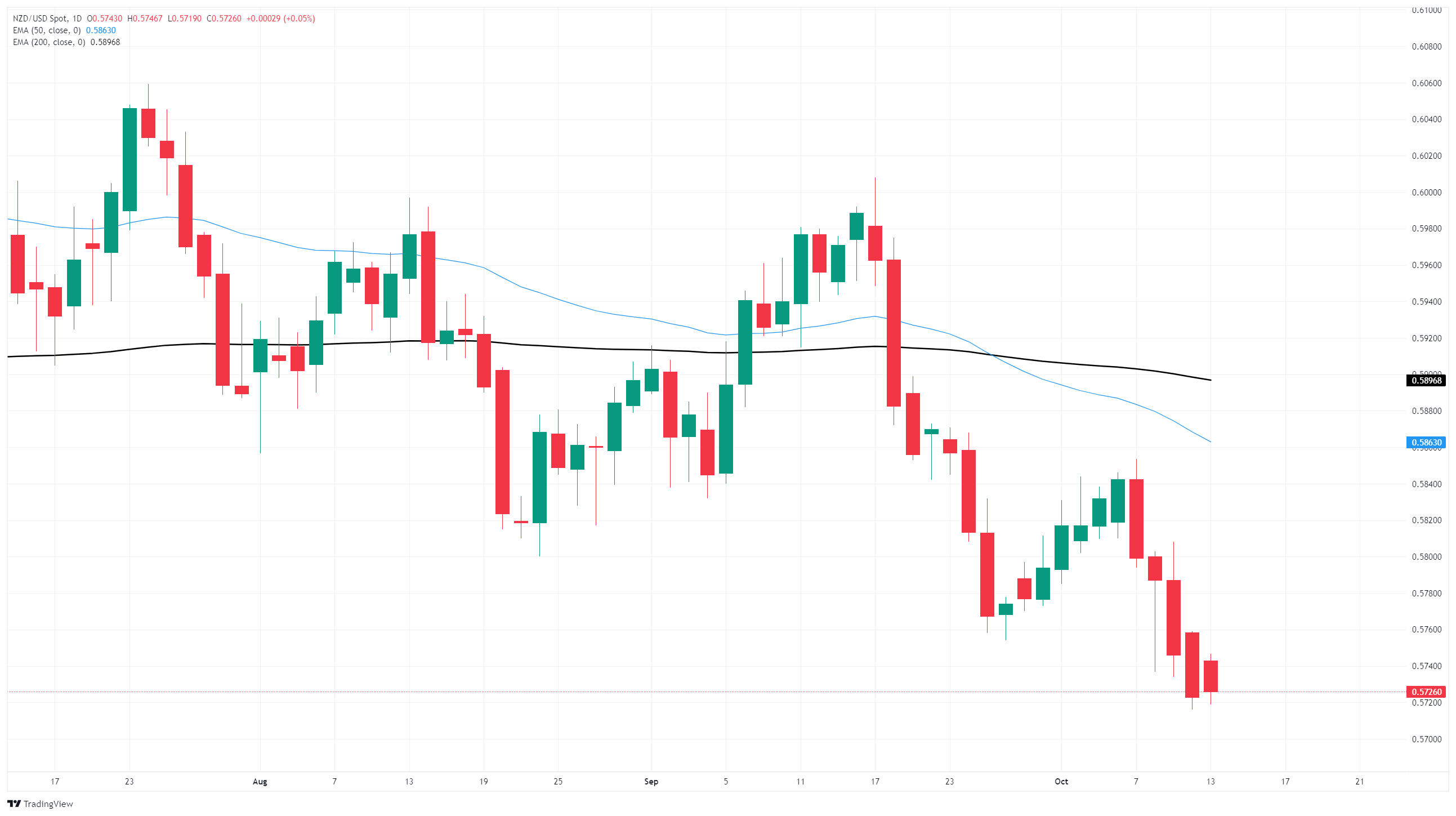
NZD/USD continues to trade under pressure, extending its downtrend that began in late September. The pair has been unable to sustain any meaningful recovery, with each bounce quickly met by renewed selling. Price remains well below both the 50-day Exponential Moving Average (EMA) at 0.5863 and the 200-day EMA at 0.5898, confirming that sellers are still in control.
The latest leg lower has pushed the pair toward the 0.5700 zone, an area that has acted as short-term support in the past. If this level gives way, the next target for traders will likely be the 0.5650 region, followed by 0.5600. On the upside, the 0.5800 handle now stands as immediate resistance, and the broader bearish bias would only start to fade if price can reclaim the 50-day EMA.
Overall, the chart paints a picture of continued weakness in the New Zealand dollar as risk sentiment softens and U.S. dollar strength persists. Momentum remains tilted to the downside until the pair shows a convincing reversal signal.
NZD/USD daily chart
New Zealand Dollar FAQs
The New Zealand Dollar (NZD), also known as the Kiwi, is a well-known traded currency among investors. Its value is broadly determined by the health of the New Zealand economy and the country’s central bank policy. Still, there are some unique particularities that also can make NZD move. The performance of the Chinese economy tends to move the Kiwi because China is New Zealand’s biggest trading partner. Bad news for the Chinese economy likely means less New Zealand exports to the country, hitting the economy and thus its currency. Another factor moving NZD is dairy prices as the dairy industry is New Zealand’s main export. High dairy prices boost export income, contributing positively to the economy and thus to the NZD.
The Reserve Bank of New Zealand (RBNZ) aims to achieve and maintain an inflation rate between 1% and 3% over the medium term, with a focus to keep it near the 2% mid-point. To this end, the bank sets an appropriate level of interest rates. When inflation is too high, the RBNZ will increase interest rates to cool the economy, but the move will also make bond yields higher, increasing investors’ appeal to invest in the country and thus boosting NZD. On the contrary, lower interest rates tend to weaken NZD. The so-called rate differential, or how rates in New Zealand are or are expected to be compared to the ones set by the US Federal Reserve, can also play a key role in moving the NZD/USD pair.
Macroeconomic data releases in New Zealand are key to assess the state of the economy and can impact the New Zealand Dollar’s (NZD) valuation. A strong economy, based on high economic growth, low unemployment and high confidence is good for NZD. High economic growth attracts foreign investment and may encourage the Reserve Bank of New Zealand to increase interest rates, if this economic strength comes together with elevated inflation. Conversely, if economic data is weak, NZD is likely to depreciate.
The New Zealand Dollar (NZD) tends to strengthen during risk-on periods, or when investors perceive that broader market risks are low and are optimistic about growth. This tends to lead to a more favorable outlook for commodities and so-called ‘commodity currencies’ such as the Kiwi. Conversely, NZD tends to weaken at times of market turbulence or economic uncertainty as investors tend to sell higher-risk assets and flee to the more-stable safe havens.
Author

Joshua Gibson
FXStreet
Joshua joins the FXStreet team as an Economics and Finance double major from Vancouver Island University with twelve years' experience as an independent trader focusing on technical analysis.
















