|

NZD/JPY Price Analysis: Pair surpasses 98.00, establishing new cycle highs

  • NZD/JPY resumes its bullish trend, surpassing 98.00 mark and hitting new cycle highs.
  • Immediate supports identified at 97.50 and 97.00 markers represented by 20-day SMA in case of potential corrections.
  • As the pair rides uncharted terrain it might test the 99.00-100.00 range.

On Wednesday, the NZD/JPY pair resumed its upward trajectory, an extension of the bullish trend noted in the previous week. Even as a strong bullish drive emerges as the predominant force, there is caution regarding a potential correction as indicators reflect overbought conditions. In the session, the pair rose by 0.60% to reach 98.70, a fresh cycle high.

In terms of the daily chart's analysis, the Relative Strength Index (RSI) has increased, now sitting in overbought territory at a reading of 75, up from Tuesday's reading of 68. This points to increasing market momentum. However, this climb incurs the risk of a potential pullback given these heightened overbought conditions. The Moving Average Convergence Divergence (MACD) presents green bars, also adding arguments to the overextended movements.

NZD/JPY daily chart
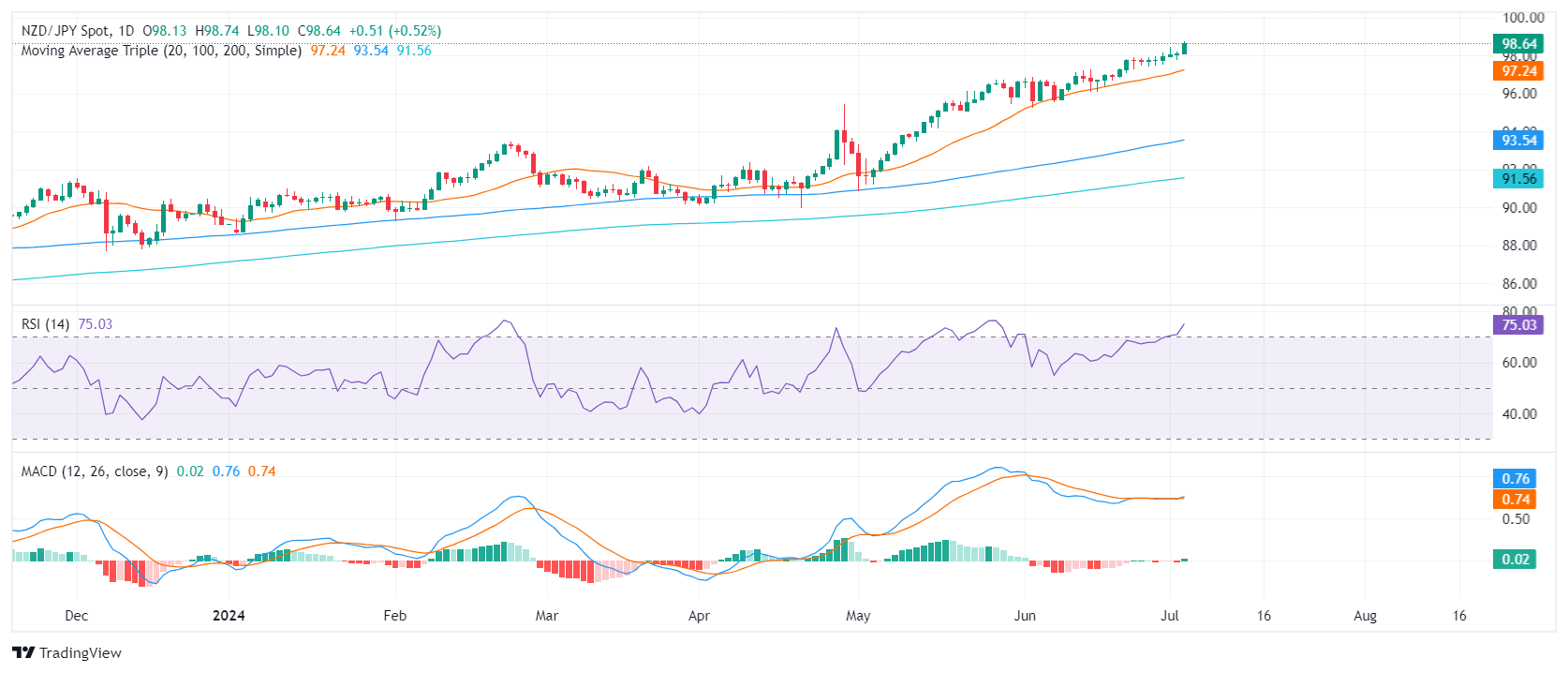
Looking ahead, it is anticipated that the pair may sustain its upward trajectory, remaining above the 20-day, 100-day, and 200-day Simple Moving Averages (SMA), suggesting ongoing bullish momentum. However, there might be possible corrections due to current overbought situations.

Immediate support in case of a downward correction is now speculated around the 97.50 and 97.00 markers, represented by the 20-day SMA. Buyers should concentrate on maintaining these levels prior to reaching newer peaks. Potential for advancements around 98.80, 99.00, and even 100.00 windows are within sight, following a successful defense of the 97.00 level.

Author

Patricio Martín

Patricio is an economist from Argentina passionate about global finance and understanding the daily movements of the markets.


More from Patricio Martín
Share:

Markets move fast. We move first.

Orange Juice Newsletter brings you expert driven insights - not headlines. Every day on your inbox.

By subscribing you agree to our Terms and conditions.

Editor's Picks

EUR/USD rebounds after falling toward 1.1700

EUR/USD gains traction and trades above 1.1730 in the American session, looking to end the week virtually unchanged. The bullish opening in Wall Street makes it difficult for the US Dollar to preserve its recovery momentum and helps the pair rebound heading into the weekend.

GBP/USD steadies below 1.3400 as traders assess BoE policy outlook

Following Thursday's volatile session, GBP/USD moves sideways below 1.3400 on Friday. Investors reassess the Bank of England's policy oıtlook after the MPC decided to cut the interest rate by 25 bps by a slim margin. Meanwhile, the improving risk mood helps the pair hold its ground.

Gold stays below $4,350, looks to post small weekly gains

Gold struggles to gather recovery momentum and stays below $4,350 in the second half of the day on Friday, as the benchmark 10-year US Treasury bond yield edges higher. Nevertheless, the precious metal remains on track to end the week with modest gains as markets gear up for the holiday season.

Crypto Today: Bitcoin, Ethereum, XRP rebound amid bearish market conditions

Bitcoin (BTC) is edging higher, trading above $88,000 at the time of writing on Monday. Altcoins, including Ethereum (ETH) and Ripple (XRP), are following in BTC’s footsteps, experiencing relief rebounds following a volatile week.

How much can one month of soft inflation change the Fed’s mind?

One month of softer inflation data is rarely enough to shift Federal Reserve policy on its own, but in a market highly sensitive to every data point, even a single reading can reshape expectations. November’s inflation report offered a welcome sign of cooling price pressures. 

XRP rebounds amid ETF inflows and declining retail demand demand

XRP rebounds as bulls target a short-term breakout above $2.00 on Friday. XRP ETFs record the highest inflow since December 8, signaling growing institutional appetite.















