|

NZD/JPY Price Analysis: Pair plunges to multi-month low before partial rebound

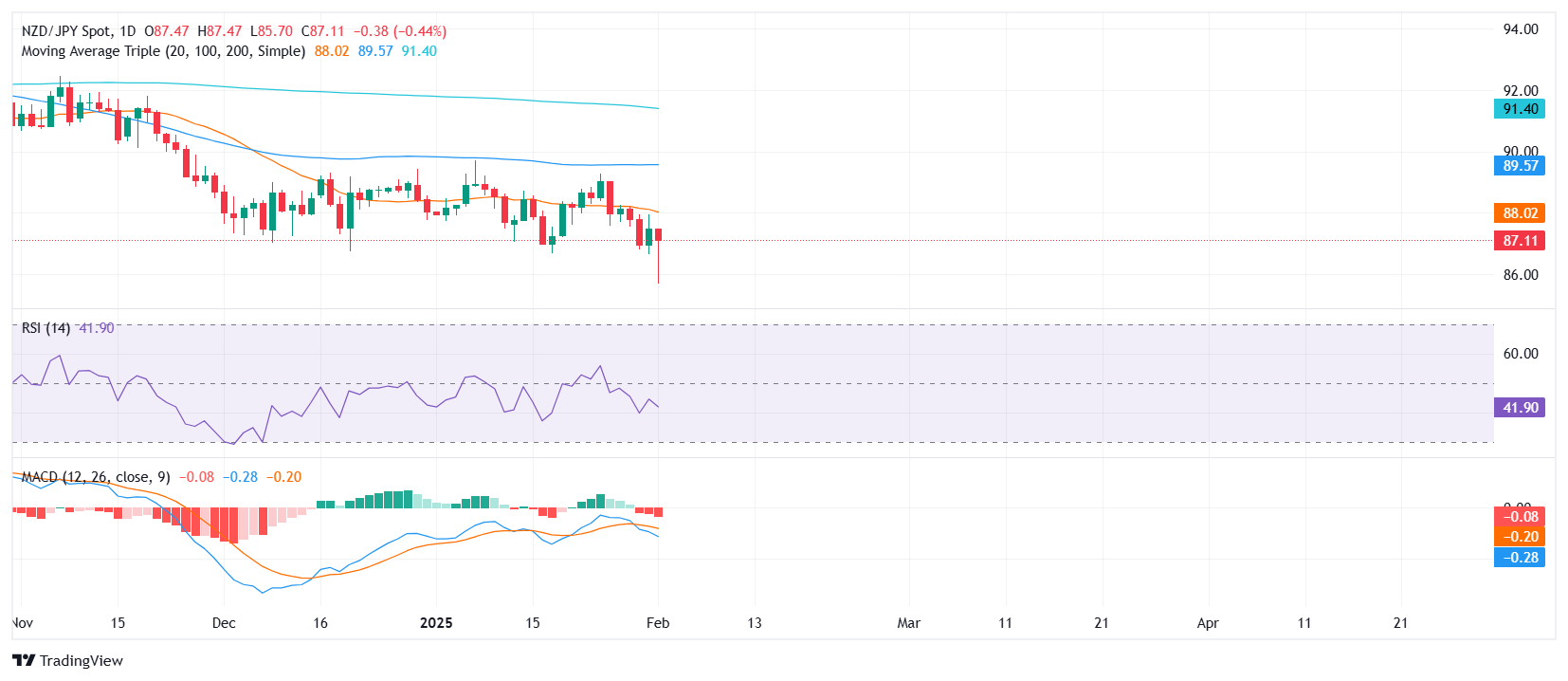
  • NZD/JPY declines 0.99% on Monday, settling at 86.55 after hitting its lowest level since August 2024.
  • The pair briefly dropped to 85.70 before bouncing back around 87.00, though it remains below the 20-day SMA at 88.00.
The NZD/JPY pair saw heightened volatility on Monday, plunging to a fresh multi-month low of 85.70 before staging a partial recovery to close at 86.55. Despite the rebound, the broader outlook remains bearish, as the pair continues to struggle below key resistance levels, with the 20-day Simple Moving Average (SMA) at 88.00 acting as a cap.

Technical indicators suggest mixed signals regarding momentum. The Relative Strength Index (RSI) remains flat at 41 in negative territory, signaling persistent selling pressure. Meanwhile, the Moving Average Convergence Divergence (MACD) histogram is printing rising red bars, which further supports the bearish thesis.

Looking ahead, the pair faces immediate resistance at 87.00, and a sustained break above this level could pave the way for a move toward the 20-day SMA at 88.00. On the downside, renewed selling could push the pair back toward 85.70, with further losses potentially targeting 85.30. As long as NZD/JPY remains below the 20-day SMA, the outlook remains tilted to the downside.

NZD/JPY daily chart
Author

Patricio Martín

Patricio is an economist from Argentina passionate about global finance and understanding the daily movements of the markets.


More from Patricio Martín
Share:

Editor's Picks

AUD/USD stays bid above 0.7100 on Australian trade data, Mideast optimism

AUD/USD clings to minor recovery gains above 0.7100 in the Asian session on Thursday as a new Israel-Lebanon ceasefire keeps a lid on the safe-haven US Dollar. Meanwhile, strong AustralianTrade Balane data also help the Aussie pair sustain the bounce from weekly lows.

USD/JPY hovers near the 160.00 intervention threshold on Mideast tensions

USD/JPY struggles to find acceptance above 160.00 and retreats from a one-month high in the Asian session on Thursday amid fears that authorities will step in again to prop up the Japanese Yen. Furthermore, a new Israel-Lebanon ceasefire caps the US Dollar and supports the currency pair. However, renewed US-Iran tensions keep the downside limited in the Greenback and the pair.

Gold defends 200-day SMA; upside seems capped on Iran uncertainty

Gold recovers from a one-week low near $4,425, or the 200-day SMA, in the Asian session on Thursday, as news of an Israel-Lebanon ceasefire acts as a headwind for the safe-haven US Dollar. However, renewed hostilities in the Gulf, along with stalled US-Iran peace talks, keep geopolitical risks in play and should support the USD, checking the Gold price rebound.


XRP and XLM outlook: Bearish streak extends as risk-off mood erodes retail demand, ETF flows

Ripple and Stellar prices face intense selling pressure, extending losses on Thursday for the fourth consecutive day this week. Cross-border remittance tokens are losing retail sentiment, while XRP faces additional pressure from Exchange-Traded Fund outflows.

Kevin Warsh takes the Fed helm: What it means for the US Dollar
The Federal Reserve moves away from the highly predictable "forward guidance" model of the Jerome Powell era to a new “Kevin Warsh environment”, characterized by less communication, more policy surprises, and an increased focus on the Fed's complex balance sheet.
Recession on paper: What really moves the Canadian Loonie now?

Statistics Canada handed the headline writers a gift and the analysts a headache. Real GDP shrank 0.1% on an annualized basis in the first quarter, and with the fourth quarter of 2025 revised down to a 1.0% contraction, that is two negative quarters in a row, the textbook definition of a technical recession and Canada's first since the pandemic.