|

NZD/JPY Price Analysis: Pair edges lower amid fading bullish momentum

  • NZD/JPY slips to 88.45 on Thursday, marking a continuation of its recent decline.
  • Momentum weakens as the pair fails to extend gains from earlier in the week.
  • Market sentiment remains cautious, with the pair trading near short-term support levels.

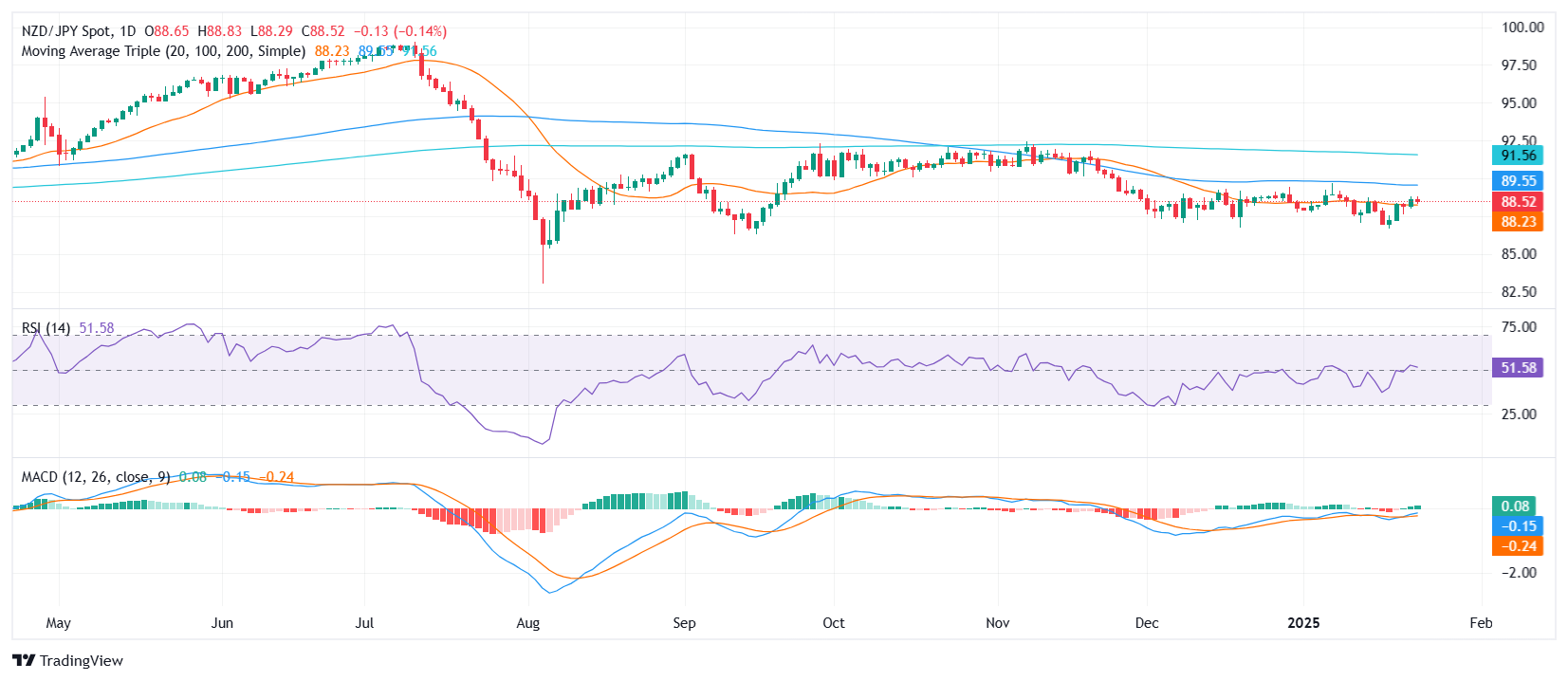
The NZD/JPY pair edged lower on Thursday, closing at 88.45, as the recent decline extended into another session. The pair’s inability to sustain its earlier upward trajectory suggests waning bullish momentum, keeping traders cautious about further upside potential. While the broader trend remains mildly positive, the latest moves point to a more balanced market dynamic.

Technical indicators offer a mixed picture. The Relative Strength Index (RSI) stands at 53, remaining in positive territory but showing a mild decline, indicating reduced buying interest. Meanwhile, the Moving Average Convergence Divergence (MACD) histogram remains flat with green bars, signaling a lack of strong directional momentum. Together, these readings suggest that the pair may struggle to regain its footing without a significant catalyst.

For now, support is seen around the 88.20 level around the 20-day Simple Moving Average (SMA), with a break below this potentially opening the door to 88.00 or lower. On the upside, resistance at 88.75 will be key, and a sustained push above this level could signal renewed bullish interest, targeting the 89.00 psychological mark as the next hurdle.

NZD/JPY daily chart
Author

Patricio Martín

Patricio is an economist from Argentina passionate about global finance and understanding the daily movements of the markets.


More from Patricio Martín
Share:

Editor's Picks

AUD/USD keeps the red near 0.6950 after weak Aussie jobs data

AUD/USD holds losses near 0.6950 on disappointing Australian jobs data, extending the previous day's retracement slide from the monthly high and hitting a fresh weekly low during Thursday’s Asian session. Meanwhile, declining US bond yields drag the US Dollar away from the April 2025 high, touched after Wednesday's hot US CPI, helping limit losses for the currency pair.

USD/JPY slides back below 158.00 as USD reverses post-CPI gains

USD/JPY extends the previous day's pullback from a three-week high, attracting follow-through selling and sliding below 158.00 during Thursday's Asian session. Traders remain on high alert amid speculation that authorities will step in to prop up the Japanese Yen. The US Dollar, meanwhile, reverses Wednesday's hot CPI-led gains to April 2025 highs as US bond yields retreat on China bond-buying talk, further pressuring the pair.

Gold sticks to gains below $4,150 on weak USD; bulls seem hesitant amid Fed hike bets

Gold clings to modest intraday gains through the early European session amid a broadly weaker US Dollar, snapping a three-day losing streak to a one-week low set on Wednesday. The initial aggressive market reaction to hot US consumer inflation figures faded quickly amid expectations that the Fed may not rush to raise interest rates immediately. This led to a further decline in US bond yields, prompting some follow-through USD profit-taking and supporting the non-yielding bullion.

Bitcoin, XRP analyst sentiment jumps as Solana bulls hit 91%: CryptoQuant

Analyst sentiment on Bitcoin, Ethereum, Solana, BNB and XRP has flipped bullish since July, as the top five cryptocurrencies recovered faster and more strongly than during the 2022-2023 market phase, according to CryptoQuant.

Budget preview: Is Healey impressing the bond market?

There is less than 2 weeks to go before the Chancellor delivers his first budget. Unusually for the UK, the economic and financial backdrop to this budget is upbeat. UK bonds have been rallying, the FTSE 100 is the top performing major stock index this week, and the Pound is also stabilising versus the Dollar.

Has Bitcoin really escaped the macro forces it was built to fight?
Over 17 years ago, Satoshi Nakamoto designed Bitcoin (BTC) on the back of a global financial crisis as an alternative to the global monetary system outside the control of central banks, governments and traditional intermediaries. This raises a key question: has Bitcoin really become independent of the macroeconomic forces it was built to challenge?















