|

NZD/JPY Price Analysis: Pair continues consolidating below 90, signs of momentum building

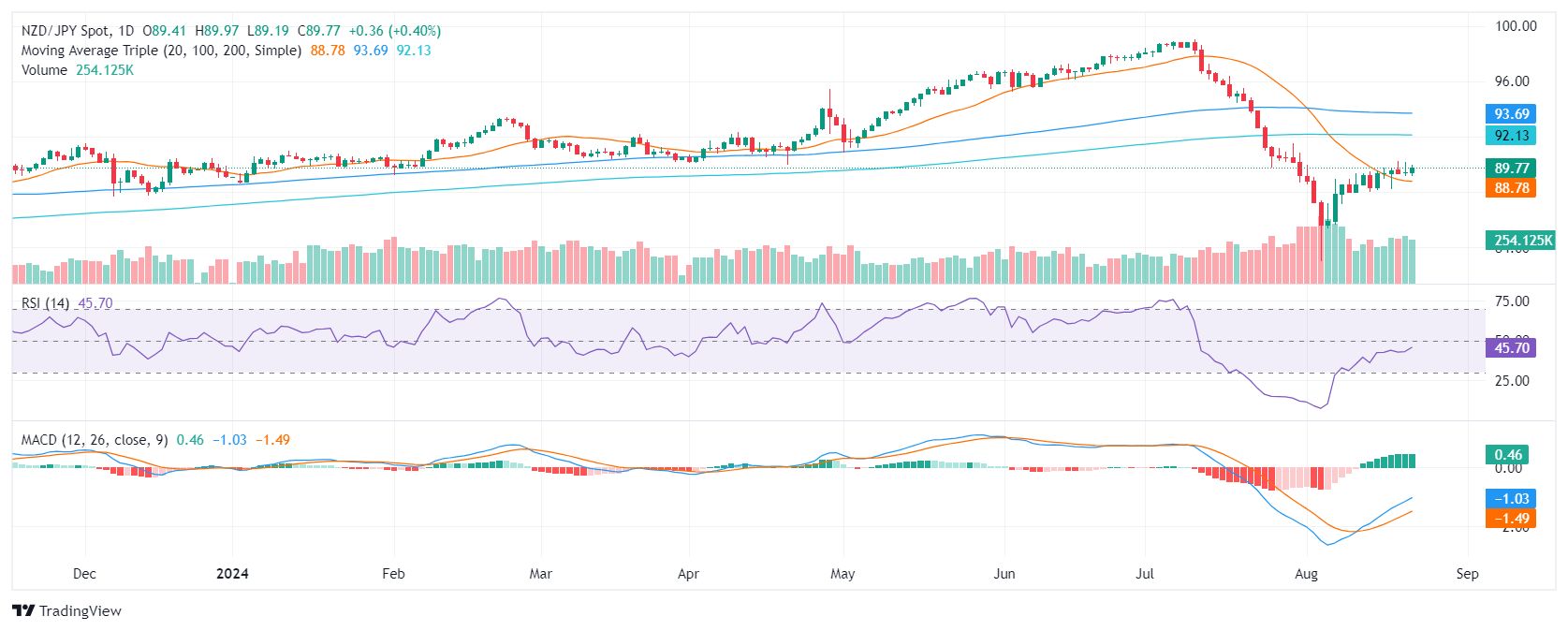
  • NZD/JPY mildly rose on Thursday, trading at 89.70.
  • The RSI is showing a rising tendency, indicating potential buying pressure, still below 50.
  • The MACD continues to print flat green bars, suggesting a neutral trend.

The NZD/JPY currency pair is trading sideways within a neutral consolidation. Technical indicators display contrasting signals, with the Relative Strength Index (RSI) hinting at buying pressure and the Moving Average Convergence Divergence (MACD) showcasing a neutral trend.

The RSI, a measure of momentum, has been rising lately and is currently at 47, near the neutral territory. This suggests that buying pressure may be building, signaling a potential shift in market sentiment. However, the MACD, continues to show flat green bars, indicating that the upward momentum is not yet strong enough to trigger a trend reversal.

The pair has been consolidating within a range defined by the 89.50 support and 90.00 resistance levels. Volume has been relatively low, indicating a lack of conviction in the recent price movements. A break above 90.00 could signal a potential bullish trend reversal, pushing the pair up to 91.00 and 91.50, while a break below 89.50 could lead to further declines towards 86.00 and possibly 84.50.

NZD/JPY daily chart
Author

Patricio Martín

Patricio is an economist from Argentina passionate about global finance and understanding the daily movements of the markets.


More from Patricio Martín
Share:

Editor's Picks

GBP/USD slides below 1.3250 after failing to break through 23.6% Fibo

The GBP/USD pair meets with a fresh supply during the Asian session on Wednesday and moves away from a nearly two-week high around the 1.3275 region, touched the previous day. Spot prices currently trade around the 1.3235 zone, down 0.20% for the day, as traders look to speeches from Bank of England Governor Andrew Bailey and Federal Reserve Chair Kevin Warsh for a fresh impetus.

EUR/USD keeps losses near 1.1400 ahead of Eurozone inflation data

EUR/USD keeps the offered tone intact near 1.1400 in early Europe on Wednesday, pressured by receding bets for aggressive tightening by the European Central Bank (ECB). Traders will take more cues from the preliminary reading of the Eurozone's Harmonized Index of Consumer Prices and the US Manufacturing PMI report due later in the day.

Gold sticks to bearish bias below $4,000 amid Fed hike bets and Iran risks

Gold attracts fresh sellers following the previous day's good two-way price swings, and weakens further below the $4,000 psychological mark through the Asian session. This marks the third straight day of a slide and keeps the precious metal closer to its lowest level since November 2025. Moreover, a bullish US Dollar suggests that the path of least resistance for the bullion is to the downside.

Solana: Retail confidence backs SOL testing 50-day EMA breakout near $75

Solana price extends gains, testing the 50-day Exponential Moving Average around $75.00. Although institutional demand for Solana remains weak, stabilizing retail confidence, with rising funding rates and steady Open Interest, supports the mild recovery. The technical outlook for SOL shifts mildly bullish, projecting a potential breakout rally toward the $100 mark.

Kevin Warsh isn't expected to say much in Sintra: That's exactly why markets will listen

Financial markets could find an important catalyst in the enchanting, fairytale-like landscape of  Sintra this week. The European Central Bank Forum will, as it does every year, gather the crème de la crème of central banks. The new boss at the Federal Reserve, who has clearly said that the Fed should stop explaining everything, will need to talk – and traders should listen.

Kevin Warsh isn't expected to say much in Sintra: That's exactly why markets will listen

Financial markets could find an important catalyst in the enchanting, fairytale-like landscape of Sintra this week. The ECB Forum will, as it does every year, gather the crème de la crème of central banks. The new boss at the Fed, who has clearly said that the Fed should stop explaining everything, will need to talk – and traders should listen.