|

NZD/JPY Price Analysis: Bearish momentum strengthens as sellers reclaim the 20-day SMA

  • The daily chart of the NZD/JPY indicates a weakening momentum, with RSI and MACD signifying rising selling pressure.
  • The NZD/JPY plunged below the crucial short-term 20-day SMA, hinting at immediate bearish prospects.
  • Despite recent bearish actions, the long-term outlook continues to favor buyers.

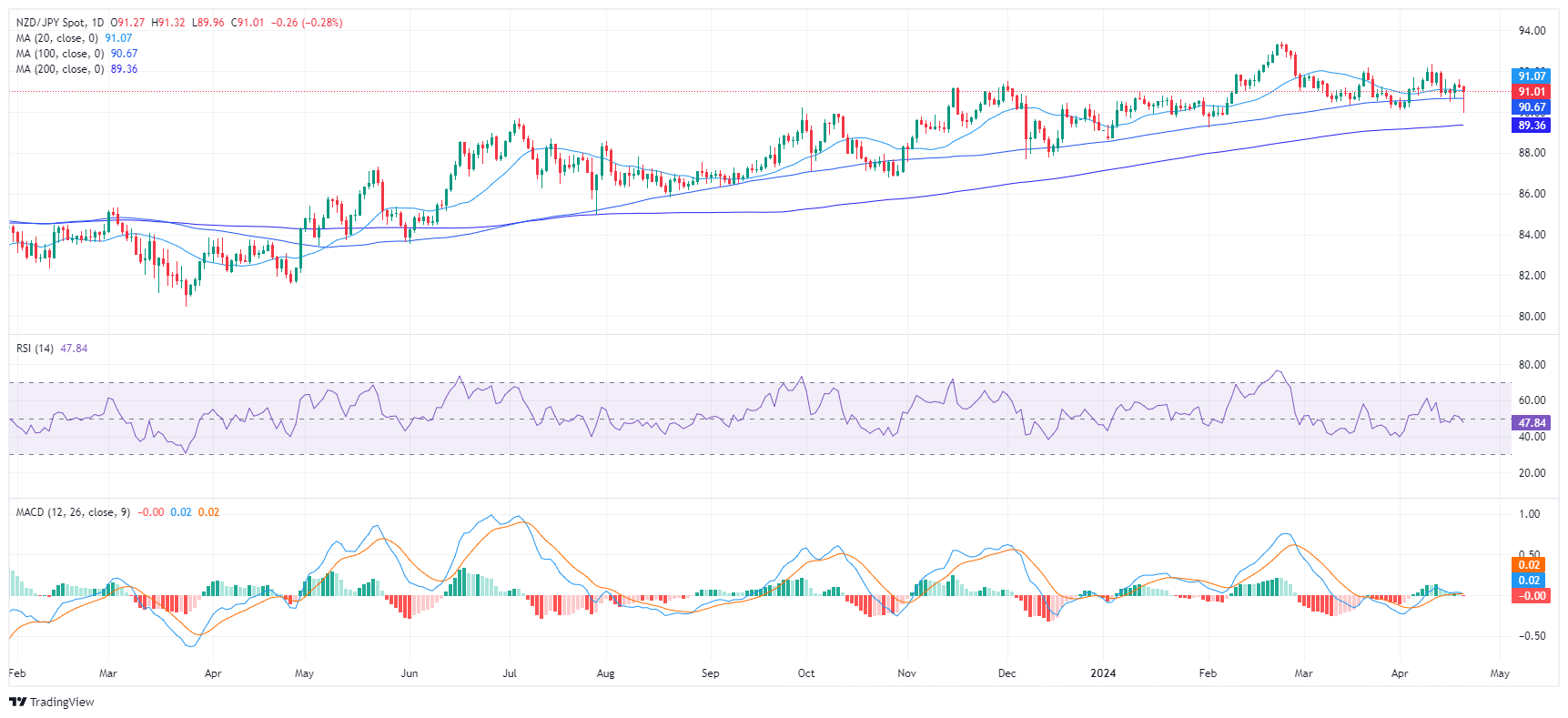
The NZD/JPY declined to 91.00, down by 0.27% on Friday. Bears are quietly gaining ground conquering the 20-day Simple Moving Average (SMA) and the selling traction is mounting. On the broader outlook, the trend is still bullish.

On the daily chart, the Relative Strength Index (RSI) pair reveals a recent drift into negative territory towards 47, indicating weakening momentum. Likewise, the Moving Average Convergence Divergence (MACD) paints a similar picture with a fresh red bar, signaling a growing bearish momentum. These indicators collectively imply sellers' dominance in the current market scenario.

NZD/JPY daily chart
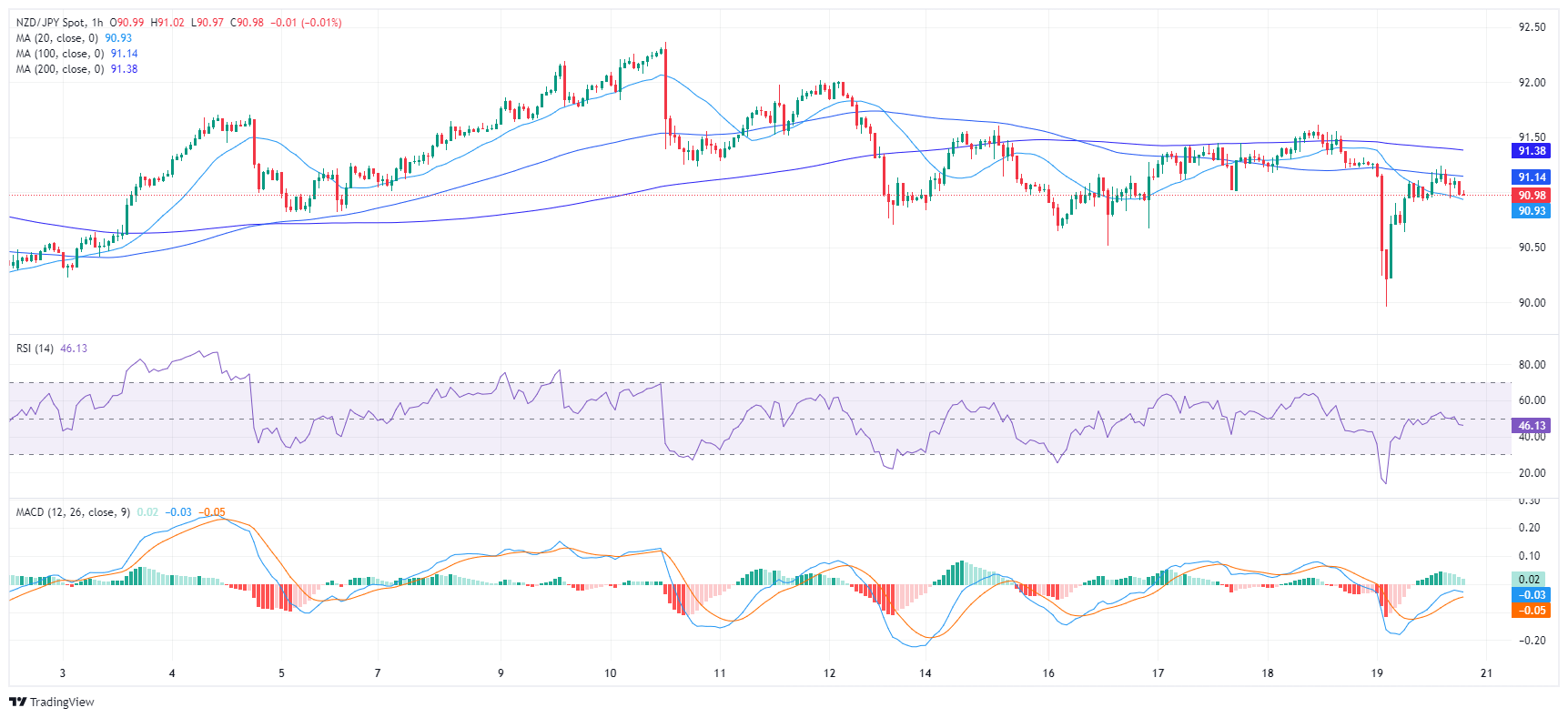
Upon examining the hourly chart, the RSI stands below its middle points, also adding arguments for a negative short-term outlook. In addition, the MACD histogram is printing decreasing green bars a clear indication of diminishing bullish momentum.

NZD/JPY hourly chart
When turning the lens to the broader landscape, NZD/JPY underwent substantial changes on Friday. The pair sunk beneath the 20-day Simple Moving Average (SMA), a significant short-term technical indicator, thus potentially establishing a bearish outlook in the immediate future. Despite this, the pair has managed to maintain its position above the 100-day and 200-day SMAs, revealing sustained bullish momentum over a more extended period. That being said, as bears gather ground, they might make a stride toward the 100-day SMA at around 90.60 which in case of conquering it, would worsen the outlook for the pair.

NZD/JPY

Overview
Today last price90.99
Today Daily Change-0.28
Today Daily Change %-0.31
Today daily open91.27
 
Trends
Daily SMA2091.05
Daily SMA5091.44
Daily SMA10090.67
Daily SMA20089.35
 
Levels
Previous Daily High91.62
Previous Daily Low91.18
Previous Weekly High92.37
Previous Weekly Low90.7
Previous Monthly High92.2
Previous Monthly Low90.17
Daily Fibonacci 38.2%91.35
Daily Fibonacci 61.8%91.45
Daily Pivot Point S191.09
Daily Pivot Point S290.92
Daily Pivot Point S390.66
Daily Pivot Point R191.53
Daily Pivot Point R291.79
Daily Pivot Point R391.96

Author

Patricio Martín

Patricio is an economist from Argentina passionate about global finance and understanding the daily movements of the markets.


More from Patricio Martín
Share:

Editor's Picks

GBP/USD clings to gains near 1.3400

GBP/USD retreats after reaching a three-week high above 1.3430, challenging the 1.3400 yardstick on Thursday. Although easing political uncertainty in the UK helps the quid limit its downside, escalating tensions in the Middle East support the Greenback, keeping Cable under scrutiny.

EUR/USD: Daily gains appear capped by 1.1450

EUR/USD keeps the recovery in place and looks to consolidate its gains north of 1.1400 the figure at the end of the NA session on Thursday. The pair’s move higher appears in tandem with a modest pullback in the US Dollar despite geopolitical concerns in the Middle East remain unabated.

Gold recovers above $4,100 as traders assess US-Iran conflict

Gold price rebounds to around $4,120 during the early Asian session on Friday. The precious metal edges higher as traders weigh a resumption of war in the Middle East.


BitGo unveils quantum risk management tools for Bitcoin wallets
BitGo has introduced a suite of quantum risk management tools for institutional Bitcoin wallets, aiming to help clients identify, assess and reduce potential exposure to future quantum computing threats before they become a practical concern.
Japan may be changing its Yen strategy, but markets don’t look scared
Japan may be changing its intervention playbook, but that might not be enough to rescue the battered Yen. With USD/JPY hovering at four-decade highs, the currency’s weakness is being driven less by speculative pressure and more by a powerful structural force: the wide US-Japan rate gap.
Bye, forward guidance: How to trade when central banks choose silence

Central banks have spent years telling markets what might come next. Now, traders face the possibility that they say a lot less. From the Federal Reserve to the European Central Bank and the Bank of England, policymakers are pushing back against forward guidance.