|

NZD/JPY Price Analysis: Bearish bias prevails as technical indicators remain flat

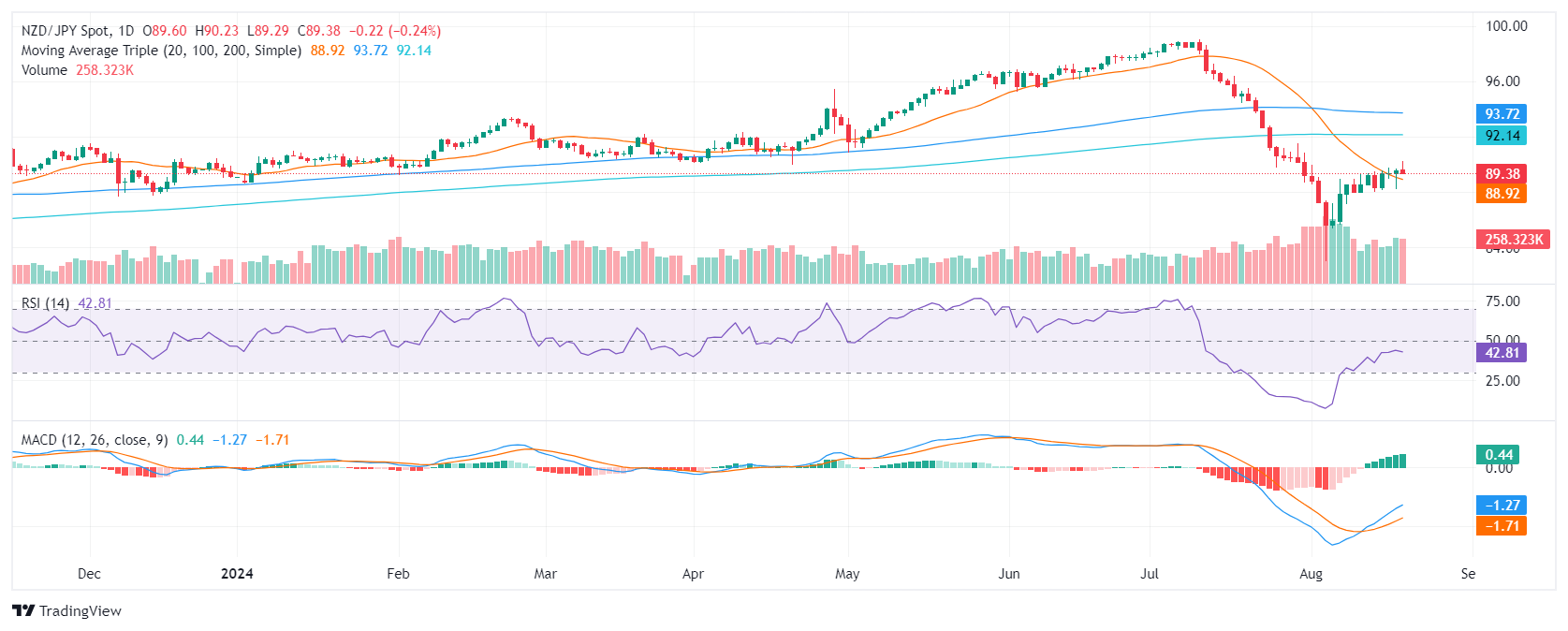
  • NZD/JPY mildly declined in Tuesday's session, landing at 89.40.
  • The RSI flattened around 40, indicating a potential bearish trend while the MACD remains neutral with green bars, suggesting a lack of clear momentum.
  • The pair continues trading within a range of 87.50 and 90.50.

The NZD/JPY currency pair has experienced continued sideways trading despite Tuesday's modest decline of 0.15%, settling at 89.40. Technical indicators paint a mixed picture, with the Relative Strength Index (RSI) and the Moving Average Convergence Divergence (MACD) hinting at mild a bearish bias.

The RSI remains neutral around 42, suggesting that the bears are present. If the RSI continues to move below, it would indicate a potential strong bearish reversal. The MACD is showing flat green bars, suggesting that there is no clear momentum in either direction. For the MACD, if the flat green bars progress to red bars, it will suggest increasing bearish momentum and a potential strong reversal.

Volume has been consistently low, indicating a lack of conviction in the recent price movements. The pair is currently trading within a range between 87.50 and 90.50. A break below 87.50 could lead to further declines towards 86.00, while a break above 90.50 could push the pair up to 92.00.
 

NZD/JPY Daily chart
Author

Patricio Martín

Patricio is an economist from Argentina passionate about global finance and understanding the daily movements of the markets.


More from Patricio Martín
Share:

Editor's Picks

AUD/USD remains above 0.7200 after China's trade data

AUD/USD sits above 0.7200 in the Asian session on Tuesday, near its highest level since May 14. The US Dollar stays under pressure as a rallying Japanese Yen outweighs support from hawkish Fed bets and geopolitical tensions. This, along with firming expectations for another RBA rate hike later this month, acts as a tailwind for the Aussie. However, mixed China trade balance data keep the pair restricted.

USD/JPY stabilizes at around 154.00 as markets assess BoJ outlook

USD/JPY fluctuates at around 154.00 in the American session on Tuesday after rebounding from the six-month low it touched below 153.00 earlier in the day. Nevertheless, the upside attempts resemble technical corrections for now as Japan's upbeat wage growth data and Q2 GDP revision cement bets on a BoJ rate hike next week and continue to support the Japanese Yen.

Gold holds around $4,400, but for how long?
Gold (XAU/USD) remains on the back foot during American trading hours on Tuesday, even as the US Dollar (USD) remains on the defensive. Rising Oil prices and expectations of a Federal Reserve (Fed) rate hike weigh on the precious metal. At the time of writing, XAU/USD trades around $4,400 after reaching an intraday high near $4,443.
Bitcoin remains highly sensitive to macro signals amid changing derivatives narrative
Bitcoin’s (BTC) sensitivity to US economic data has become increasingly evident this year. As the market approaches several important data dumps this week, BTC traders are keenly aware of the significance just like their counterparts in TradFi. And just like the stock market, crypto traders are focused squarely on the US central bank's interest rate policy.
Europe in focus: September 2026
Six major net contributors demanded substantial cuts to the European Commission’s proposed 2028–2034 EU budget. Germany, Denmark, the Netherlands, Austria, Finland and Sweden issued a joint position on 27 August calling for the nearly €2 trillion proposal to be reduced by several hundred billion euros and rejecting additional common EU borrowing.
Diesel’s record $100 warning: The oil shock hiding in plain sight

The Oil market may look calmer than it did a few months ago, but diesel is sending a very different message. The US diesel crack spread, the premium of ultra-low sulphur diesel futures over WTI, recently surged above $100 per barrel for the first time, reaching an intraday record of just over $102.00.















