|premium|

NEXT Stock Price: NextDecade Corp gains again despite a further setback in its plans for Europe

  • NASDAQ:NEXT added 11.36% on Friday to close the trading week.
  • NextDecade saw its MOU with Ireland expire at the end of 2020, with on plans to renew.
  • Greenhouse gas concerns were the main issue that caused the agreement to break down.

NASDAQ:NEXT had a difficult 2020, as the liquid natural gas (or LNG) firm returned a forgettable -54.55% over the past 52-weeks to investors. That figure lags the benchmark S&P 500 index by nearly 67% over that same time period and illustrates just how much the energy industry has been beaten down during the COVID-19 pandemic. The spike in price on Friday put NextDecade above both its 50-day and 200-day moving averages, but it remains nearly 58% off of its 52-week high price of $5.83. 

The catalyst for the expiration of the Memorandum of Understanding between the Irish government and NextDecade revolves around the introduction of the new coalition including the Green Party which is not in favor of LNG terminals that imported gas that has been fracked in the United States. As a result of the party’s emphasis on climate action and the elimination of greenhouse gasses, it has been reported that the Irish government no longer wishes to renegotiate the Memorandum of Understanding (MOU) with NextDecade. 

Nextdecade Corp (NEXT) price news
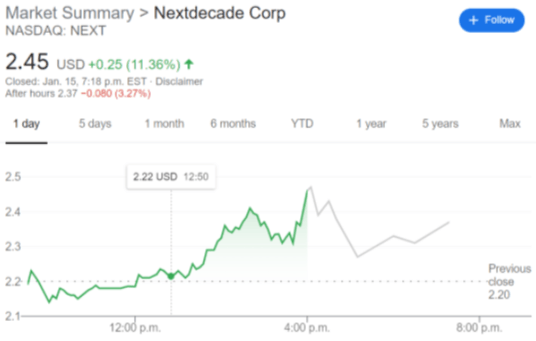
NEXT stock price chart

Despite this, NextDecade is still in negotiations with other European countries to provide LNG via their Rio Grande LNG processing location in Texas. NextDecade is working on getting its LNG to target carbon neutrality in anticipation of abiding with Europe's ambitions to be carbon-neutral in the next thirty years. NextDecade is aiming to provide its customers with the lowest greenhouse gas intensity from its LNG resources in the world.

Premium

You have reached your limit of 3 free articles for this month.

Start your subscription and get access to all our original articles.

Subscribe to PremiumSign In

Author

More from Stocks Reporter
Share:

Editor's Picks

AUD/USD falls to near 0.7100 after slipping below 50-day EMA

AUD/USD depreciates after registering minor gains in the previous day, trading around 0.7120 during the Asian hours. The technical analysis of the daily chart shows the pair consolidating sideways within a rectangle pattern, as neither bulls nor bears gain control. The AUD/USD pair is holding a slight bearish tone however as it sits beneath both the nine-day and 50-day EMAs.

160.00: USD/JPY back near intervention territory after upbeat US jobs report

US Nonfarm Payrolls beat expectations by a wide margin in May, with 172K jobs added. The US Dollar rebounds after the release, helping USD/JPY recover from its intraday lows. Warnings from Japanese authorities continue to limit upside potential near the 160.00 threshold.

Gold targets $4,300 amid stronger Dollar

Gold faces increasing selling interest and navigates the area of three-month lows near the $4,300 mark per troy ounce on Friday. The precious metal’s decline comes as traders assess the stronger-than-expected NFP, while the bid bias in the Greenback and higher US Treasury yields also collaborate with the retracement.

Cardano hits five-year low even as Hoskinson clarifies "break" isn't an exit

Cardano (ADA) price is down 10% at press time on Friday, extending losses over 30% so far this week amid Charles Hoskinson's clarification that "break" isn't an exit.

Week ahead – Fed countdown begins amid US inflation data and geopolitical risks

Fed Chair Warsh’s first meeting approaches as key US inflation data could reshape expectations. Oil prices remain elevated as US-Iran talks continue; tariffs also return to the spotlight. ECB is expected to hike; will it be a one-off move or is July live?

The US economy defies the rules: 100 days into the Oil shock and the recession signal is still missing

More than three months after the start of the Iran war and the resulting disruption to global energy markets, the US economy continues to display remarkable resilience. The conflict has triggered a sharp rise in Oil prices, reignited inflationary pressures and fueled widespread concerns about a potential economic slowdown.