|

NatWest shares slide despite beating on profits

NatWest followed up its announcement that it was buying wealth manager Evelyn Partners for £2.7bn earlier this week, with a solid set of full year results today.

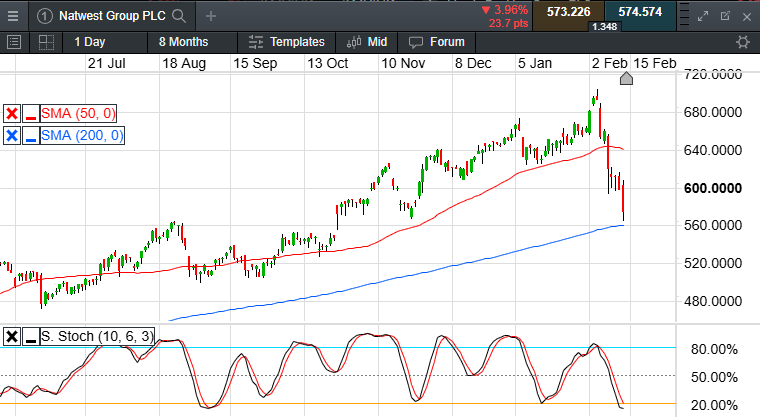
Rather surprisingly this hasn’t been enough to prevent its shares from falling to their lowest levels since October 2025, testing the 200-day SMA in the process, having started February well above the 700p level.

Chart here
Source: CMC Markets

On any measure today’s Q4 and full year numbers are impressive, with net interest income rising by 13.8% on an annual basis to £12.8bn, while total income jumped 13.2% to £16.64bn.

Total profits for the year rose 21.3% to £5.83bn, despite an 86.9% increase in annual impairments to £671m.

The bank reported a sizeable increase in net interest margin of 21bps to 2.34%, in spite of a falling rate environment.

On guidance NatWest management were equally bullish saying that they expect total income for 2026 to be in the region of between £17.2bn and £17.6bn, and to deliver ROTE in excess of 17%.

The bank announced a final dividend of 23p per share, taking the total dividend for the year to 32.5p, a 51% increase on 2024, which you would have expected to have halted the recent slide in the share price, but no.

There still seems to be some short-term negativity around the price paid for Evelyn Partners at the expense of the share buybacks.

This could well pass once it becomes apparent that the deal is likely to add more value in the long term as the short-term effect of lower buybacks fades.    

Author

Michael Hewson MSTA CFTe

Michael Hewson MSTA CFTe

Independent Analyst

Award winning technical analyst, trader and market commentator. In my many years in the business I’ve been passionate about delivering education to retail traders, as well as other financial professionals. Visit my Substack here.


More from Michael Hewson MSTA CFTe
Share:

Editor's Picks

EUR/USD: Cautiously optimistic near 1.1550 ahead of the ECB

EUR/USD extends its weekly recovery for the third day in a row on Wednesday, navigating in a sidelined fashion around 1.1550 on the back of humble losses in the US Dollar. In the meantime, market participants continue to closely follow developments in the Middle East while slowly gearing up for the ECB gathering on Thursday.

GBP/USD recedes from tops, hovers around 1.3400

GBP/USD could not sustain the initial bull run and is now slipping back toward the 1.3400 neighbourhood on Wednesday. Cable’s continuation of the ongoing leg higher follows mild selling pressure on the Greenback, despite steady uncertainty on the geopolitical front and elevated US inflation.

Gold bleeding continues as Middle East crisis escalates, Fed hike coming

Gold is accelerating its downward trends and approaches the area of $4,100 per troy ounce on Wednesday, where the 2026 bottom sits so far. The persistent decline in the precious metal almost exclusively follows the swelling opinion that the Fed will keep a cautious stance in H2, a view that was reinforced following earlier US CPI data.

$1,500: Why Ethereum just crashed 20% despite spot markets barely selling
Ethereum (ETH) recently suffered one of its sharpest declines of 2026, dropping more than 20% and briefly testing the $1,500 area. While the sell-off appeared to reflect broader market fears, derivatives and on-chain data suggest a more complex story may be unfolding beneath the surface.
Brutal sell-off: Silver deepens months-long slide, refocusing on $60

Silver has never been known for its calm temperament. The precious metal can spend weeks grinding higher before suddenly giving back months of gains in a matter of days. That volatile reputation has been on full display in recent weeks.

The US economy defies the rules: 100 days into the Oil shock and the recession signal is still missing

More than three months after the start of the Iran war and the resulting disruption to global energy markets, the US economy continues to display remarkable resilience. The conflict has triggered a sharp rise in Oil prices, reignited inflationary pressures and fueled widespread concerns about a potential economic slowdown.