Nasdaq 100 Micro futures hold the lower structure floor into New York

The late-2025 two-way framework remains intact, with 24,833–25,002 acting as the key daily support band. A hold keeps 25,138/25,274/25,467 in play, while failure shifts focus to 24,562 and the lower band.
Nasdaq 100 Micro futures hold a key daily floor as New York approaches
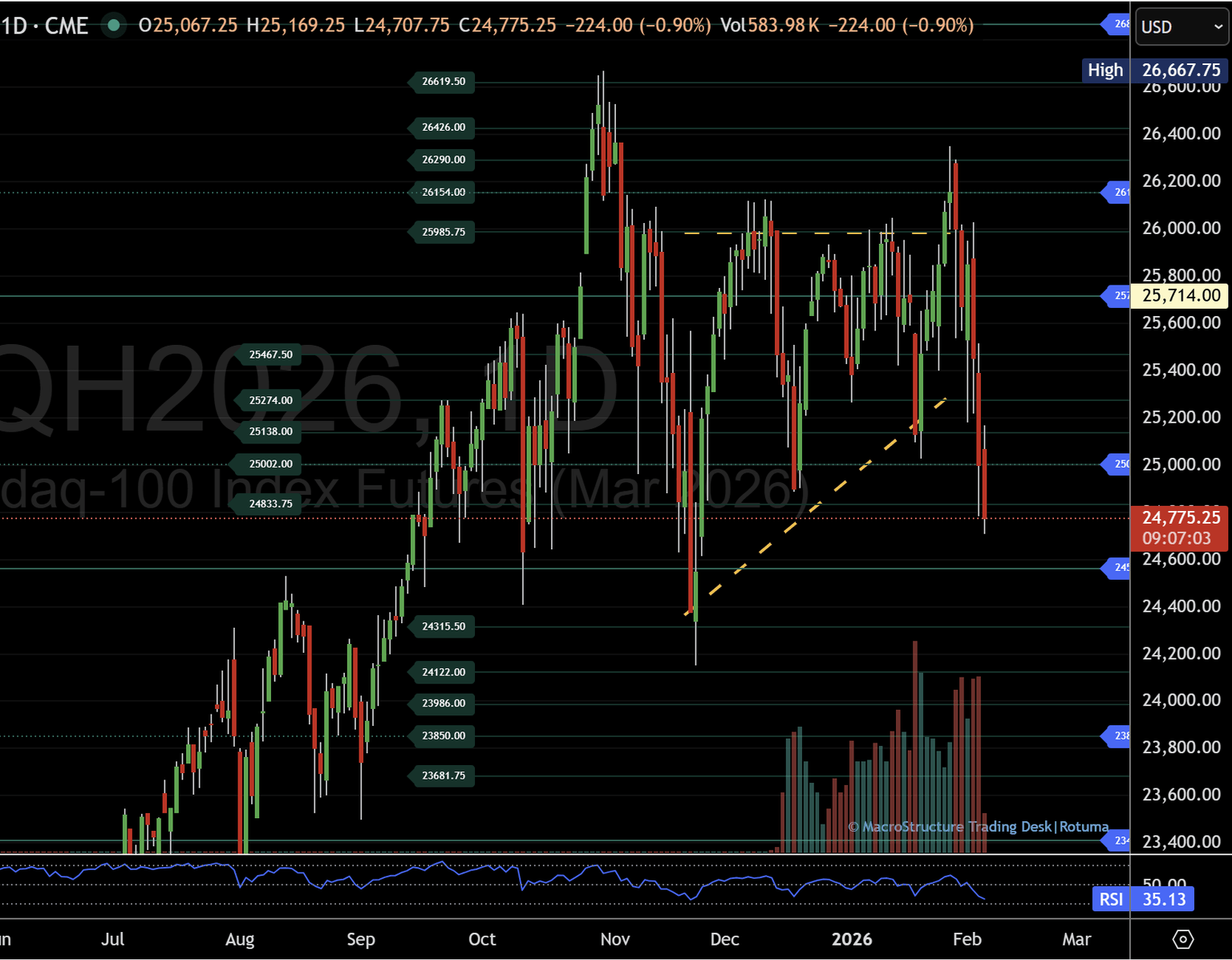
Nasdaq 100 Micro futures (MNQ) have rotated back into the lower half of the same two-way structure that has been in place since the late-2025 desk work. The framework itself hasn’t changed — the only variable has been where price is operating within it since the decline over the past two sessions.
Today’s focus is the daily timeframe, where the market is now pressing into a well-defined support shelf that has repeatedly acted as the “floor” of the current range. From a structure-first view, the next decisions are simple: either the market defends the floor and begins repairing value back toward the middle of the range, or it fails the shelf and transitions into the next downside phase.
The daily floor that matters: 24,833–25,002
The 24,833–25,002 band (Micro 1–2) is the immediate support zone doing the heavy lifting. As long as price can continue to respond from this area and avoid acceptance below it, the two-way structure remains intact and the session stays in “range repair” mode.
The risk increases if price begins spending time below 24,833, because that opens the door to a test of the next pivot zone where the market can either stabilize… or roll into a new phase.
The downside trigger: 24,562
Below the floor, the next reference is 24,562. This level is less about a single tick and more about acceptance — whether the market trades below it and stays below it (time + continuation), rather than quickly snapping back into the prior range.
If 24,562 fails to attract responsive buying, the next lower references come into play at 24,315 and 24,122, where the market previously found balance and where responsive demand may attempt to reappear.
What the market is telling us into the New York open
The cleanest way to frame today is as a decision day around the lower boundary of the range.
Scenario 1: Floor holds, and value begins to repair higher
If the 24,833–25,002 band holds, the first objective is not a “trend call,” but a repair sequence: price spending time back above the shelf and pulling value upward toward the nearest volume references.
In that case, the recovery checkpoints above are:
- 25,138 (first repair zone and nearby volume reference).
- 25,274 (next step in the reclaim sequence).
- 25,467 (a higher reclaim point that would place price back into a stronger range territory).
A constructive hold typically shows up as repeated responses from the band and reduced downside follow-through — not perfection, but evidence that sellers are no longer able to press and hold price below the shelf.
Scenario 2: Floor fails, and rotation continues to the next lower shelf
If price loses 24,833 and cannot reclaim it, attention shifts quickly to 24,562. This is the level that can define whether the market is still “rotating within structure” or beginning to transition into the next downside phase.
Below 24,562, the market has room to rotate to:
- 24,315.
- 24,122.
In this scenario, rallies that cannot regain the prior shelf tend to behave like sell-to-defend moves, where the market revisits the breakdown zone, rejects, and continues lower.
TPO and volume context: Where the market is anchored
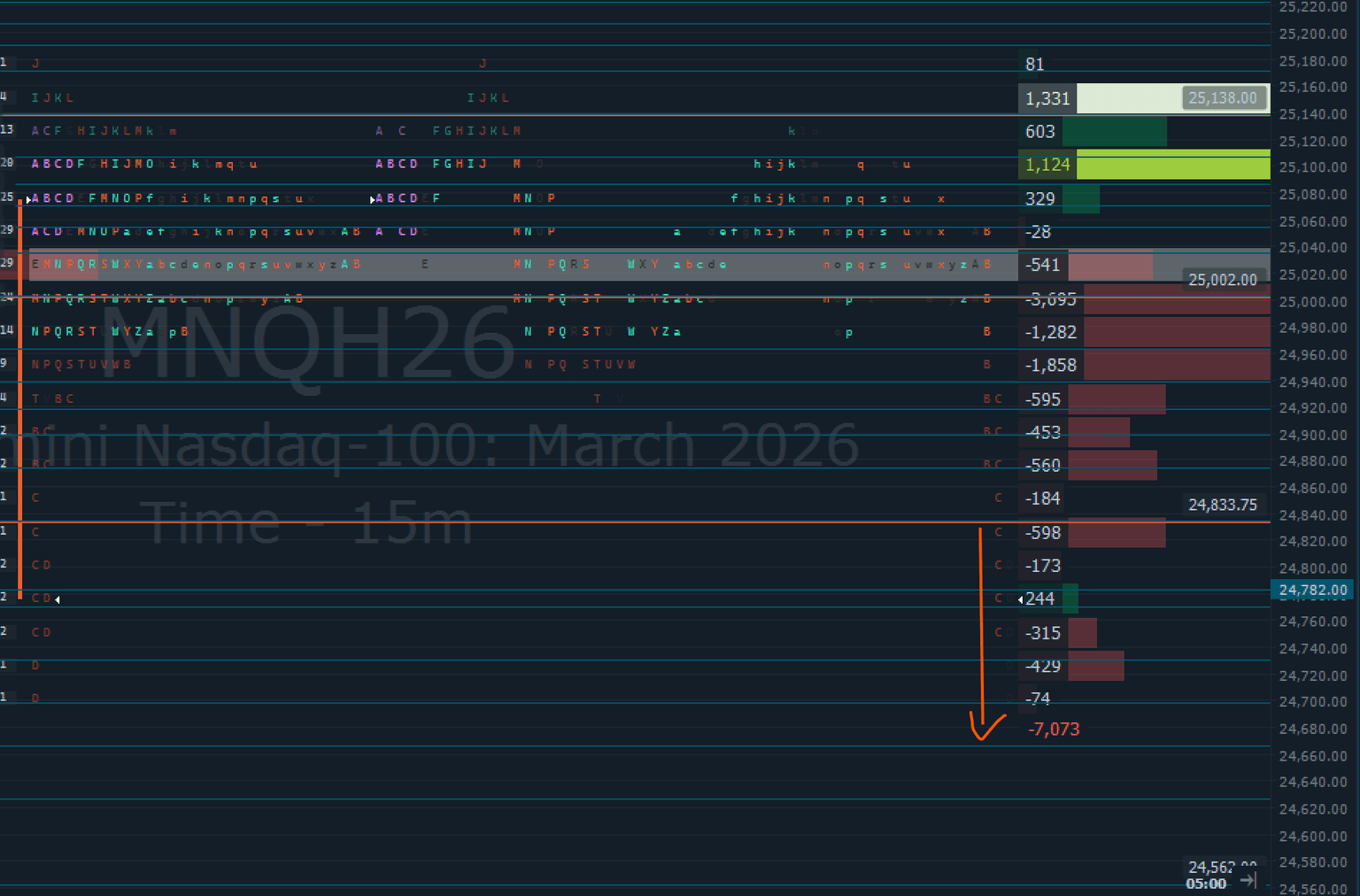
From a profile perspective, the market still reads as a range environment, but one that has recently shifted into a defensive posture after the sell pressure of the past two sessions.
The profile references to watch are:
- POC near ~25,000, acting as a balance anchor.
- Additional volume reference near ~25,138, which sits as the first meaningful “repair” area above the floor.
The practical read is straightforward: acceptance back above 25,002–25,138 helps the market rebuild value higher and supports the repair scenario. If price remains trapped below that region, the tape stays vulnerable to another push into the lower shelf — especially if selling pressure reappears during the New York drive.
A simple New York checklist
Rather than forcing direction, today’s decision points can be tracked with a few clean questions:
- Does price hold 24,833–25,002 and spend time back above 25,002?
- Can the market reclaim 25,138 and keep value building above it?
- If 24,833 fails, does 24,562 act as a stabilising shelf or a trapdoor?
- If acceptance develops below 24,562, does rotation accelerate toward 24,315–24,122?
Levels summary
Support: 25,002 / 24,833.
Downside trigger: 24,562.
Lower references: 24,315 → 24,122.
Recovery checkpoints: 25,138 → 25,274 → 25,467.
These desk updates document a structure-first process, observing how price accepts or rejects predefined levels over time. Coverage spans futures, commodities, forex, bonds, crypto, stocks, and indices, with structure providing context before direction. This observation is for informational purposes only and does not constitute financial advice.
Structure defines context; price reveals response.
Author
Denis Joeli Fatiaki
Independent Analyst
Denis Joeli Fatiaki possesses over a decade of extensive experience as a multi-asset trader and Market Strategist.