|

MULN Stock Forecast: Mullen Automotive surges after completing ELMS acquisition

  • NASDAQ: MULN gained 57.1% during Wednesday’s trading session. 
  • Mullen Automotive completes its acquisition of Electric Last Mile Solutions. 
  • The EV maker is also set to produce its first 300 electric delivery vans for DelPak.

Mullen Automotive (MULN) skyrocketed on Wednesday after a recent acquisition deal was officially completed. The company also provided plans for development for the future, and investors were eager to buy up the discounted shares. On Wednesday, shares of MULN soared by 57.1% and closed the trading session at a price of $0.34. Stocks cooled off after back-to-back positive sessions to start the week. Despite more strong earnings reports on Wednesday, 10-year treasury bond yields hit their highest levels since July 2008. Overall, the Dow Jones lost 0.3%, the S&P 500 dropped by 0.7%, and the Nasdaq sank by 0.9% during the session. 

Mullen Automotive stock price

What was the reason for Mullen’s big surge on Wednesday? The company officially completed its recent acquisition of Electric Last Mile Solutions (ELMSQ). Mullen announced that it would be using the plant in Indiana to produce the upcoming FIVE crossover EV as well as several models from another recent acquisition, Bollinger Motors. In the end, Mullen ended up paying a total of $240 million for ELMS, which is more than its own current market capitalization. The Indiana plant provides Mullen with the ability to produce up to 50,000 vehicles per year. 

Mullen also provided an update on another recent partnership, this one is with Amazon (AMZN) delivery partner DelPak Logistics. Mullen noted that the first 300 electric delivery trucks should be ready by the end of November, with the next 300 to be delivered over the next year or so. The electric last-mile delivery truck sector has heated up in recent months with RIvian (RIVN) and Canoo (GOEV) securing their own high-profile partnerships. 
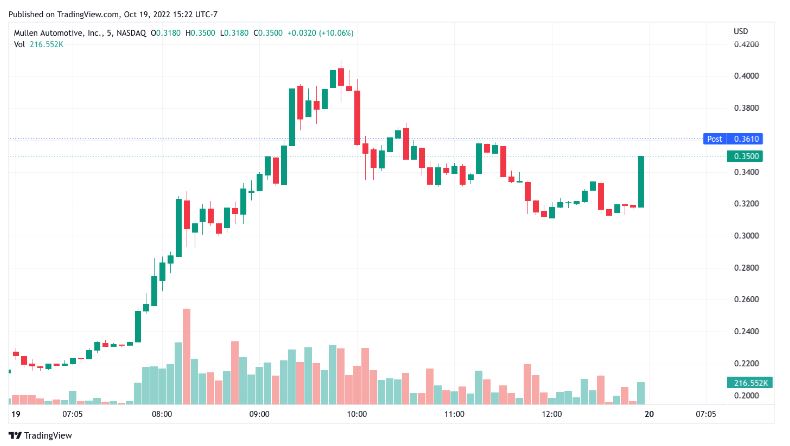
MULN 5-minute chart 20-10-22

Author

More from Stocks Reporter
Share:

Editor's Picks

GBP/USD extends the drop to 1.3360

GBP/USD builds on Monday’s decline and briefly clinches five-day lows near 1.3360 on Tuesday. Cable’s extra pullback follows the better tone in the Greenback as uncertainty in the Middle East prompts investors to adopt a cautious stance. Meanwhile, an apathetic UK labour market report also collaborates with the selling pressure on the British Pound.

EUR/USD looks inconclusive near 1.1420

EUR/USD trades in a tight range in the low 1.1400s on Tuesday, struggling to gain momentum amid an equally absence of clear direction in the US Dollar (USD). Uncertainty surrounding the US-Iran conflict is capping the pair’s upside, while traders avoid taking significant positions ahead of Thursday’s ECB gathering.

Gold shows signs of life; focus is back to $4,100

Gold gains ground on Tuesday, reversing Monday’s pessimism and advancing toward the $4,100 mark per troy ounce. Nevertheless, uncertainty surrounding the Middle East conflict and rising expectations for a hawkish Fed policy outlook are expected to limit the precious metal’s bullish momentum in the near term.

XRP extends recovery as on-chain activity grows
Ripple (XRP) ticks up and trades around $1.13 at the time of writing on Tuesday. This rebound aligns with a broader recovery in the cryptocurrency market, attributed to reports that mediators between the United States (US) and Iran are seeking a 10-day cessation of strikes to find a way back to the signed Memorandum of Understanding (MoU).
The Iranian war has again risen
The Iranian war has again risen to the top of the economics factor list. There is no end in sight. Intelligence experts say the current level of offense/retaliation will not change minds in Tehran, while in Washington, Trump fears all-out war, which would mean boots on the ground.
US Dollar mid-year outlook: Exceptional currency, exceptional risks?
The US Dollar enters the second half of 2026 in a markedly different position from a year ago. The King currency has recovered, reflecting persistent US inflation, changing expectations for Fed policy, geopolitical tensions and renewed demand for defensive assets.