|

MULN Stock Forecast: Despite stake in Bollinger Motors, MULN trading down 9% on Friday

  • NASDAQ:MULN fell by 9.27% during Thursday’s trading session.
  • Mullen acquired a 60% stake in EV Truck startup Bollinger Motors.
  • General Motors is banking on the Electric version of its Equinox SUV.

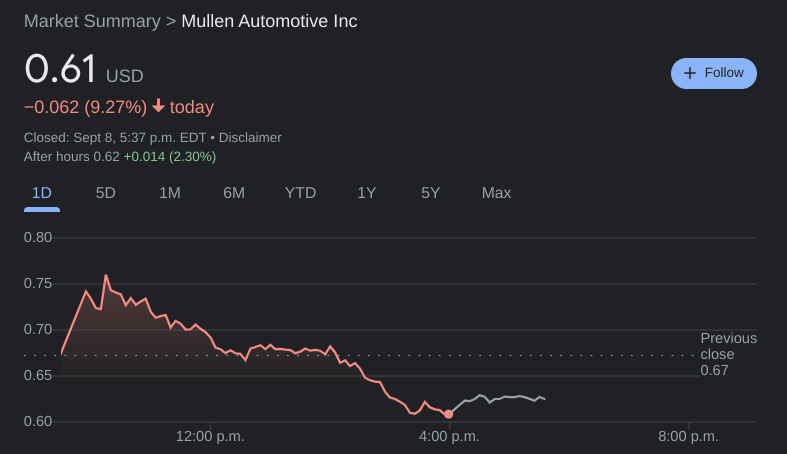
UPDATED: Mullen Automotive stock dropped more than 9% on Friday to trade around $0.5545 despite the recent news of its majority stake in Bollinger Automotive. That news sent the stock up to $0.76 at the beginning of Thursday's session, but the rest of the day saw traders take profits. MULN stock is now down 30% over the past month. It began trading on August 9 around $0.79. Shares of the EV startup have now broken through support from February in the low $0.60s.

NASDAQ:MULN had a volatile day of trading and was even halted at one point in the morning due to the impending announcement. On Thursday, shares of MULN tumbled by 9.27% and closed the trading session at a price of $0.61. Stocks extended their gains from Wednesday as all three major averages closed higher for the second straight day. The markets briefly dipped into the red as Chairman Powell reiterated the need to hike rates to battle inflation. Overall, the Dow Jones gained 193 basis points, the S&P 500 added 0.66%, and the NASDAQ rose higher by 0.60% during the session.


Stay up to speed with hot stocks' news!


The major announcement that halted Mullen’s stock this morning was that the company acquired a controlling stake in Bollinger Motors. Bollinger is an EV Truck startup that made headlines as a potential early competitor to Tesla’s (NASDAQ:TSLA) Cybertruck. Mullen acquired the 60% stake in the company for a price of $148.2 million cash, which investors clearly thought could be spent better elsewhere. The stock initially surged higher by double digits, only to pare those gains and close the day nearly 10% lower.

Mullen stock price
MULN Stock

In other EV news, General Motors (NYSE:GM) is counting on a mass adoption of its EV offerings with the $30,000 Equinox SUV model. It will be one of the more affordable offerings in the industry and is set to hit retail floors next fall. GM is working on transitioning its full lineup of vehicles to all electric by the year 2035.


Like this article? Help us with some feedback by answering this survey:

Author

More from Stocks Reporter
Share:

Editor's Picks

AUD/USD bulls regain control above 0.6950 amid USD retreat

AUD/USD regains traction and extends the previous day's bounce from the weekly low, aiming for 0.7000 in Asia on Friday. The overnight pullback in US bond yields keeps the US Dollar below an 18-month high, which in turn offers some support to the pair. Meanwhile, hawkish RBA expectations also keep the major underpinned.

USD/JPY holds gains near 158.00 after Japan's weak Household Spending data

USD/JPY clings to gains around 158.00 after data showed on Friday that Japan's Household Spending fell for the ninth straight month, undermining the Japanese Yen. Meanwhile, the US Dollar remains depressed as the overnight fall in US bond yields counters a hawkish Fed and geopolitical uncertainties, could cap any downside in the pair.

Gold remains range-bound below $4,200

Gold has given up some ground after an initial bullish attempt to reach weekly highs, returning to below the $4,200 mark per troy ounce on Friday. The US Dollar’s strong upside momentum, combined with rising US Treasury yields across the curve, seems to keep further gains in the yellow metal under scrutiny.

Has Bitcoin really escaped the macro forces it was built to fight?
Over 17 years ago, Satoshi Nakamoto designed Bitcoin (BTC) on the back of a global financial crisis as an alternative to the global monetary system outside the control of central banks, governments and traditional intermediaries. This raises a key question: has Bitcoin really become independent of the macroeconomic forces it was built to challenge?
The Euro is not the sick man of Europe. France's bond market is
EUR/USD remains under pressure, near the 17-month low of 1.1161 reached on Monday. The pair has lost more than 7% since its yearly peak, as concerns over France's public finances increasingly weigh on the single currency. But behind the weakness of the Euro (EUR), the problem does not necessarily lie with the European economy as a whole.
Has Bitcoin really escaped the macro forces it was built to fight?
Over 17 years ago, Satoshi Nakamoto designed Bitcoin (BTC) on the back of a global financial crisis as an alternative to the global monetary system outside the control of central banks, governments and traditional intermediaries. This raises a key question: has Bitcoin really become independent of the macroeconomic forces it was built to challenge?
















