Mullen Automotive Stock Forecast: MULN advances on plan to save $170 million
- Mullen Automotive says it will endeavor to save $170 million over next year.
- MULN stock rises 2% in Monday market on new cost-saving strategy.
- Mullen stock is down 70% already this year.
- EV company aims to sell 100 commercial units in April.

Mullen Automotive (MULN) stock gained 2.75% on Monday as the California-based electric vehicle (EV) manufacturer debuted a new cost-saving strategy to streamline its operations. CEO David Michery and other officials expect that the new plan will reduce costs by $170 million over the next year as Mullen focuses on optimizing its commercial vehicle segment.
Mullen rose 2.75% to $4.11 by the close but was up more than 6% earlier in the session. The S&P 500, Dow Jones and NASDAQ ended the day largely flat with only the NASDAQ producing a gain of 0.03%. The other indices retreated about the same amount.
Mullen stock news
Mullen’s eagle-eyed focus on revving up sales from its commercial segment are being pushed into hyperdrive. CEO Michery enumerated three parts of the strategy:
- Prioritizing near-term revenue and reducing non-commercial initiatives
- Consolidating the Troy and Irvine engineering offices
- Expanding national commercial dealer network
“Momentum is increasing and we have transactions with fleets of varying sizes and vocations,” said Brad Sigmon, vice president of Randy Marion Automotive Fleet Operations, Mullen's commercial dealership partner. “Building on March transactions, our April goal is to move 100 units of Mullen Commercial EVs.”
By consolidating certain initiatives and ceasing certain non-core parts of the business, Mullen hopes to save $170 million in operating expenses in the coming four quarters. That figure does not take into account the most recent two quarters ending in December and March. Instead, it involves savings of $170 million when compared to the 12 months ending on September 30, 2023.
More specifically, Mullen's statement reads: “Reductions in operating cash flows are estimated to be approximately $69 million and investment spending is estimated to contract by $101 million over the next 12 months when compared to the Company’s spend over the last fiscal year.”
The trimming of the fat comes at a significant crossroads for the company, which may need to raise further funding this year in order to meet its production goals. CEO Michery has at least intimated to shareholders that he wants to halt dilution of MULN stock in 2024, instead focusing on raising debt.
The company is focused on sales of its Mullen ONE delivery van, Mullen CAMPUS and Mullen THREE cab chassis.
Mullen Automotive FAQs
Mullen Automotive is a publicly-traded development-stage electric vehicle company based in Brea, California that typically uses outside partnerships to manufacture its vehicles. The company was founded in 2014 and currently sells self-designed electric delivery vehicles. Besides its commercial offerings, Mullen plans to begin manufacturing its Mullen FIVE EV crossover in late 2024 or early 2025. Mullen Automotive went public on the NASDAQ exchange through a reverse merger in late 2021.
David Michery has been the company’s CEO since he founded and incorporated the company in 2014. The existing company came from the merging of CODA Automotive and Mullen Motor Cars through acquisition. Michery is joined by Chief Financial Officer Jonathan New, Chief Commercial Officer John Schwegman and President of the Automotive Division Calin Popa.
Through a partnership with Randy Marion Automotive Group, Mullen distributes its Mullen One delivery van that has an electric range of 110 miles. Through an agreement with a Chinese manufacturer and distributor based in Ireland, the company also distributes the Mullen-GO Commercial Urban Delivery EV in Europe. In July 2023, Mullen will begin commercial production at its facility in Mississippi of its Class 3 EV Cab Chassis long-haul truck for immediate delivery. Through its 60% ownership stake in Bollinger Motors, Mullen will also reap the benefits of that company’s B1 SUV and B2 pickup truck, as well as other commercial vehicles in the future. The Mullen FIVE crossover vehicle is not slated for production until at least late 2024, but it is already taking reservations.
Mullen has been diluting its stock since going public in late 2021. This is because the company as of yet currently has little revenue from operations and no profits. The stock has fallen over 99% since the company’s reverse merger in November 2021, and the rapid dilution is mostly to blame. Taking into account Mullen’s 1-for-25 reverse stock split on May 4, 2023, Mullen had 33,338,727 shares outstanding on September 30, 2022, but 126,281,274 shares on March 31, 2023. The company is allowed to sell up to 200 million shares under current authorization.
Mullen stock forecast
Mullen stock is down 70% year to date and 99% over the past year. Following its most recent reverse stock split last December, MULN has continued to crash as prior warrants were cashed in for common stock, putting downward pressure on the share price.
There is no reason to believe that Monday’s gains will survive. The one constant in MULN’s history is its downtrend. This is the type of stock that should never be held long term. Opportunistic bulls might enter the fray, however, if MULN stock can overtake the 21-day Simple Moving Average (SMA) near $5. Further resistance sits at $6.36 and $6.95.
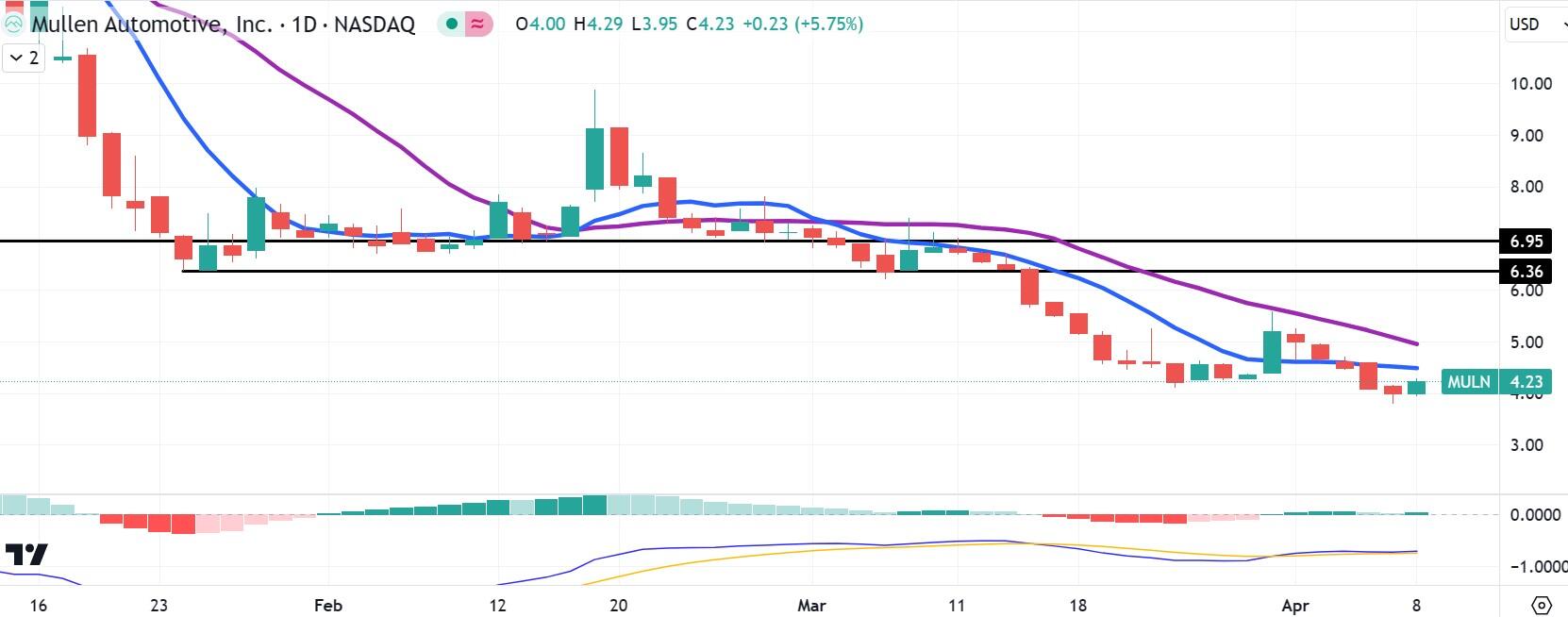
MULN daily stock chart
Author

Clay Webster
FXStreet
Clay Webster grew up in the US outside Buffalo, New York and Lancaster, Pennsylvania. He began investing after college following the 2008 financial crisis.