|premium|

MRNA Stock Forecast: Moderna Inc dips on concerns of allergic reactions to its COVID-19 vaccine

  • NASDAQ:MRNA falls 3.58% despite a market rally coming out of the MLK holiday. 
  • The state of California halts the issuance of Moderna’s vaccine candidate because of allergic reactions. 
  • Moderna’s CEO likens the COVID-19 vaccine market to the seasonal flu.

NASDAQ:MRNA has carried its momentum from the end of 2020 into 2021 so far as the stock has steadily risen throughout the first two trading weeks of the new year. On Tuesday, following the MLK extended holiday in the United States, Moderna shed 3.58% amidst a global market rally that saw the NASDAQ add 1.53% and the S&P 500 add 30 basis points. Moderna continues to be a global leader in the ongoing fight against the novel coronavirus, and investors have reaped the rewards as the stock is up nearly 520% over the past 52-weeks. 

The pullback in price may be related to a recent report out of California that health officials had ordered a halt to the issuance of Moderna’s vaccine candidate mRNA-1273 due to allergic reactions from patients. This is not the first time that the issue of allergies has arisen, as Moderna’s rival Pfizer (NYSE:PFE) also reported reactions when its vaccine was issued in the United Kingdom. Apparently, over 300,000 vaccine doses have been put on pause until health officials can find out more about the reactions, which came from one specific clinic. The shipment that was delivered to that clinic, however, was a part of a larger shipment that distributed over 1.2 million doses around the United States.

MRNA stock price news
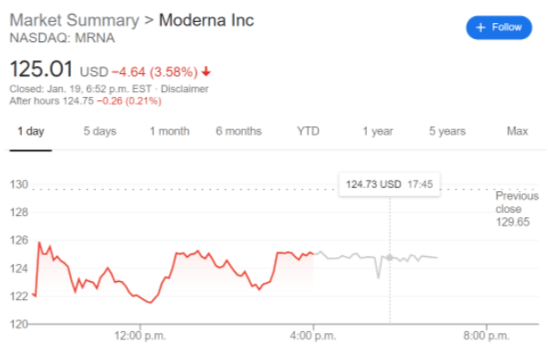
MRNA stock price chart

Recently, Moderna CEO Stephane Bancel caught the ear of investors when he stated that the COVID-19 vaccine could be a recurring seasonal dosage. While this isn’t great news for the population as a whole, it seems Moderna is expecting a recurring revenue stream from mRNA-1273 moving forward. Moderna is already expecting an estimated $11 billion in 2021 from mRNA-1273 alone. 

Premium

You have reached your limit of 3 free articles for this month.

Start your subscription and get access to all our original articles.

Subscribe to PremiumSign In

Author

More from Stocks Reporter
Share:

Editor's Picks

EUR/USD challenges 1.1700, six-week lows

EUR/USD remains under heavy downside pressire in quite a dfrreadful start to the new trading week, putting the 1.1700 support to the test amid the marked rebound in the US Dollar. The flight-so-safety environment continues to support the Greenback following the escalating conflict in the Middle East.

GBP/USD hits new yearly lows near 1.3300

GBP/USD adds to the recent bearish tone, approaching to the key 1.3300 support to reach fresh YTD troughs against the backdrop of the robust performance of the US Dollar. Indeed, Cable’s decline comes amid the firm demand for the safe-haven space in the wake of the US and Israel attacks to Iran.

Gold shifts its attention to $5,600 on fligh-to-safety mood

Gold climbs to levels last seen in late January past the $5,400 mark per troy ounce on Monday. The yellow metal’s strong uptick remains fuelled by incresing geopolitical tensions in the Middle East and the consequent demand for safer assets.

Bitcoin on brink of breakdown amid US-Iran war

Bitcoin (BTC) remains under pressure near the key support level of $65,700. Trading at $66,400 at the time of writing on Monday, a breakdown below this critical level would suggest a deeper correction ahead.

The week ahead: Conflict in the Middle East jolts markets

Events in the Middle East are obviously dominating financial markets this morning. The Brent crude oil price is extending gains and is higher by more than 8%, stock futures are pointing lower and the gold price is higher by more than 2%. 

Pi Network Price Forecast: Core team offloads supply, weighing on PI recovery

Pi Network  hovers below $0.1700, broadly steady at press time on Monday, attempting a recovery after a 2% loss the previous day. Sunday’s decline aligned with nearly 49 million PI tokens offloaded by the Pi Foundation, implying a spike in supply pressure that capped the prevailing four-day recovery.