Mexican Peso falls as US economic data reignites further Fed tightening
- Mexican Peso drops on solid US economic data, with the USD/MXN climbing above 18.00.
- US Retail Sales and Industrial Production showed the US economy's resilience.
- Atlanta Fed GDP Now predicts a 5.45% expansion for the US economy in Q3.
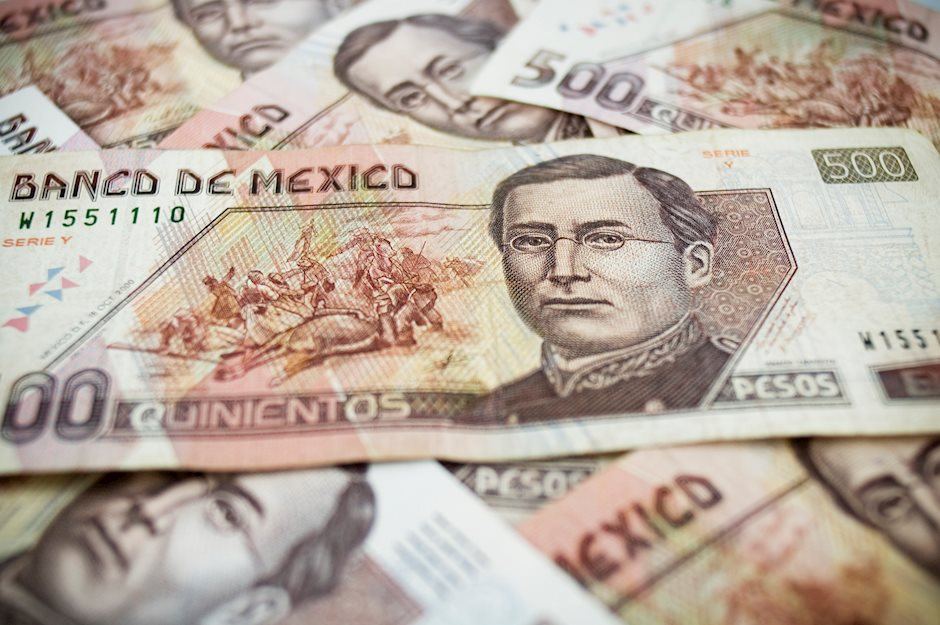

Mexican Peso (MXN) suffered solid losses against the US Dollar (USD) on Tuesday amidst a risk-off impulse, courtesy of elevated Treasury bond yields in the United States (US), after solid data reignited fears of further tightening by the US Federal Reserve (Fed). Therefore, the USD/MXN is trading at 18.01, gaining 0.81%.
The CME FedWatch Tool shows that one in two traders expect a quarter of a percent rate hike by January 2024, after the US Bureau of Economic Analysis (BEA) announced that Retail Sales figures in September beat forecasts despite trailing August’s upward revised numbers. In addition, a solid Industrial Production (IP) September report by the Fed portrays a resilient economy, which, according to the Atlanta Fed GDP Now, projects an expansion of 5.45 for Q3.
Aside from this, risk appetite improved on news of US President Joe Biden’s travel to Israel, where he would meet Israel's PM and Arab leaders.
Daily Digest Market Movers: Mexican Peso falls as USD/MXN buyers reclaim 18.00
- US Retail Sales in September grew by 0.7% MoM, above forecasts of 0.3%, but trailed upward revised August of 0.8%.
- Industrial Production rose 0.3% MoM, better than expected, and the previous month's 0.0% reading.
- Mexico’s 2023 GDP is expected to hit 3.2%, according to the World Bank and the International Monetary Fund.
- New York Fed Empire State Manufacturing Index for October plunged to -4.6, higher than forecasts of -7 but worse than September’s 1.9 expansion.
- Philadelphia Fed President Patrick Harker commented the current level of rates kept house buyers on the sideline, highlighting that the Fed is likely done hiking rates.
- Chicago Fed President Austan Goolsbee said the fall in US inflation is not a bleep, according to the Financial Times.
- Inflation expectations for one year rose from 3.2% to 3.8%, while for five years jumped to 3% from 2.8%.
- Mexico's Industrial Production (IP) for August improved by 5.2% YoY, exceeding forecasts of 4.6% and July’s 4.8% increase.
- Monthly, IP in Mexico rose 0.3% as expected but trailed the previous 0.5% reading.
- The US Consumer Price Index increased 3.7% YoY in September, unchanged from August but above forecasts of 3.6%.
- US core CPI dipped as expected to 4.1% from 4.3% in August.
- Mexico’s Consumer Price Index (CPI) grew by 4.45% YoY in September, slightly below the 4.47% estimated.
- The core CPI inflation in Mexico stood at a stickier 5.76% YoY, as widely estimated, but has broken below the 6% threshold.
- The Bank of Mexico (Banxico) held rates at 11.25% in September and revised its inflation projections from 3.5% to 3.87% for 2024, above the central bank’s 3% target (plus or minus 1%).
Technical Analysis: Mexican Peso descends as technical indicators support further USD/MXN upside
The Mexican Peso is trimming some of its Monday gains. Still, it remains below the 18.00 figure, maintaining its upward bias, unless the USD/MXN drops below the 200-day Simple Moving Average (SMA) at 17.75. In that case, the exotic pair could aim towards 17.50, followed by the 50-day SMA at 17.35. Contrarily, if the pair could re-test the 18.00 figure, which once broke, the pair could rally and test 18.20. Subsequent resistance would be the October 6 high of 18.48.
GDP FAQs
What is GDP and how is it recorded?
A country’s Gross Domestic Product (GDP) measures the rate of growth of its economy over a given period of time, usually a quarter. The most reliable figures are those that compare GDP to the previous quarter e.g Q2 of 2023 vs Q1 of 2023, or to the same period in the previous year, e.g Q2 of 2023 vs Q2 of 2022.
Annualized quarterly GDP figures extrapolate the growth rate of the quarter as if it were constant for the rest of the year. These can be misleading, however, if temporary shocks impact growth in one quarter but are unlikely to last all year – such as happened in the first quarter of 2020 at the outbreak of the covid pandemic, when growth plummeted.
How does GDP influence currencies?
A higher GDP result is generally positive for a nation’s currency as it reflects a growing economy, which is more likely to produce goods and services that can be exported, as well as attracting higher foreign investment. By the same token, when GDP falls it is usually negative for the currency.
When an economy grows people tend to spend more, which leads to inflation. The country’s central bank then has to put up interest rates to combat the inflation with the side effect of attracting more capital inflows from global investors, thus helping the local currency appreciate.
How does higher GDP impact the price of Gold?
When an economy grows and GDP is rising, people tend to spend more which leads to inflation. The country’s central bank then has to put up interest rates to combat the inflation. Higher interest rates are negative for Gold because they increase the opportunity-cost of holding Gold versus placing the money in a cash deposit account. Therefore, a higher GDP growth rate is usually a bearish factor for Gold price.
Author
Christian Borjon Valencia
FXStreet
Christian Borjon began his career as a retail trader in 2010, mainly focused on technical analysis and strategies around it. He started as a swing trader, as he used to work in another industry unrelated to the financial markets.