Mexican Peso backslides on Wednesday despite upbeat MXN Retail Sales

Most recent article: Mexican Peso pushes into familiar highs on Thursday as risk appetite rebounds
- The Mexican Peso middled on Wednesday before a late-day USD bid.
- Mexico's October Retail Sales came in better than expected.
- US Dollar flows helping to prop up MXN despite a dovish Banxico.
The Mexican Peso (MXN) held in place for most of Wednesday trading, pinned into recent highs against the US Dollar (USD) as broad-market selling pressure kept the Greenback in place and gave the Peso a chance to cover more ground even as a dovish Banco de Mexico (Banxico) weighs the potential for rate cuts as soon as 2024’s first quarter.
Bearish pressure on the US Dollar proved to be short-lived, with the US Dollar seeing a late-session break to the topside.
Despite both the Federal Reserve (Fed) and Banxico adopting “data dependant” stances, Mexico’s central bank is far more dovish than its US counterpart. Banxico Governor Victoria Rodriguez Ceja noted recently that Mexico’s interest rate, currently at its highest in over 15 years, could start seeing cuts as soon as 2024’s first quarter.
Banxico held its main rate at 11.25% at its December policy meeting for a sixth straight hold call, after a 15-rate hike run since first raising rates in June of 2021.
Daily digest market movers: Mexican Peso holds on the high side as markets target Greenback underbelly
- Mexico Retail Sales beat the street, rising 3.4% for the year through October versus the forecast 2.0%.
- Over the month, Mexico Retail Sales in October similarly vaulted over the forecast 0.0% to print a 0.8% gain.
- Existing US Home Sales Change showed a 0.8% improvement in November.
- US Existing Home Sales jumped from a 13-year low on a unit basis, climbing from 3.79 million to 3.82 million in November, compared to the median market expectation of a continued decline to 3.77 million.
- US Consumer Confidence also rose to 110.7 in December, compared to November’s 101.0 (revised lower from 102.0).
- Overall market tone is keeping risk appetite pinned into ‘risk on’ territory, pushing down the US Dollar and giving the MXN a slight boost.
- Thursday to see another update on Mexico´s half-month inflation in December.
- 1st half-month Mexico Inflation is forecast to pull back from 0.63% to 0.4%.
- Core Inflation for the 1st half-month is expected to see an increase to 0.48% versus the previous 0.2%.
- Thursday’s US Gross Domestic Product (GDP) print for the third quarter will dominate the calendar headlines. US third quarter GDP is forecast to be confirmed at 5.2%.
Technical Outlook: Mexican Peso holds on the top end amidst market holiday slowdown
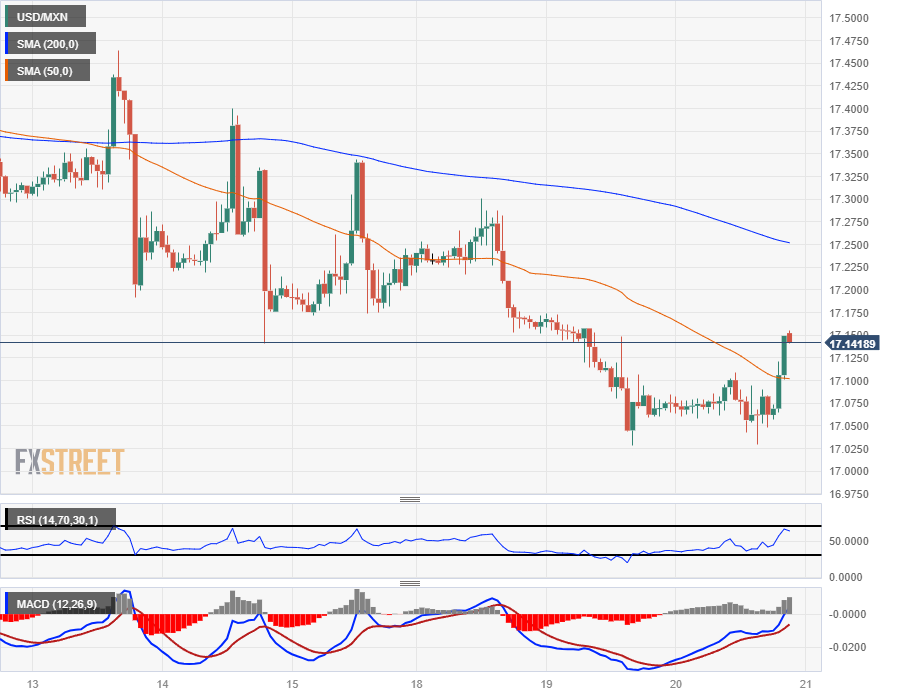
The Mexican Peso briefly stuck in place against the US Dollar through the mid-week market session, with the USD/MXN testing the waters between 17.10 and 17.00. The 17.00 price level remains a major barrier, keeping the pair propped up and limiting MXN gains in the near term.
The USD/MXN made a late break in the US Session, climbing back into 17.15.
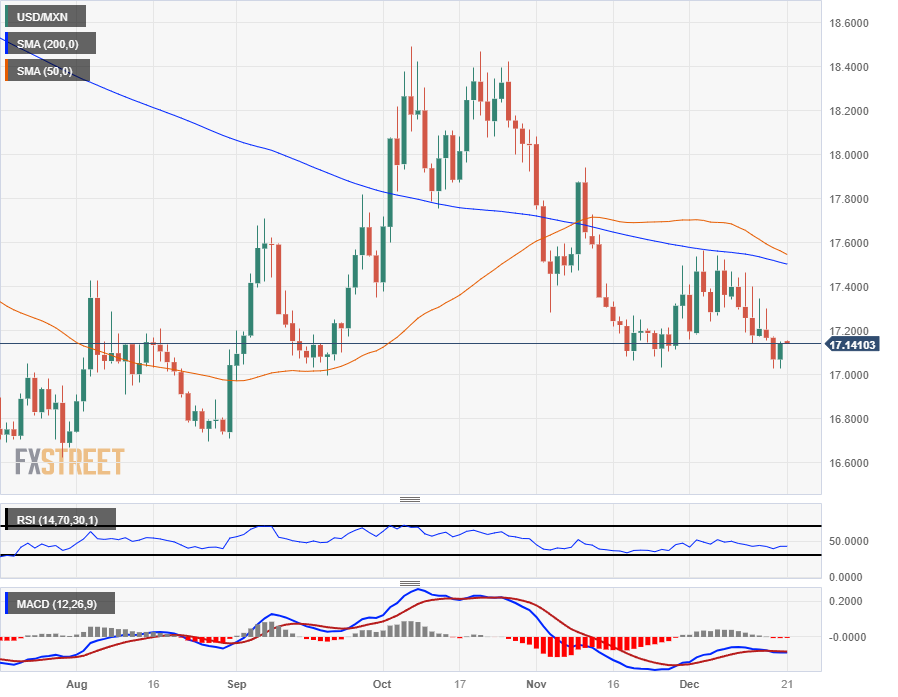
The Peso has gained nearly 3% against the US Dollar since falling from 17.56 after a rejection from the 200-day Simple Moving Average (SMA) earlier in the month.
Intraday action has been capped under the 200-hour SMA descending into 17.25, and near-term momentum is leaning firmly bearish with the 50-hour SMA slipping into 17.10, squeezing the day’s price action into a right range just above 17.02.
USD/MXN Hourly Chart
USD/MXN Daily Chart
Banxico FAQs
What is the Bank of Mexico?
The Bank of Mexico, also known as Banxico, is the country’s central bank. Its mission is to preserve the value of Mexico’s currency, the Mexican Peso (MXN), and to set the monetary policy. To this end, its main objective is to maintain low and stable inflation within target levels – at or close to its target of 3%, the midpoint in a tolerance band of between 2% and 4%.
How does the Bank of Mexico’s monetary policy influence the Mexican Peso?
The main tool of the Banxico to guide monetary policy is by setting interest rates. When inflation is above target, the bank will attempt to tame it by raising rates, making it more expensive for households and businesses to borrow money and thus cooling the economy. Higher interest rates are generally positive for the Mexican Peso (MXN) as they lead to higher yields, making the country a more attractive place for investors. On the contrary, lower interest rates tend to weaken MXN. The rate differential with the USD, or how the Banxico is expected to set interest rates compared with the US Federal Reserve (Fed), is a key factor.
How often does the Bank of Mexico meet during the year?
Banxico meets eight times a year, and its monetary policy is greatly influenced by decisions of the US Federal Reserve (Fed). Therefore, the central bank’s decision-making committee usually gathers a week after the Fed. In doing so, Banxico reacts and sometimes anticipates monetary policy measures set by the Federal Reserve. For example, after the Covid-19 pandemic, before the Fed raised rates, Banxico did it first in an attempt to diminish the chances of a substantial depreciation of the Mexican Peso (MXN) and to prevent capital outflows that could destabilize the country.
Author

Joshua Gibson
FXStreet
Joshua joins the FXStreet team as an Economics and Finance double major from Vancouver Island University with twelve years' experience as an independent trader focusing on technical analysis.















