Mexican Peso depreciates on carry-trade outflows, US Durable Goods defy expectations

Most recent article: Mexican Peso weakens amid judiciary reforms fears and Banxico’s dovish commentary
- The Mexican Peso is trading lower in key pairs on carry trade outflows stimulated by a strengthing JPY.
- Furth downside comes from an increase in risk aversion from the escalating Middle East conflict.
- Technically, USD/MXN pulls back within a rising channel.
The Mexican Peso (MXN) is trading lower in its most-traded pairs on Monday morning as traders arrive at their desks after the weekend break.
The continued appreciation of the Japanese Yen (JPY) suggests more outflows from the Mexican Peso as the carry trade unwinds. That, and fears of an escalation in the Middle East conflict after a bloody exchange between Israel and Hezbollah is weighing on riskier assets, including the MXN.
US Durable Goods orders, released during the US session, showed a 9.9% surge in Durable Goods orders in July, which was a big turnaround from the 6.9% decline in the previous month, and well above consensus estimates of a 4.0% increase. It was the largest gain since May 2020 and suggested a resilience in the US economy that goes against the countervailing mood of pessimism.
That said, the USD/MXN remained little changed in the minutes after the release, trading at 19.21, only a few centavos higher than prior to the release.
Mexican Peso benefits from Fed Powell’s Jackson Hole speech
The Mexican Peso experienced a temporary recovery on Friday, triggered by a speech from the Chairman of the Federal Reserve (Fed) Jerome Powell at the Jackson Hole banking symposium, in which he confirmed the Fed would be cutting interest rates. Powell said a noted slowdown in the US labor market was a key reason to lower borrowing costs.
“The timing and pace of rate cuts will depend on incoming data,” said Powell, adding, "upside risks to inflation have diminished, downside risks to employment have increased."
His comments sent the US Dollar (USD) lower in its pairs since the expectation of lower interest rates is negative for a currency as it usually results in a fall in foreign capital inflows. USD/MXN ended the day down over two percent. EUR/MXN and GBP/MXN also fell, but to a lesser degree.
After Powell’s speech other Fed officials chimed in with similar opinions. Chicago Fed President Austan Goolsbee said attention needed to be given to the cooling job market since inflation was now on its way sustainably lower, in an interview with Bloomberg News. Philadelphia Fed’s Patrick Harker said the Fed needed to be methodical in its approach to reducing interest rates, cautioning, perhaps, against any large step-decreases in interest rates.
Overall the Mexican Peso is in a downtrend, and despite Friday’s recovery rally still ended the week substantially weaker in its key pairs. A combination of factors, including cooler-than-expected Mexican inflation data for August, weaker retail sales in July and resurfacing concerns regarding the impact of proposed changes to the Mexican constitution by the new government, have been posited as factors weighing on the currency.
Carry-trade outflows a headwind
The carry trade – which benefited the Peso with high inflows of foreign capital for several years – is unwinding, adding a further negative background factor for MXN. The investment operation involves traders borrowing in a currency where interest rates are low – like the Japanese Yen (JPY) – in order to purchase a currency where interest rates are high – like the Peso.
Assuming no change in the exchange rate, traders pocket the difference between the interest they have to pay on the loan and the interest they earn from the investment. However, given the Japanese Yen (JPY) is now trending higher and the Mexican Peso lower, the carry trade is not as profitable as it used to be, and this is causing outflows from MXN.
Part of the reason for the popularity of the Peso in the carry trade is the relatively high interest rates in Mexico. These, which are set by the Banco de Mexico (Banxico), peaked at 11.25% in 2023. However, the bank has since cut them to 10.75% in two 0.25% reductions.
In August, Banxico surprised markets by cutting rates by 0.25%. The release of the August Banxico meeting Minutes last week, however, shows the decision was only narrowly agreed on, with two of the members of the five-person Banxico board voting against a cut. This suggests further rate cuts may be delayed or implemented at a more leisurely pace – a mildly supportive counterfactor for MXN.
At the time of writing, one US Dollar (USD) buys 19.21 Mexican Pesos, EUR/MXN trades at 21.45, and GBP/MXN at 25.37.
Technical Analysis: USD/MXN pulls back within rising channel
USD/MXN is in a broad uptrend within a rising channel, which overall favors longs over shorts.
After Friday’s decline, however, the short-term trend is unclear and despite the overall bullish technical position there is a risk of more weakness, perhaps back down to the lower channel line at around 18.55. A break below 19.00 would confirm more downside.
USD/MXN Daily Chart
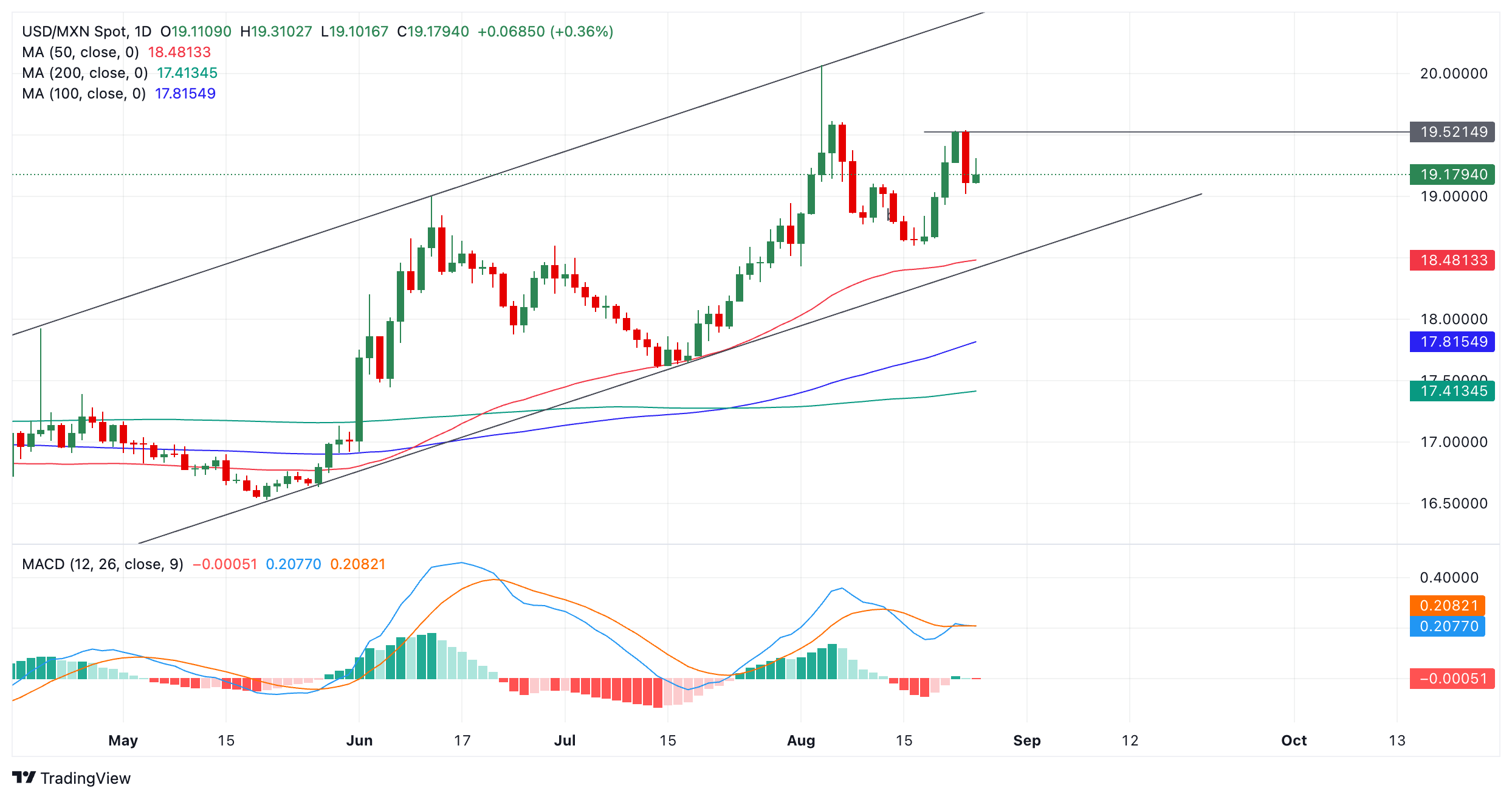
That said, the overall trend on the medium and longer-term time frames is arguably up, suggesting a bullish backdrop. This could easily stimulate a quick recovery and continuation of the up leg seen since August 19, towards a target at the channel highs at circa 20.50.
A break above the 19.53 swing high of August 22 would provide additional confirmation of the continuation of the up leg.
Economic Indicator
Durable Goods Orders
The Durable Goods Orders, released by the US Census Bureau, measures the cost of orders received by manufacturers for durable goods, which means goods planned to last for three years or more, such as motor vehicles and appliances. As those durable products often involve large investments they are sensitive to the US economic situation. The final figure shows the state of US production activity. Generally speaking, a high reading is bullish for the USD.
Read more.Last release: Mon Aug 26, 2024 12:30
Frequency: Monthly
Actual: 9.9%
Consensus: 4%
Previous: -6.6%
Source: US Census Bureau
Author

Joaquin Monfort
FXStreet
Joaquin Monfort is a financial writer and analyst with over 10 years experience writing about financial markets and alt data. He holds a degree in Anthropology from London University and a Diploma in Technical analysis.