Mexican Peso holds gains as the Greenback remains under pressure
- The Mexican Peso holds gains as US Dollar pressure builds.
- US bond markets reopen on Tuesday, contributing to the pair's next move.
- USD/MXN remains in a downtrend with immediate resistance at 19.30.

The Mexican Peso (MXN) is experiencing a steady appreciation against the US Dollar (USD) on Monday, reflecting lingering uncertainty in the United States (US) economic outlook amid concerns about US President Donald Trump’s tariff threats and the country’s fiscal outlook.
With US markets closed for Memorial Day on Monday, the Mexican Peso remains resilient, with the USD/MXN pair trading at around 19.22, down 0.18%, at the time of writing.
As participants keep an eye on US Treasury yields and remarks from US policymakers, they should be aware of the limited liquidity in the US market due to the holiday weekend.
On this week’s economic agenda, the fate of the USD/MXN will likely remain at the mercy of the Greenback and insights provided by the Fed meeting minutes on Wednesday.
Market participants are particularly focused on the release of the Fed’s preferred inflation measure, the US core Personal Consumption Expenditures (PCE) data for April, as well as the University of Michigan consumer sentiment data, which are scheduled for Friday.
These data points are crucial for understanding inflation and consumer sentiment trends, and gauging how US citizens feel about the current economic situation, both of which are important factors that may influence expectations regarding when the Federal Reserve (Fed) might consider cutting interest rates.
Mexican Peso daily digest: USD/MXN faces pressure due to renewed US Dollar weakness
- The US credit rating downgrade, rising expectations of increased US debt levels, and a sell-off in the bond market have placed the resilience of the USD under significant scrutiny.
- The USD struggles to gain ground as investors digest US President Donald Trump’s decision to extend EU tariffs until July 9. The announcement on Monday cheered risk markets, as traders see it as an opportunity for negotiations between the two significant economies.
- On Friday, Trump had threatened to impose 50% tariffs on European Union imports and 25% tariffs on Apple and Samsung smartphones, rattling markets.
- The persistent threats of tariffs from President Trump directed at international counterparts are undermining investor confidence, thereby challenging the USD's status as the preferred reserve currency.
- On Tuesday, US Consumer Confidence data, which gauges Americans’ views about the economy and finances, will be released.
- Wednesday’s agenda will see the publication of the minutes from the May Federal Open Market Committee (FOMC) meeting, offering insights into interest rate discussions, alongside public statements from Fed members providing additional context for future monetary policy.
Mexican Peso technical analysis: USD/MXN pressures support with October low in focus
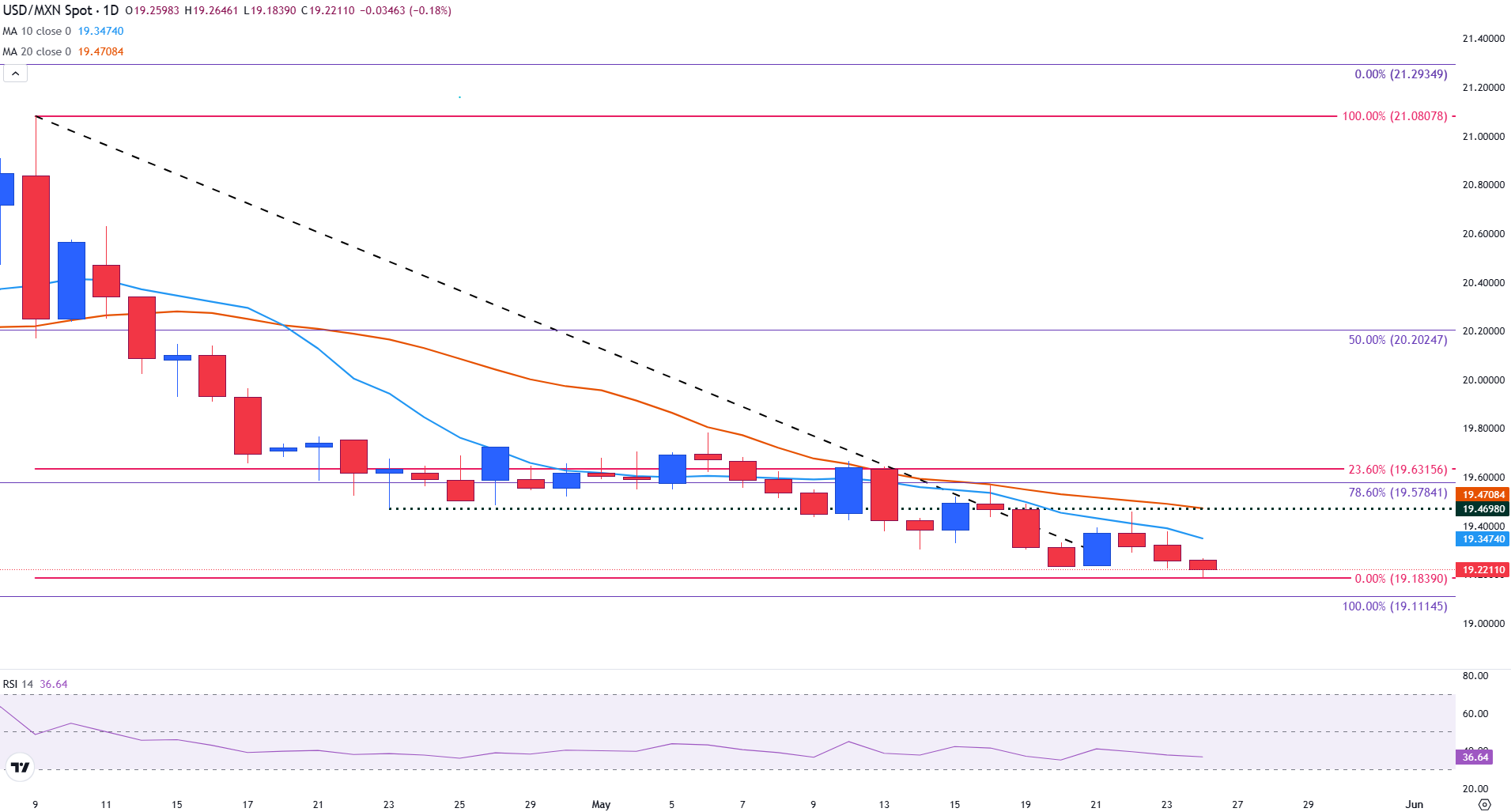
USD/MXN remains entrenched in a firm downtrend, hitting a new year-to-date low just below 19.20 at the time of writing.
Price action continues to hover below both the 10-day and 20-day Simple Moving Averages (SMA), which act as dynamic resistances at 19.34 and 19.47, respectively.
Momentum indicators remain weak, with the Relative Strength Index (RSI) parked at 35.79, suggesting that while bearish momentum, the market is not yet in oversold territory.
With downside pressure building, attention now shifts to the October low at 19.11, which serves as the next major support.
A sustained break below this level could open the door to deeper declines toward 19.00, while any rebound would first need to reclaim 19.47 to shift short-term sentiment.
USD/MXN daily chart
Central banks FAQs
Central Banks have a key mandate which is making sure that there is price stability in a country or region. Economies are constantly facing inflation or deflation when prices for certain goods and services are fluctuating. Constant rising prices for the same goods means inflation, constant lowered prices for the same goods means deflation. It is the task of the central bank to keep the demand in line by tweaking its policy rate. For the biggest central banks like the US Federal Reserve (Fed), the European Central Bank (ECB) or the Bank of England (BoE), the mandate is to keep inflation close to 2%.
A central bank has one important tool at its disposal to get inflation higher or lower, and that is by tweaking its benchmark policy rate, commonly known as interest rate. On pre-communicated moments, the central bank will issue a statement with its policy rate and provide additional reasoning on why it is either remaining or changing (cutting or hiking) it. Local banks will adjust their savings and lending rates accordingly, which in turn will make it either harder or easier for people to earn on their savings or for companies to take out loans and make investments in their businesses. When the central bank hikes interest rates substantially, this is called monetary tightening. When it is cutting its benchmark rate, it is called monetary easing.
A central bank is often politically independent. Members of the central bank policy board are passing through a series of panels and hearings before being appointed to a policy board seat. Each member in that board often has a certain conviction on how the central bank should control inflation and the subsequent monetary policy. Members that want a very loose monetary policy, with low rates and cheap lending, to boost the economy substantially while being content to see inflation slightly above 2%, are called ‘doves’. Members that rather want to see higher rates to reward savings and want to keep a lit on inflation at all time are called ‘hawks’ and will not rest until inflation is at or just below 2%.
Normally, there is a chairman or president who leads each meeting, needs to create a consensus between the hawks or doves and has his or her final say when it would come down to a vote split to avoid a 50-50 tie on whether the current policy should be adjusted. The chairman will deliver speeches which often can be followed live, where the current monetary stance and outlook is being communicated. A central bank will try to push forward its monetary policy without triggering violent swings in rates, equities, or its currency. All members of the central bank will channel their stance toward the markets in advance of a policy meeting event. A few days before a policy meeting takes place until the new policy has been communicated, members are forbidden to talk publicly. This is called the blackout period.
Author

Tammy Da Costa, CFTe®
FXStreet
Tammy is an economist and market analyst with a deep passion for financial markets, particularly commodities and geopolitics.