Mexican Peso surges as US hits the brakes on auto tariffs

Most recent article: Mexican Peso gains as Trump exempts tariffs on USMCA products
- Mexican Peso rebounds 0.92% after hitting a four-week high at 20.99
- Trump administration reportedly considering a one-month tariff delay for automakers.
- Mexico’s economy weakens, with Banxico’s GDP forecast cut to 0.81%.
- Goldman Sachs warns Mexico’s GDP could shrink by up to 4% if tariffs remain.
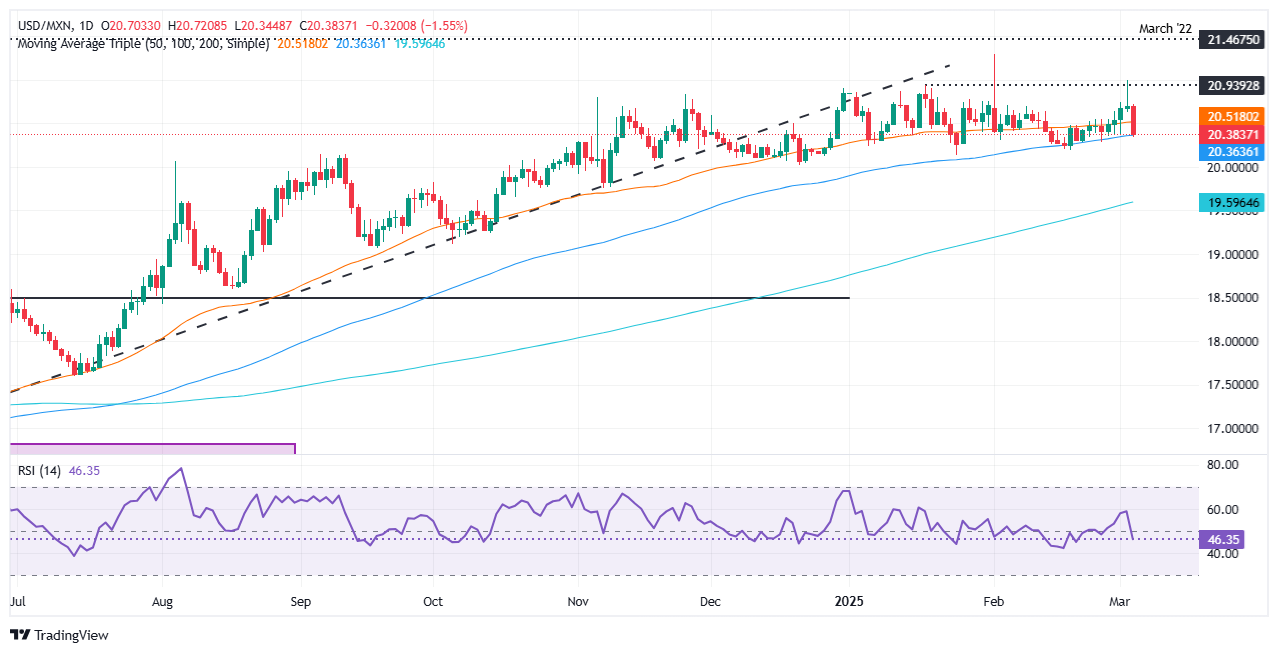
The Mexican Peso (MXN) is recovering some ground against the US Dollar (USD) on Wednesday, on rumors that tariffs imposed by the United States (US) since March 4 could be rolled back or at least adjusted, according to US Commerce Secretary Howard Lutnick. Therefore, the USD/MXN pair retraced after hitting a four-week high of 20.99, trading at 20.38, down over 0.92%.
Bloomberg reported that the Trump administration could be considering another one-month delay of tariffs for automakers in Mexico and Canada, according to people familiar with the matter. The emerging market currency recovered after weakening 2.61% on Tuesday, clawed back, and is up 0.67% in the week, as USD/MXN tests the 100-day Simple Moving Average (SMA) at 20.32.
On Tuesday, 25% tariffs became effective for Mexican imports and sent the Peso plunging. Nevertheless, it seems discussions continued while Mexican President Claudia Sheinbaum said that retaliations will be unveiled on Sunday.
Meanwhile, data shows the Mexican economy continues to deteriorate as Gross Fixed Investment fell in December on monthly and yearly readings. Banco de Mexico’s (Banxico) private analysts' survey revealed that economists project the economy to grow 0.81%, down from a 1% estimate in January 2025.
According to El Financiero, Mexico’s economy is in the midst of a recession, and the Gross Domestic Product (GDP) could contract up to 4% if Trump’s tariffs remain.
Alberto Ramos, Chief Economist for Latin America at Goldman Sachs, stated that even in a scenario with a combined impact of trade policy uncertainty and partial retaliation, Mexico's GDP could shrink by 3% to 3.5%, and inflation could reaccelerate.
However, the Mexican Peso gained steam on Wednesday, a relief rally as traders await an update on tariffs on Mexico.
The Institute for Supply Management (ISM) Services PMI for February revealed that business activity improved. Meanwhile, US jobs data was dismal across the border, spurring fears of a possible recession.
Daily digest market movers: Mexican Peso rallies amid soft US Dollar
- Mexico’s Gross Fixed Investment in December dropped from 0.1% to -2.6% MoM. In the twelve months to December, the figures deteriorated further from -0.7% to -4%.
- Banco de Mexico's (Banxico) private economists' showed that headline inflation is forecast to end at 3.71%, slightly lower than the previous 3.83%, while core CPI is expected to finish at 3.75%, unchanged from the prior estimate.
- Economists now predict the USD/MXN pair exchange rate to close in 2025 at 20.85, slightly lower than the 20.90 projection in the previous survey. However, for 2026, they anticipate a sharper depreciation of the Peso, well beyond the 21.30 level expected in January’s poll.
- In the US, the ADP National Employment Change showed that private hiring rose by 77K, less than estimates of 140K and well below January’s outstanding 186K increase.
- The ISM Services PMI in February expanded by 53.5, above forecasts of 52.6, up from January’s 52.8.
- Hence, money market traders had priced in 81 basis points of easing in 2025, up from last week’s 70 bps, via data from the Chicago Board of Trade (CBOT).
- Trade disputes between the US and Mexico remain front and center. If countries could come to an agreement, it could pave the way for a recovery of the Mexican currency. Otherwise, further USD/MXN upside is seen, as US tariffs could trigger a recession in Mexico.
USD/MXN technical outlook: Mexican Peso surges as USD/MXN drops below 20.40
The Peso recovery has driven the USD/MXN pair towards the 100-day SMA, which if cleared, could pave the way for testing the 20.00 psychological barrier. Due to trade headlines suggesting a “possible” delay on tariffs, momentum shifted bearish as seen in the Relative Strength Index (RSI). That said, the path of least resistance near-term favors further appreciation for the Mexican currency.
The next support would be 20.00. If surpassed, the next demand zone would be the 200-day SMA at 19.54. Otherwise, if USD/MXN climbs past 20.50, it could exacerbate a rally towards the March 4 peak at 20.99. Up next lies the year-to-date (YTD) peak of 21.28.
Tariffs FAQs
Tariffs are customs duties levied on certain merchandise imports or a category of products. Tariffs are designed to help local producers and manufacturers be more competitive in the market by providing a price advantage over similar goods that can be imported. Tariffs are widely used as tools of protectionism, along with trade barriers and import quotas.
Although tariffs and taxes both generate government revenue to fund public goods and services, they have several distinctions. Tariffs are prepaid at the port of entry, while taxes are paid at the time of purchase. Taxes are imposed on individual taxpayers and businesses, while tariffs are paid by importers.
There are two schools of thought among economists regarding the usage of tariffs. While some argue that tariffs are necessary to protect domestic industries and address trade imbalances, others see them as a harmful tool that could potentially drive prices higher over the long term and lead to a damaging trade war by encouraging tit-for-tat tariffs.
During the run-up to the presidential election in November 2024, Donald Trump made it clear that he intends to use tariffs to support the US economy and American producers. In 2024, Mexico, China and Canada accounted for 42% of total US imports. In this period, Mexico stood out as the top exporter with $466.6 billion, according to the US Census Bureau. Hence, Trump wants to focus on these three nations when imposing tariffs. He also plans to use the revenue generated through tariffs to lower personal income taxes.
Author

Christian Borjon Valencia
FXStreet
Markets analyst, news editor, and trading instructor with over 14 years of experience across FX, commodities, US equity indices, and global macro markets.