Mexican Peso steadies on Friday as Finance Minister Ramirez de la O resigns
- USD/MXN retreats as US trade policies overshadow economic data.
- Mexico’s inflation beats forecasts, but Banxico still expected to cut rates on March 27.
- USMCA four-week exemptions are secured, but tariffs on steel and aluminum remain in place.
- US Dollar weakens despite solid NFP; markets price in 80 bps of Fed cuts in 2025.

The Mexican Peso (MXN) registers modest gains against the US Dollar (USD) and remains unable to reach a new weekly high, as the exotic pair seems to have found a floor near 20.22. A mildly hot inflation report in Mexico and solid US Nonfarm Payrolls (NFP) figures continued to be overshadowed by US President Donald Trump's trade policies. The USD/MXN trades at 20.26, down 0.17%.
Recently, breaking news from Mexico revealed that Finance Minister Rogelio Ramirez de la O stepped down, according to Reuters sources.
Inflation in Mexico exceeded forecasts in headline and underlying figures in February. Nevertheless, it wouldn’t offset another rate cut by the Bank of Mexico (Banxico) at the March 27 meeting.
In the meantime, economic data takes a backseat to US trade policies. Although Mexico has achieved a one-month exemption for USMCA-related products imported to the US, duties on steel and aluminum remain. Therefore, the Peso could be pressured as it is one of the four largest exporters in the US. Mexican Economy Minister Marcelo Ebrard said he would meet US trade officials to discuss the matter.
In February, US Nonfarm Payrolls improved compared to January’s data but missed the mark. The Unemployment Rate rose 0.10%, yet it was mostly aligned with estimates.
US jobs data did little to boost the Greenback, which fell over 3.56% in the week, according to the US Dollar Index (DXY). The data doesn’t suggest that the Federal Reserve (Fed) needs to cut rates at the upcoming meeting.
Market participants seem confident that the Federal Reserve (Fed) will cut interest rates in 2025. At the time of writing, December 2025 Fed funds rate futures contract is pricing in 80 basis points of easing.
Ahead on the calendar, USD/MXN traders will be eyeing Fed Chair Jerome Powell's speech at the University of Chicago at 17:30 GMT.
Daily digest market movers: Mexican Peso pressured by US trade rhetoric
- Mexico's headline inflation rose 0.28% MoM in February, above estimates of 0.27% and down from the previous 0.29%. For 12 months, it increased by 3.77% as expected, up from 3.59%.
- Core inflation MoM rose by 0.48% up from 0.46% forecasted by analysts and from January’s 0.41%. Annually, it rose 3.65%, exceeding forecasts of 3.62%, down from last month’s 3.66%.
- Banco de Mexico's (Banxico) private economists' survey showed that headline inflation is forecast to end at 3.71%, while core CPI is expected to finish at 3.75%. The USD/MXN exchange rate is projected to end at 20.85 in 2025, slightly lower than the 20.90 projection in the previous survey. However, for 2026, they anticipate a sharper depreciation of the Peso, well beyond the 21.30 level expected in January’s poll.
- US February’s Nonfarm Payroll figures were 151K, up from January’s 125K but missing estimates of 160K. The Unemployment Rate ticked up to 4.1%, above forecasts of 4%.
- A Reuters poll showed that 70 out of 74 economists say the risk of recession has risen in the US, Canada and Mexico.
- Fed Governor Adriana Kugler said that monetary policy could remain steady for some time, added that inflation risks are tilted to the upside. She added that the labor market has rebalanced and that wages are not a key driver of inflation pressure.
- Trade disputes between the US and Mexico remain front and center. If countries could come to an agreement, it could pave the way for a recovery of the Mexican currency. Otherwise, further USD/MXN upside is seen as US tariffs could trigger a recession in Mexico.
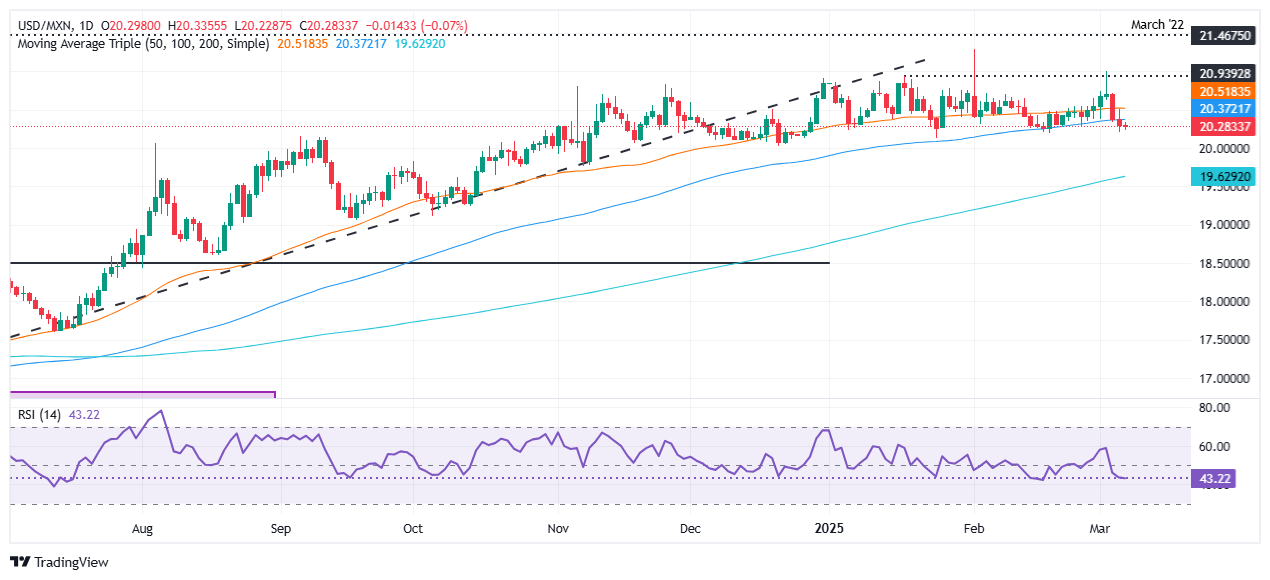
USD/MXN technical outlook: Mexican Peso consolidates as USD/MXN stays flat near 20.30
The USD/MXN, after clearing the 100-day Simple Moving Average (SMA) at 20.33, has consolidated within the 20.20-20.30 range. Price action suggests that neither buyers nor sellers are in charge, and it seems the pair could remain within familiar levels amid the lack of a catalyst.
If USD/MXN clears the 100-day SMA, the next resistance would be 20.50. If surpassed, the next key resistance levels would be the March 4 peak at 20.99 and the year-to-date (YTD) peak of 21.28.
Otherwise, a breach of the 20.00 figure, would expose the 200-day SMA at 19.54.
Banxico FAQs
The Bank of Mexico, also known as Banxico, is the country’s central bank. Its mission is to preserve the value of Mexico’s currency, the Mexican Peso (MXN), and to set the monetary policy. To this end, its main objective is to maintain low and stable inflation within target levels – at or close to its target of 3%, the midpoint in a tolerance band of between 2% and 4%.
The main tool of the Banxico to guide monetary policy is by setting interest rates. When inflation is above target, the bank will attempt to tame it by raising rates, making it more expensive for households and businesses to borrow money and thus cooling the economy. Higher interest rates are generally positive for the Mexican Peso (MXN) as they lead to higher yields, making the country a more attractive place for investors. On the contrary, lower interest rates tend to weaken MXN. The rate differential with the USD, or how the Banxico is expected to set interest rates compared with the US Federal Reserve (Fed), is a key factor.
Banxico meets eight times a year, and its monetary policy is greatly influenced by decisions of the US Federal Reserve (Fed). Therefore, the central bank’s decision-making committee usually gathers a week after the Fed. In doing so, Banxico reacts and sometimes anticipates monetary policy measures set by the Federal Reserve. For example, after the Covid-19 pandemic, before the Fed raised rates, Banxico did it first in an attempt to diminish the chances of a substantial depreciation of the Mexican Peso (MXN) and to prevent capital outflows that could destabilize the country.
Author

Christian Borjon Valencia
FXStreet
Markets analyst, news editor, and trading instructor with over 14 years of experience across FX, commodities, US equity indices, and global macro markets.