Mexican Peso gives up gains after ECB decision, US PPI data
- The Mexican Peso gives up earlier gains on Thursday after policy decisions and data releases support its counterparts.
- The Peso made gains on Wednesday and built on these early on Thursday as market sentiment remained upbeat.
- EUR/MXN rises moderatly following the release of the ECB monetary policy meeting amid upwards revisions to core inflation.

The Mexican Peso (MXN) trades mixed and slightly lower versus European FX after the European Central Bank (ECB) meeting, whilst the US Dollar recovers ground against the Peso following the release of US inflation and labor data.
Mexican Peso pares gains against the US Dollar after release of PPI data
The Mexican Peso recovers early losses against the US Dollar to trade in the 19.80s during the US session on Thursday after the release of US "factory gate" inflation came out mixed, showing a marked cooling on an annual basis but an above-expectations rise on a monthly basis.
The Producer Price Index, which is often seen as a predictor of broader inflation, came in mixed in August, with the monthly readings beating – but the annual readings falling – below expectations. There were also substantial downward revisions to July’s data.
The Producer Price Index (PPI) ex Food & Energy rose by 2.4% in August, the same as the 2.4% registered in July. The result came in below expectations of 2.5%, according to data from the US Bureau of Labor Statistics (BLS).
On the month, core PPI rose 0.3% compared to the downwardly-revised 0.2% decline in July. Economists had expected a 0.2% rise.
Headline PPI, meanwhile, rose 1.7% in August after a downwardly-revised 2.1% rise in the previous month. The result was below expectations of 1.8%. On a monthly basis PPI rose 0.2%, which compared to the revised-down 0.0% registered in July and was above the 0.1% expected.
Employment data released at the same time showed US Initial Jobless Claims rose 230K in the week ending September 6, coming in above the revised-up 228K of the previous week and was in line with the 230K forecast.
Continuing Jobless Claims rose 1.850M, which was higher/lower than the previous week’s revised-up 1.845M, according to the US Department of Labor.
The data did not change the market-based outlook for interest rates in the US. The probability of a larger 0.50% reduction at the Federal Reserve’s (Fed) September stayed around the 13%-15% mark following the release, according to the CME FedWatch tool, after falling dramatically on Wednesday following CPI data.
Mexican Peso falls against the Euro following ECB meeting
The Mexican Peso depreciates versus the Euro on Thursday to trade in the 21.80s during the US session, after the European Central Bank (ECB) decided to cut its deposit facility rate (DFR) by 25 basis points (bps) to 3.50% at its policy meeting, as expected, although an upwards revision to core inflation forecasts supporterd the single currency.
The ECB also cut its main refinancing operations (MRO) and its marginal lending facility (MLF) by 60 basis points each to 3.65% and 3.90% respectively, in order to narrow the spread with the DFR.
In its accompanying statement the ECB said, "For core inflation, the projections for 2024 and 2025 have been revised up slightly, as services inflation has been higher than expected. At the same time, staff continue to expect a rapid decline in core inflation, from 2.9% this year to 2.3% in 2025 and 2.0% in 2026."
At the same time the ECB slightly revised down its growth projections for the region stating, "Financing conditions remain restrictive, and economic activity is still subdued, reflecting weak private consumption and investment. Staff project that the economy will grow by 0.8% in 2024, rising to 1.3% in 2025 and 1.5% in 2026. This is a slight downward revision compared with the June projections."
Technical Analysis: USD/MXN breaks out of rising channel
USD/MXN has broken out of an ascending mini-channel. The breakdown indicates more weakness probably on the horizon for the pair.
USD/MXN 4-hour Chart
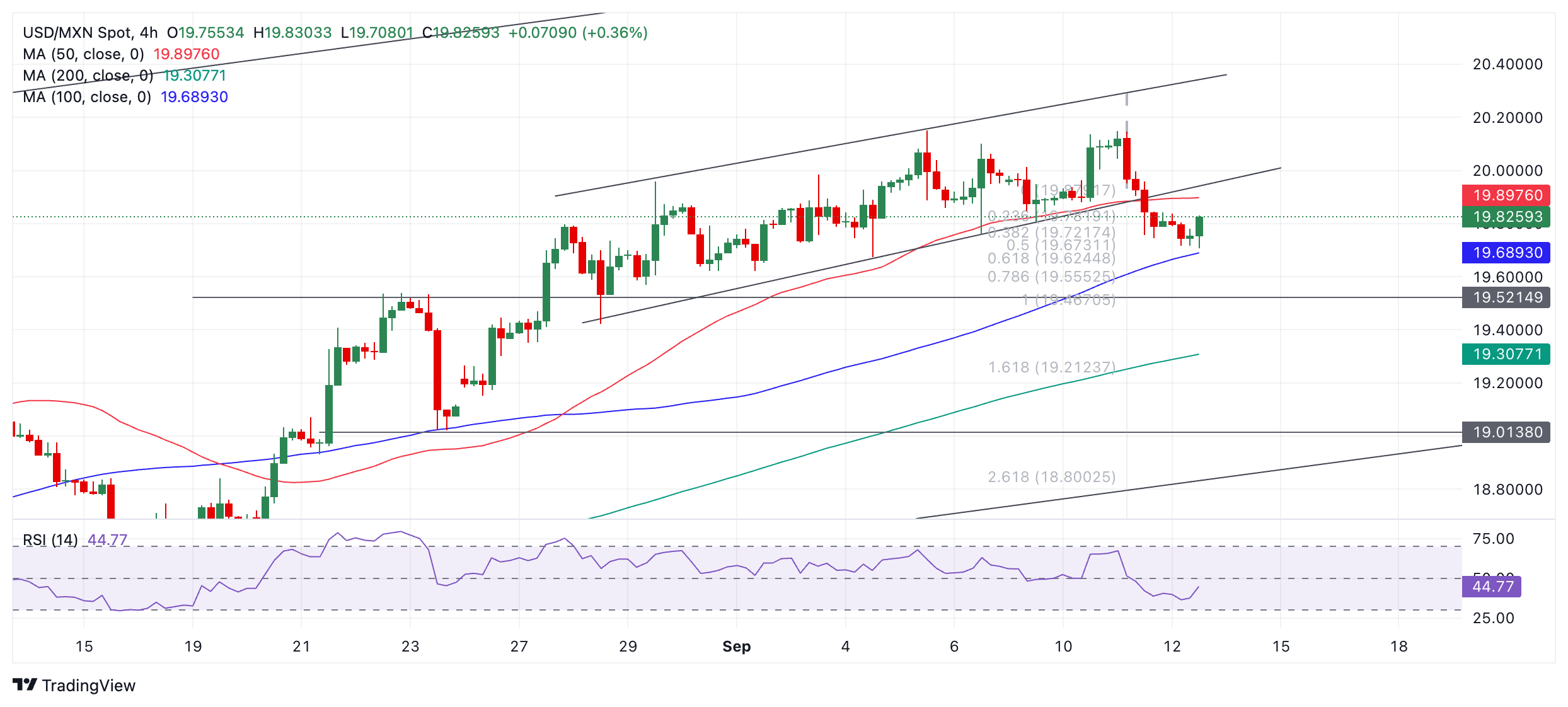
According to technical analysis, the breakout from the channel activates a downside target at 19.62, the 0.618 Fibonacci (Fib) extension of the height of the channel extrapolated to the downside. More bearishness could even see prices fall to around the 19.50 mark, the 1.000 ratio Fib extension, and the key support level from the August 22 swing high.
However, the overall trend in the medium and long-term is bullish, and since, according to technical analysis theory, “the trend is your friend,” this favors more upside emerging eventually. As such, any weakness may be temporary before the pair rallies again.
A break above the top of the mini-channel and year-to-date high at 20.15 would provide confirmation of a continuation of the bull trend, with the next target at the upper channel line in the 20.60s.
(This story was corrected on September 12 at 09:45 GMT to add the USD/MXN 4-hour chart, instead of Gold's chart.)
Economic Indicator
Producer Price Index (MoM)
The Producer Price Index released by the Bureau of Labor statistics, Department of Labor measures the average changes in prices in primary markets of the US by producers of commodities in all states of processing. Changes in the PPI are widely followed as an indicator of commodity inflation. Generally speaking, a high reading is seen as positive (or bullish) for the USD, whereas a low reading is seen as negative (or bearish).
Read more.Last release: Thu Sep 12, 2024 12:30
Frequency: Monthly
Actual: 0.2%
Consensus: 0.1%
Previous: 0.1%
Source: US Bureau of Labor Statistics
Author

Joaquin Monfort
FXStreet
Joaquin Monfort is a financial writer and analyst with over 10 years experience writing about financial markets and alt data. He holds a degree in Anthropology from London University and a Diploma in Technical analysis.