Mexican Peso strengthens as Fed Chair Powell signals patience
- USD/MXN drops 0.26% after Fed holds rates and Powell hints at cautious approach amid tariff and mandate uncertainty.
- Fed keeps rates at 4.25%–4.50%, citing rising risks to both inflation and employment goals.
- Powell adopts neutral tone, says Fed can act “quickly as appropriate” but isn't in a rush.
- Traders await Mexico’s April CPI; Banxico still expected to cut rates on May 15 despite inflation risks.

The Mexican Peso extended its gains against the US Dollar on Wednesday after the US Federal Reserve (Fed) held rates unchanged as Fed Chair Jerome Powell hinted that policymakers would remain patient. At the time of writing, the USD/MXN trades at 19.61, down 0.26%.
On Wednesday, the Fed kept rates at 4.25%-4.50% for the third straight meeting in 2025, flagging uncertainty about the economy and heightened risks on both sides of the dual mandate of maximum employment and price stability.
The Fed Chair, Jerome Powell, maintained a neutral stance, emphasizing that the central bank is not in a hurry and that current monetary policy is appropriate. He added that if things develop, the Fed can move “quickly as appropriate,” adding that the Fed goals would not be reached “if tariffs remain.”
Powell said that if one of the mandates deviates too far from achieving the Fed’s goal, then the central bank would determine which monetary policy tool to use to balance the risks of both mandates. When asked which of the two needs more attention, he said that it is too early to tell.
The USD/MXN spiked following the Fed’s decision but then followed its downward path after reaching a daily high of 19.67.
In the meantime, Mexico’s economic docket remains absent with USD/MXN traders awaiting April’s Consumer Price Index (CPI) report on May 8. Estimates suggest that headline and core prices are set to rise sharply, according to a Reuters survey. Yet most analysts expect Banco de Mexico (Banxico) to lower interest rates at the May 15 meeting.
Daily digest market movers: Mexican Peso appreciates following Fed’s decision
- Following the Fed’s decision, data from the Chicago Board of Trade (CBOT) suggests that traders are pricing 77 bps of easing toward the end of 2025.
- Mexico’s CPI in April is projected to jump from 3.80% to 3.90%. The core CPI is expected to rise from 3.64% in March to 3.90%. Although both readings are approaching the highest point of the 2% to 4% Banxico target for inflation, this would not stop Banxico from lowering interest rates next week.
- Banxico’s Deputy Governor Jonathan Heath said that it is highly probable that the central bank will continue to lower its interest rates, although inflation risks are skewed to the upside.
- Heath added that in the second half of 2025, the decision would be taken with more caution, adding that there is room to ease policy.
- Citi Mexico Expectations Survey shows that most analysts estimate Banxico will cut rates by 50 bps at the May 15 meeting.
- Even though Mexico’s latest GDP figures surprised the markets, with the economy dodging a technical recession, tariffs imposed on Mexican products, a reduced budget, and geopolitical uncertainties will continue to stress the country’s finances and influence the Peso.
USD/MXN technical outlook: Mexican Peso remains bullish as USD/MXN stays below 200-day moving average
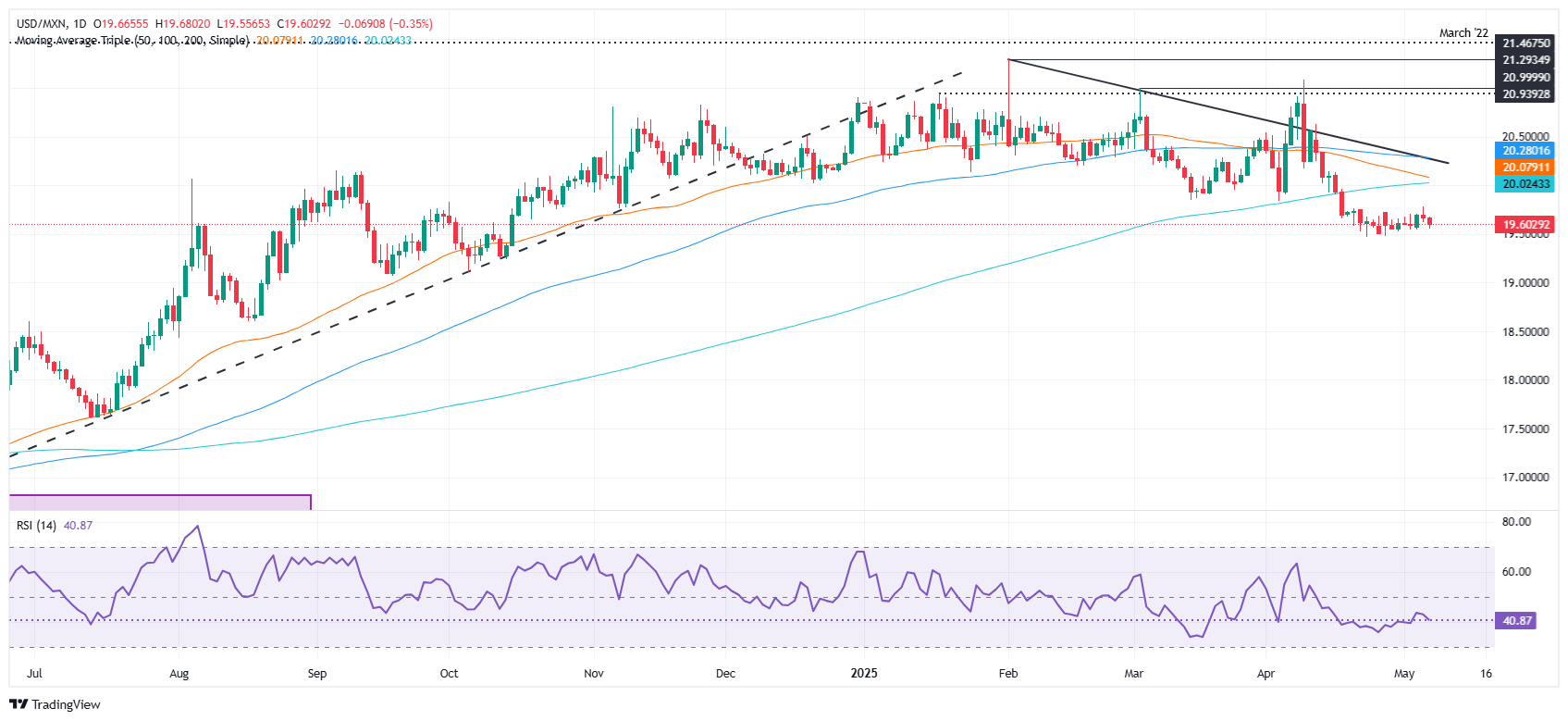
The USD/MXN is in a bearish downtrend, although buyers have kept the pair from dropping significantly below the yearly record low of 19.46, reached on April 24. After reaching a weekly high at the 20-day Simple Moving Average (SMA) at 19.75 on May 6, the exotic pair extended its losses.
The Relative Strength Index (RSI) favors further downside, with the RSI currently at 40 and poised to decline further.
Therefore, the USD/MXN’s first support would be 19.50 and the yearly low of 19.46. Once these levels are cleared, the next floor level will be the 19.00 psychological level, followed by the August 19, 2024 low of 18.59.
On the other hand, if USD/MXN climbs past 19.78, expect a test of the 200-day SMA at 19.98. A breach of the latter will expose the 20.00 mark.
Mexican Peso FAQs
The Mexican Peso (MXN) is the most traded currency among its Latin American peers. Its value is broadly determined by the performance of the Mexican economy, the country’s central bank’s policy, the amount of foreign investment in the country and even the levels of remittances sent by Mexicans who live abroad, particularly in the United States. Geopolitical trends can also move MXN: for example, the process of nearshoring – or the decision by some firms to relocate manufacturing capacity and supply chains closer to their home countries – is also seen as a catalyst for the Mexican currency as the country is considered a key manufacturing hub in the American continent. Another catalyst for MXN is Oil prices as Mexico is a key exporter of the commodity.
The main objective of Mexico’s central bank, also known as Banxico, is to maintain inflation at low and stable levels (at or close to its target of 3%, the midpoint in a tolerance band of between 2% and 4%). To this end, the bank sets an appropriate level of interest rates. When inflation is too high, Banxico will attempt to tame it by raising interest rates, making it more expensive for households and businesses to borrow money, thus cooling demand and the overall economy. Higher interest rates are generally positive for the Mexican Peso (MXN) as they lead to higher yields, making the country a more attractive place for investors. On the contrary, lower interest rates tend to weaken MXN.
Macroeconomic data releases are key to assess the state of the economy and can have an impact on the Mexican Peso (MXN) valuation. A strong Mexican economy, based on high economic growth, low unemployment and high confidence is good for MXN. Not only does it attract more foreign investment but it may encourage the Bank of Mexico (Banxico) to increase interest rates, particularly if this strength comes together with elevated inflation. However, if economic data is weak, MXN is likely to depreciate.
As an emerging-market currency, the Mexican Peso (MXN) tends to strive during risk-on periods, or when investors perceive that broader market risks are low and thus are eager to engage with investments that carry a higher risk. Conversely, MXN tends to weaken at times of market turbulence or economic uncertainty as investors tend to sell higher-risk assets and flee to the more-stable safe havens.
Author

Christian Borjon Valencia
FXStreet
Markets analyst, news editor, and trading instructor with over 14 years of experience across FX, commodities, US equity indices, and global macro markets.